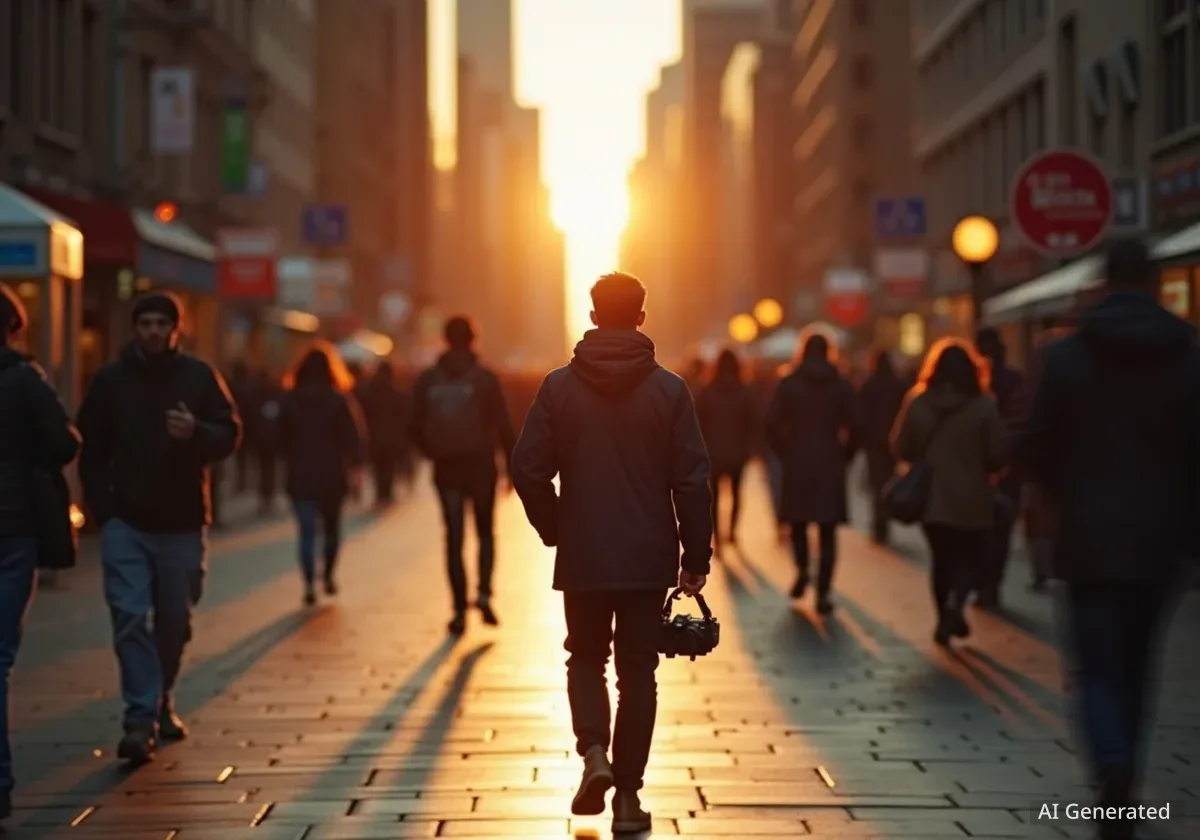



Street photography captures contemporary life, often focusing on people interacting with their surroundings. This genre, while compelling, frequently sparks debate among photographers and enthusiasts about its exact definition and ethical boundaries. It involves telling a story through candid or posed shots in public spaces.
Key Takeaways
- Street photography documents everyday life in public spaces.
- The genre thrives on storytelling and capturing interesting moments.
- Ethical considerations, especially regarding privacy, are crucial.
- Techniques vary from active movement to waiting for the 'decisive moment'.
Defining Street Photography
Street photography primarily involves capturing individuals within the built environment. This definition can extend to include public areas like beaches, parks, and even zoos, as well as domestic animals. Photographers can choose to shoot in color or black and white, using various focal lengths.
The images can be close-up portraits or wider shots, taken with or without the subject's knowledge. Both posed and candid approaches are valid. The core aim is to convey something interesting, something beyond the ordinary.
Fact Check
There are no prescriptive rules for equipment in street photography. Any lens that helps achieve the desired result is acceptable. The focus should always be on the narrative the image creates.
The Importance of Storytelling
Every photograph tells a story, but a successful street photograph goes further. It should evoke curiosity, perhaps asking, "What is this person doing?" or "Why are they standing like that?" It might also make a statement about solitude, tenderness, or the interplay between a person and their backdrop.
The goal is to capture moments that are not everyday occurrences. While images of people holding coffee cups or staring at phones are common, they typically lack impact unless a compelling juxtaposition exists. For example, showing someone engrossed in their phone while ignoring a more interesting event nearby can create a powerful image.
"A successful street photograph conveys something interesting to the viewer. It might ask a question, such as, ‘What is that person doing there?’ Or ‘Why are they standing like that?’"
Photographs inherently reflect the era and culture in which they are taken. Images captured today look distinct from those taken thirty years ago. Changes in clothing, vehicles, shop fronts, and daily activities all contribute to this evolving visual record. The specific location also heavily influences the style of street photography. A quiet fishing town will yield very different images compared to a bustling metropolis like Helsinki or a city in Albania.
Navigating Ethical and Legal Boundaries
Ethical considerations are paramount in street photography. The ability to take a photo does not always mean one should. For instance, photographing a homeless person without offering compensation might be seen as profiting from their misfortune. Particular caution is necessary when photographing children, as covertly pointing a long lens can raise concerns about motives.
Legal Context
In the USA, privacy laws for public spaces vary by state, generally allowing photography where there is no reasonable expectation of privacy. However, how these images are used or shared can differ, with artistic use often protected under the First Amendment. Internationally, countries like those in Europe have stricter privacy laws, such as Article 8 of the European Convention of Human Rights, which protects private and family life. When images are used for commercial purposes, local data protection laws may also apply.
It is always advisable to err on the side of caution. Understanding local laws and respecting individual privacy are crucial for responsible street photographers. The potential for legal challenges, especially in countries with strong human rights protections, highlights the need for careful judgment.
Techniques for Street Photographers
Street photographers typically employ two main approaches. The first involves actively moving around, seeking out and photographing people as they pass by. This method offers a wide variety of subjects and locations.
The second technique is to identify an interesting backdrop or 'hotspot' and wait for compelling action to unfold. This static approach can increase the likelihood of capturing unique moments and can also improve a photographer's ability to anticipate human behavior.
Henri Cartier-Bresson's iconic photograph, "Behind the Gare Saint-Lazare," exemplifies the latter technique. Cartier-Bresson pre-composed his shot through a fence, focusing on a puddle and reflections, then waited for a subject to complete the frame. He captured the decisive moment when a man jumped, taking a single exposure.
However, Cartier-Bresson also moved actively, constantly finding new compositions. Achieving well-composed shots without extensive cropping requires significant practice and an acute sense of timing. The interplay between active movement and patient waiting defines much of street photography's methodology.
Resources and Inspiration
For those interested in exploring street photography further, numerous resources exist. Websites dedicated to the genre offer inspiration and insights. Brandon Stanton's "Humans of New York," for example, is a well-known project that combines street portraiture with personal stories, offering a powerful example of the human element in this art form.
Books also provide valuable perspectives. Clément Chéroux's biography of Henri Cartier-Bresson offers a deep dive into the life and philosophy of one of the genre's pioneers. Additionally, non-commercial sites like Street-Photography feature works by artists such as Michael W Plant and David Castillo, alongside interviews with other notable street photographers, showcasing diverse interactions with public environments.
- Brandon Stanton's Humans of New York: A prime example of street portraiture combined with storytelling.
- Clément Chéroux's Henri Cartier-Bresson biography: Provides insight into the 'father of street photography'.
- Street-Photography website: Features works and interviews from various street photographers.
These resources highlight the varied approaches and philosophies within street photography, from capturing spontaneous moments to documenting personal narratives.