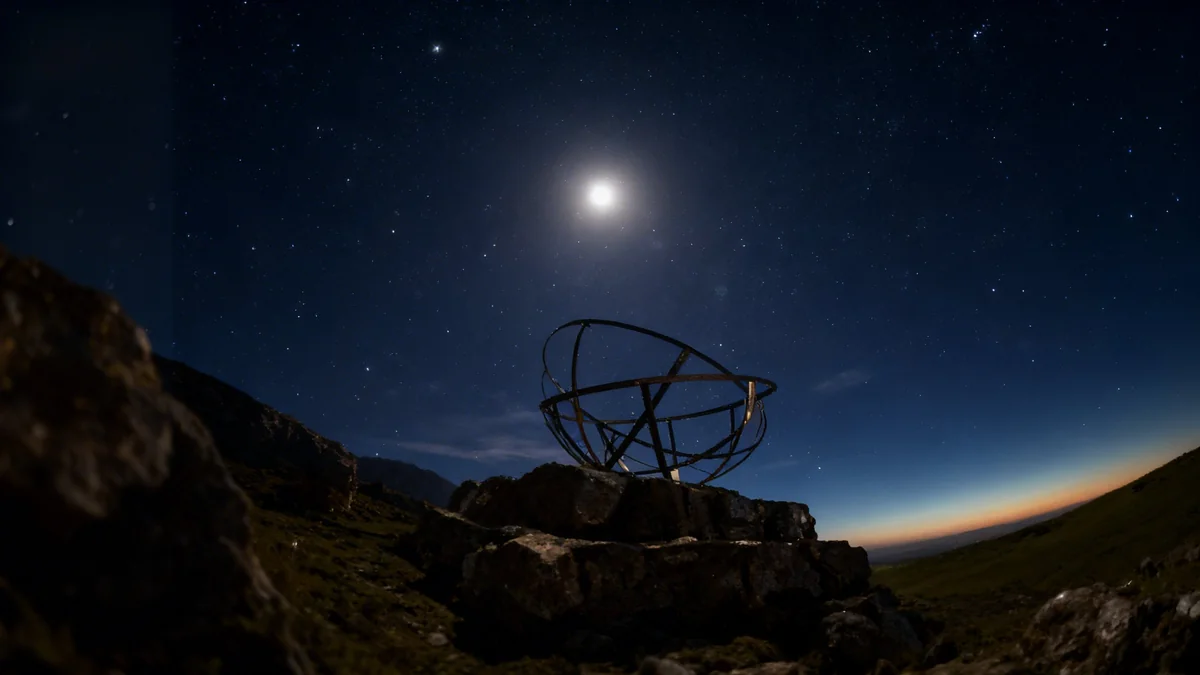




A Bristol photographer successfully captured a rare celestial event earlier this week, photographing six planets and the Moon in a single frame. Josh Dury documented the planetary parade from a radar memorial in Worth Matravers, Dorset, just after 6:30 PM GMT on Tuesday. The image showcases Earth, Mercury, Venus, Jupiter, Saturn, Uranus, and Neptune, offering a unique perspective on our solar system.
Key Takeaways
- Six planets and the Moon were photographed in a rare alignment.
- The event was captured by Bristol photographer Josh Dury in Dorset.
- Another viewing opportunity for a similar planetary parade is expected Saturday evening.
- Specialized equipment like binoculars or a telescope can enhance viewing.
Photographer's Journey to Capture the Sky
Josh Dury described his endeavor as a "battle against time." He faced a challenging four-hour journey to the location, double the usual travel time due to unexpected road closures. Despite the delays, he arrived just as the sun began to set, allowing him to prepare for the night sky. The photographer used a wide-angle lens, which provided nearly a 180-degree field of view.
This wide perspective was crucial for capturing the planets as if they were a "string of pearls" across the sky. The alignment appeared as a natural arc, making the wide lens an ideal tool for such a comprehensive shot. Dury expressed his profound satisfaction upon reviewing the images.
"It was wonderful to see the developmental stages of the parade happen," Dury stated. "It's quite a rare photograph purely because it's that line-up of how they appear in the night sky. It just really puts into perspective our place among the solar system."
The Challenge of Celestial Photography
Interesting Fact
Capturing multiple planets in a single frame requires precise timing and a clear view of the horizon. Atmospheric conditions and light pollution can significantly impact visibility.
Capturing such a phenomenon requires more than just the right equipment. It demands patience, careful planning, and a bit of luck with the weather. The clear skies over Worth Matravers provided the perfect conditions for Dury's photographic feat. The remote location, away from urban light pollution, played a vital role in the clarity of the image.
Dury's dedication highlights the passion many astrophotographers share for documenting the wonders of the cosmos. His image serves as a powerful reminder of the vastness and beauty of our celestial neighborhood.
Understanding a Planetary Parade
What is a Planetary Parade?
A planetary parade refers to a phenomenon where several planets appear to align on one side of the Sun when viewed from Earth. This alignment is not necessarily a straight line in space but rather an optical illusion from our vantage point. These events vary in the number of planets involved and their visibility.
These alignments are relatively rare, especially when six or more planets are visible. Such events provide a unique opportunity for both professional astronomers and amateur skywatchers to observe multiple celestial bodies simultaneously. The apparent closeness of the planets in the sky can be quite striking, creating a memorable visual experience.
While the planets may appear close from Earth, they remain vast distances apart in space. The phenomenon is a testament to the complex orbital mechanics of our solar system. Each planet follows its own path, and occasionally, these paths align to create these visual spectacles.
Upcoming Viewing Opportunities
For those who missed Dury's capture or wish to witness a similar event, another planetary parade is expected to be visible in the UK from sunset on Saturday. This upcoming alignment will feature Mercury, Venus, Saturn, and Neptune appearing low in the western sky, near the horizon.
- Mercury and Venus: These planets will be very low in the sky, requiring a clear view of the western horizon.
- Saturn and Neptune: These will also be visible low in the western sky.
- Uranus: Positioned higher in the constellation Taurus, Uranus will remain visible until around midnight.
- Jupiter: Shining brightly in the constellation Gemini, Jupiter will be the easiest to locate and will stay in view for much of the night, even from areas with some light pollution.
To enhance the viewing experience, binoculars or a telescope are highly recommended, especially for fainter planets like Uranus and Neptune. Local astronomy societies often host public viewing events, providing access to specialized equipment and expert guidance. Finding a spot with minimal light pollution and an unobstructed view of the horizon will greatly improve visibility, particularly for the planets closer to the horizon.
Tips for Skywatchers
If you plan to observe the upcoming planetary parade, consider these tips:
- Find a clear horizon: Mercury and Venus will be very low.
- Minimize light pollution: Head away from city lights if possible.
- Use optical aids: Binoculars or a telescope will reveal more detail.
- Check local astronomy events: Societies may offer public viewings.
- Dress warmly: Night sky observations can be long.
The beauty of these celestial events is their ability to connect us with the larger universe. Observing multiple planets in alignment offers a moment of reflection on Earth's place in the cosmos. Such opportunities are a reminder of the dynamic and ever-changing nature of our solar system.