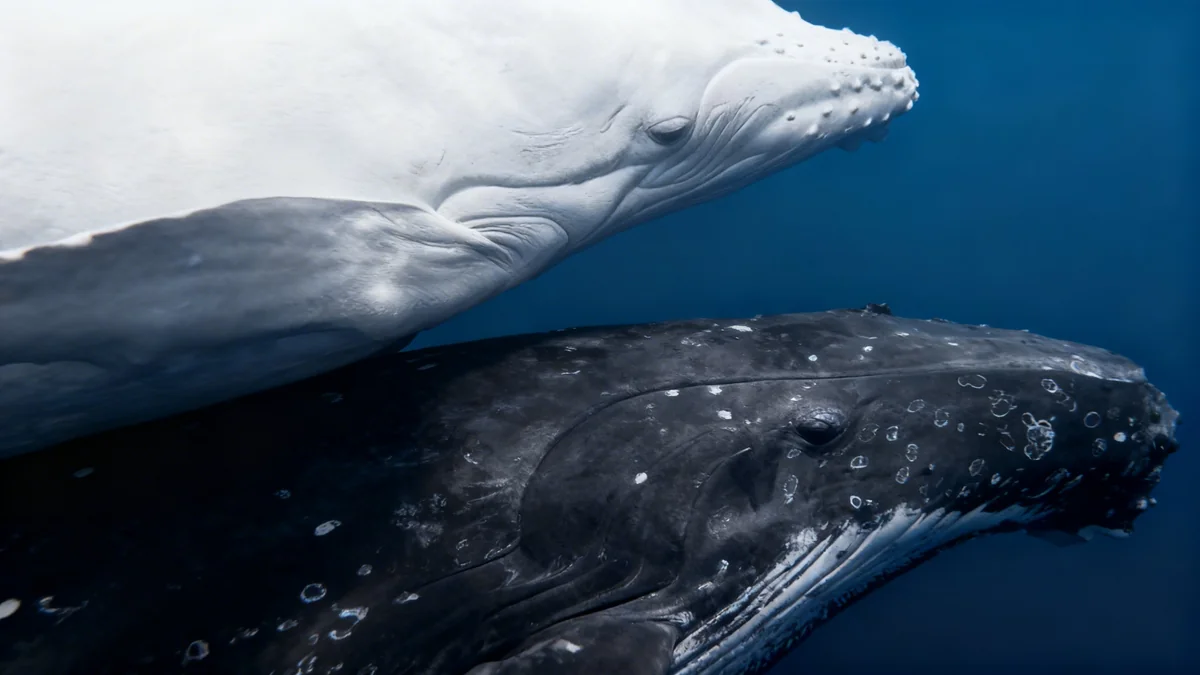

A striking image of a rare white humpback whale calf and its mother has taken the top prize at the World Nature Photography Awards 2026. Australian photographer Jono Allen captured the winning shot in the waters of Vava’u, Tonga, an experience he described as truly life-changing.
The calf, named Mãhina, which means "moon" in Tongan, represents an incredibly rare occurrence of albinism among humpback whales, affecting only about one in 40,000 births. This photograph highlights both the beauty of the natural world and the unique challenges faced by these magnificent creatures.
Key Takeaways
- An image of a rare white humpback whale calf, Mãhina, won the World Nature Photography Awards 2026.
- Albinism in humpback whales is exceptionally rare, occurring in roughly one out of 40,000 births.
- Photographer Jono Allen captured the winning shot in Vava’u, Tonga.
- Humpback whale populations are recovering but face challenges from climate change, affecting migration patterns.
- Other winning images featured diverse wildlife, from gorillas and butterflies to polar bears and e-waste.
The Story Behind the Award-Winning Image
Jono Allen's photograph, titled "Mãhina," depicts the rare white humpback whale calf swimming alongside its mother. Allen first encountered Mãhina in the summer of 2024. He recalled the day as a moment that will stay with him forever.
The image stands out not only for its technical skill but also for its subject. White humpback whales are a phenomenon rarely documented. This genetic condition results in a lack of skin pigmentation, making them visually distinct in the ocean.
"It was a memory that will live with me forever," Jono Allen stated about his encounter with Mãhina. "A truly life-changing experience."
Allen received a $1,000 cash prize for his achievement. His work draws global attention to the delicate balance of marine ecosystems and the importance of conservation.
Did You Know?
Albinism, the condition affecting Mãhina, is extremely rare in humpback whales, with estimates suggesting it occurs in as few as one in 40,000 births. This makes Allen's photograph even more extraordinary.
Humpback Whale Conservation and Climate Change
The International Union for Conservation of Nature’s Red List currently classifies humpback whales as a species of "least concern." This positive assessment reflects successful conservation efforts that have curbed commercial whaling in the 20th and 21st centuries.
As of 2018, the global humpback whale population has grown to approximately 135,000 individuals. This recovery is a testament to international cooperation and dedicated protection programs.
However, these whales are not without new threats. Scientists observe significant changes in their behavior, particularly shifts in their epic migration routes in the Southern Hemisphere. Whales are now migrating weeks earlier than in previous decades.
Environmental Impact
A warming Southern Ocean is believed to be the primary driver behind these altered migration patterns. Changes in ocean temperatures directly impact food supplies, forcing whales to adjust their movements in search of sustenance.
These early migrations highlight the ongoing impact of climate change on marine life. Protecting these magnificent creatures requires continued monitoring and adaptation to new environmental challenges.
Diverse Winners Showcase Global Nature
The World Nature Photography Awards 2026 received entries from 51 countries, showcasing a stunning array of natural wonders. The competition celebrates photographers who capture the beauty and fragility of our planet.
Beyond the winning whale image, other categories honored remarkable photographs. A female gorilla observing a butterfly in Uganda’s Bwindi Impenetrable Forest captured hearts. Another image showed a Namaqua chameleon enduring a sandstorm in Namibia's Namib Desert.
One particularly poignant photograph depicted a polar bear inspecting a pile of e-waste in Manitoba, Canada. This image served as a stark reminder of humanity's environmental footprint on remote wildlife habitats.
Other Notable Winning Photographs
- Plants and Fungi Category: Duncan Wood from the UK captured a majestic elder birch in Glen Affric, Scotland.
- Water Ballet: Vaidehi Chandrasekar of Singapore photographed a giraffe making water dance at the Boteti River in Botswana.
- Shared Wonder: Mary Schrader’s image from Bwindi, Uganda, showed a gorilla and a butterfly sharing a moment.
- Eye on the Prize: Vince Burton from Norfolk, England, captured a barn owl reaching out with its talons.
- Fire Alert: Jonathan Wosinski’s photograph from Masai Mara, Kenya, depicted a female leopard turning away from a savannah fire.
- Climate Change: Thiago Campi’s image from Ilha do Cardoso State Park, Brazil, presented a scene of beautiful desolation.
- Salamander Eggs: Mark Bernards from Canada captured an otherworldly close-up of salamander eggs.
- Elephant Pool Party: Bill Klipp witnessed elephants enjoying a pool party near his tent in Botswana's Okavango Delta.
- Trash Trail Temptations: Robert Gloeckner’s photograph highlighted a polar bear inspecting e-waste in Churchill, Manitoba, Canada.
These diverse winning entries underscore the vast beauty and complex issues facing nature globally. The awards encourage photographers to use their craft to raise awareness and inspire action.
Entries for next year’s competition are already open, inviting photographers worldwide to share their unique perspectives on the natural world.