

The Nikon Small World photomicrography competition has announced its 2025 winners, showcasing the intricate beauty of the microscopic world. This year marks the 51st edition of the annual contest, which celebrates images captured through light microscopes.
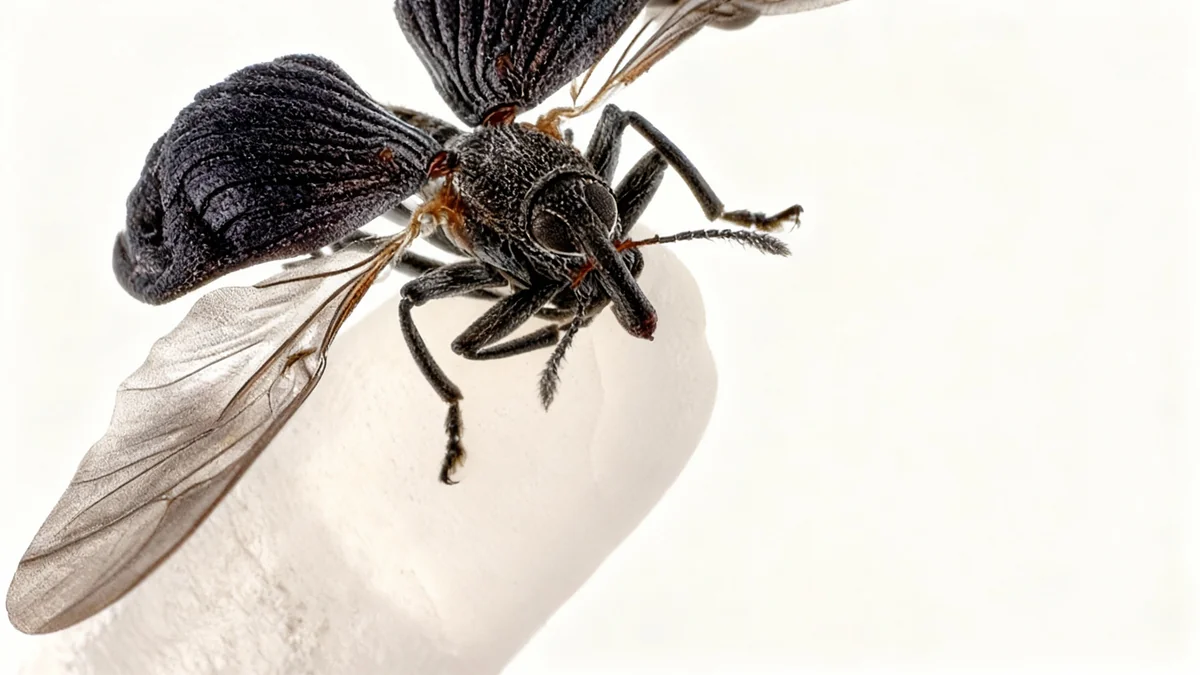
The top honor went to Zhang You for his striking photograph of a rice weevil positioned on a single grain of rice. His work highlights both artistic vision and scientific precision.
Key Takeaways
- Zhang You won first place for a rice weevil on a grain of rice.
- The competition is in its 51st year, dating back to 1975.
- Winners demonstrate the blend of art and science in photomicrography.
- The contest encourages deep dives into microscopic subjects.
Celebrating Microscopic Art and Science
The Nikon Small World competition has consistently pushed the boundaries of what is possible in microscopic imaging. For over five decades, it has served as a platform for scientists and artists to share their unique perspectives.
This year's winning image by Zhang You captures a common agricultural pest, the rice weevil (Sitophilus oryzae), in stunning detail. The photograph not only reveals the insect's complex morphology but also places it in its natural context on a rice grain.
You, an entomologist from the Entomological Society of China, emphasized the importance of combining scientific understanding with artistic skill. He stated that a standout work merges both elements to capture the essence of these creatures.
"It pays to dive deep into entomology: understanding insects’ behaviors and mastering lighting, a standout work blends artistry with scientific rigor, capturing the very essence, energy, and spirit of these creatures."
Competition Fact
The Nikon Small World competition began in 1975, making the 2025 awards the 51st iteration of the prestigious event. It remains a leading showcase for photomicrography.
The Art of Photomicrography
Photomicrography is a specialized field that involves taking photographs through a microscope. It requires a deep understanding of optics, lighting, and the subject matter itself. The images often reveal hidden structures and vibrant colors not visible to the naked eye.
The competition encourages participants to explore a wide range of subjects, from biological specimens to chemical reactions and geological formations. Each entry offers a glimpse into a world that is usually unseen, fostering both scientific curiosity and aesthetic appreciation.
Winners are chosen based on several criteria, including originality, informational content, technical proficiency, and visual impact. The judges look for images that are not only scientifically accurate but also visually compelling.
Technical Skill and Artistic Vision
Capturing a clear and detailed image of a microscopic subject is a significant technical challenge. Factors such as depth of field, contrast, and illumination must be meticulously controlled. Many winning entries involve advanced techniques like focus stacking or specialized staining to enhance visibility.
Beyond the technical aspects, the artistic composition plays a crucial role. The best photomicrographs often tell a story or evoke a sense of wonder. They transform scientific data into captivating visual art.
Understanding the Rice Weevil
The rice weevil (Sitophilus oryzae) is a common pest found in stored grains, including rice, wheat, and maize. It is a small, dark beetle, typically 2-3 mm long. The female weevil drills a hole into a grain, lays an egg inside, and seals it with a gelatinous secretion, making it difficult to detect early infestations.
Impact on Science and Public Engagement
The Nikon Small World competition does more than just award prizes; it serves as an important tool for science communication. By presenting complex scientific subjects in an accessible and beautiful way, it engages a broader audience.
These images can inspire future scientists and photographers. They demonstrate that scientific research can also be a source of profound beauty and artistic expression. The competition highlights the interdisciplinary nature of modern exploration.
Many winning images have practical applications, aiding in research across various fields, including biology, medicine, and materials science. For instance, detailed images of pests like the rice weevil can help in understanding their behavior and developing control strategies.
- Biology: Detailed cell structures, microbial life.
- Medicine: Disease pathology, tissue analysis.
- Materials Science: Microscopic defects, crystalline structures.
- Entomology: Insect anatomy, pest identification.
The annual announcement of winners generates considerable interest, bringing microscopic photography into the mainstream. It reminds us of the complexity and beauty present at every scale of existence.