


Capturing sharp, detailed images of mushrooms and other fungi requires a precise approach that differs from traditional landscape photography. Photographers often face challenges like low light, narrow depth of field, and distracting backgrounds when documenting these small, intricate subjects on the forest floor. The key to overcoming these hurdles and achieving exceptionally clear results often lies in a technique called focus stacking.
Key Takeaways
- Fungi photography benefits greatly from a slow, deliberate approach.
- Focus stacking is essential for achieving sharpness across the entire mushroom.
- Shooting from a low perspective enhances composition and detail.
- Understanding lens minimum focusing distance prevents common errors.
- Stable equipment and manual focus adjustments are crucial for success.
Understanding the Unique Challenges of Fungi Photography
Mushrooms present distinct photographic difficulties. They are typically small, grow close to the ground, and thrive in shaded, damp environments. These conditions mean photographers frequently work with limited natural light, which impacts shutter speeds and aperture choices. Furthermore, the shallow depth of field inherent to close-up photography means that even at small apertures like f/16, only a small portion of the mushroom may appear sharp.
This often results in images where the front of the mushroom cap is in focus, but the stem or the back edge of the cap appears soft. This lack of complete sharpness can make an otherwise well-composed image feel incomplete or unprofessional. The surrounding forest floor, with its moss, leaves, and twigs, can also easily pull attention away from the main subject if not managed carefully.
Fact: Depth of Field
Even with a narrow aperture like f/16, the depth of field in close-up photography is often insufficient to render an entire mushroom sharp from front to back. This is a common issue for many photographers.
The Power of Focus Stacking for Detail
Focus stacking is a crucial technique for achieving complete sharpness in fungi photography. It involves capturing multiple images of the same subject, with each shot focused on a slightly different part of the mushroom. These individual images are then combined in post-processing software, such as Adobe Photoshop, to create a single photograph where every element, from the cap's tip to the stem's base, is in sharp focus.
The process requires patience and precision. Depending on the mushroom's size and the photographer's proximity, between five and ten individual shots are typically needed. Each shot requires a very small adjustment to the focus ring, often just a few millimeters, to ensure that focus shifts incrementally through the subject. While some cameras offer built-in focus bracketing, many photographers prefer manual adjustment for greater control and awareness of the focus plane.
"The biggest factor that separates an average fungi image from one that truly stands out is focus. And I don’t just mean autofocus. I’m talking about my entire approach — my positioning, lens choice, and how I handle depth of field through focus stacking." — Darren J. Spoonley
Manual Versus Automated Focus Bracketing
Manual focus adjustment allows for a deeper understanding of how depth of field behaves at close distances. It encourages a more deliberate and thoughtful photographic process. This methodical approach can be calming, providing a welcome change from faster-paced genres like landscape photography that often depend on fleeting moments of light.
Achieving the Right Perspective: Getting Down Low
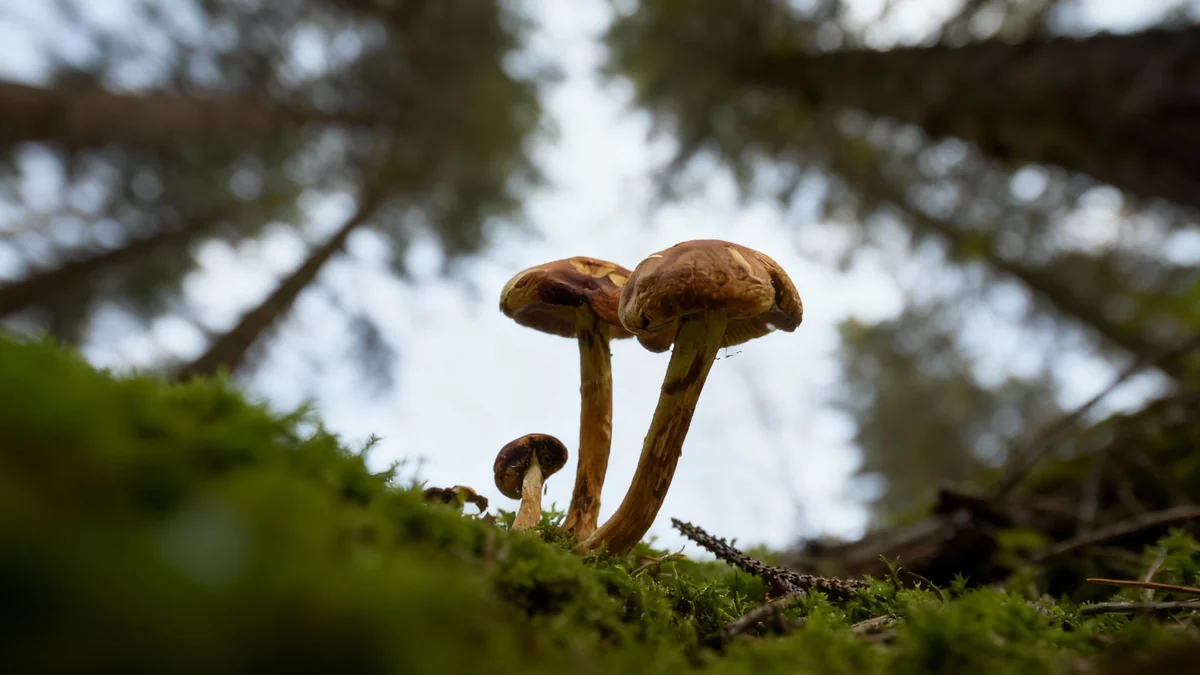
To truly capture the essence of fungi, photographers must adopt a low perspective. Shooting from above rarely does justice to their unique shapes, textures, and delicate structures. By positioning the camera at the mushroom's level, photographers can reveal intricate details such as the curve of the cap, the delicate gills underneath, and the texture of the stem.
This often means setting the tripod almost flat to the ground or removing its center column entirely. Some tripods allow for an inverted center column, which can help, but keeping the camera upright generally offers easier adjustment and reframing. While lying on the damp forest floor might seem uncomfortable, this low viewpoint fundamentally transforms the composition, allowing for a more intimate and detailed portrayal of the subject.
Context: Compositional Impact
A low perspective can highlight environmental elements like moss patches, using them as natural framing. It also allows for better observation of how soft, filtered light from the canopy interacts with the mushroom's surface, enhancing its visual appeal.
Lens Choice and Minimum Focusing Distance
Before heading into the field, photographers should always check the minimum focusing distance of their chosen lens. Every lens has a limit to how close it can focus, and this distance determines how near the photographer can get to the subject while still achieving sharp focus. A dedicated macro lens is ideal for fungi photography because it is specifically designed for close-up work without sacrificing detail.
However, general-purpose zoom lenses, such as a 24-105mm or 70-200mm, can also be effective if used within their focusing limits. It is important to understand these boundaries to avoid frustration during a shoot. Additionally, photographers must be mindful of the distance between the front element of the lens and the subject. Getting too close can result in the lens blocking light or casting unwanted shadows on the mushroom.
Sometimes, stepping back slightly and cropping the image later in post-processing yields a cleaner and better-lit result than forcing the lens closer than it should be. This strategic distance ensures optimal lighting and prevents accidental obstruction.
Balancing Aperture and Overall Sharpness
Selecting the right aperture is a critical decision in fungi photography, involving a trade-off between depth of field and overall image sharpness. Wide apertures, such as f/2.8, create pleasing background blur, but they also result in a very shallow depth of field, making focus stacking more challenging as each individual image captures less in-focus area.
Conversely, very narrow apertures, like f/16 or f/22, can introduce diffraction. Diffraction is an optical phenomenon that reduces fine detail and overall image sharpness, even if more of the scene appears to be in focus. Through practical experience, many photographers find that an aperture range of f/5.6 to f/10 offers the best balance. This range provides sufficient sharpness and enough overlap between focus slices for a smooth and effective focus stack.
Ensuring Stability and Making Precise Adjustments
Fungi typically grow in shaded woodland environments, leading to slower shutter speeds. Therefore, a sturdy tripod is absolutely essential for sharp images. To further minimize camera shake, photographers should use a remote shutter release or the camera's 2-second timer. It is also important to turn off any in-camera image stabilization features when the camera is mounted on a tripod, as these can sometimes introduce minor vibrations.
After each shot in a focus stack sequence, the photographer must refocus slightly further into the subject, ensuring that each new focus zone significantly overlaps with the previous one. Once the full series of images is captured, a quick review of the frames helps to confirm that focus has not drifted and that all necessary areas have been covered. This repetitive, careful checking saves considerable time during the post-processing phase.
Optimizing Light and Environment
Overcast conditions provide ideal lighting for fungi photography. The soft, diffused light evenly illuminates the subject, enhancing natural colors and textures without creating harsh shadows. If the light appears too flat, a small reflector or a handheld LED light can be used to gently lift shadows, particularly under the mushroom cap, adding depth and dimension.
The surrounding environment also plays a vital role in the composition. Elements like fallen leaves, moss, or decaying wood can serve as strong supporting elements, telling the story of the mushroom's habitat. While photographers may carefully move a distracting twig or leaf, it is crucial never to disturb the fungi themselves or significantly alter the natural scene. Preserving the integrity of the environment is paramount.
Post-Processing and Image Blending
Once back at the computer, the captured images are blended using software like Adobe Photoshop. The 'Auto-Blend Layers' feature can automatically align the individual frames and merge only the sharpest areas from each exposure into a single file. After the merge, subtle adjustments to contrast, clarity, and color balance are typically made.
Photographers may also use dodging and burning techniques to subtly shape the light, drawing attention to specific textures on the cap or the intricate details of the gills underneath. The goal is to enhance the already rich detail provided by the focus stack, rather than to create artificial effects. The inherent sharpness from the stacking process often speaks for itself, requiring minimal additional manipulation.
The Value of Deliberate Practice
The most rewarding aspect of fungi photography is its capacity to encourage a slower, more deliberate pace. It shifts the focus away from dramatic light and rapidly changing skies, emphasizing quiet observation and patience. This genre encourages photographers to study small subjects closely, finding profound beauty in their intricate structures and delicate forms.
A finely crafted fungi image can be as satisfying as any expansive landscape photograph. The sense of accomplishment comes from seeing every fine detail rendered perfectly, knowing that this precision is the result of a series of small, careful decisions. For aspiring fungi photographers, the key message is clear: success hinges on both technical and mental focus. Taking time, mastering focus stacking, understanding equipment, and adopting a low perspective will ensure that even the smallest mushroom makes a significant impact in the final photograph.
- Patience: Essential for setting up and executing focus stacks.
- Precision: Required for minute focus adjustments between shots.
- Perspective: Getting low to the subject reveals critical details.
- Post-processing: Key for blending images into a single sharp photo.