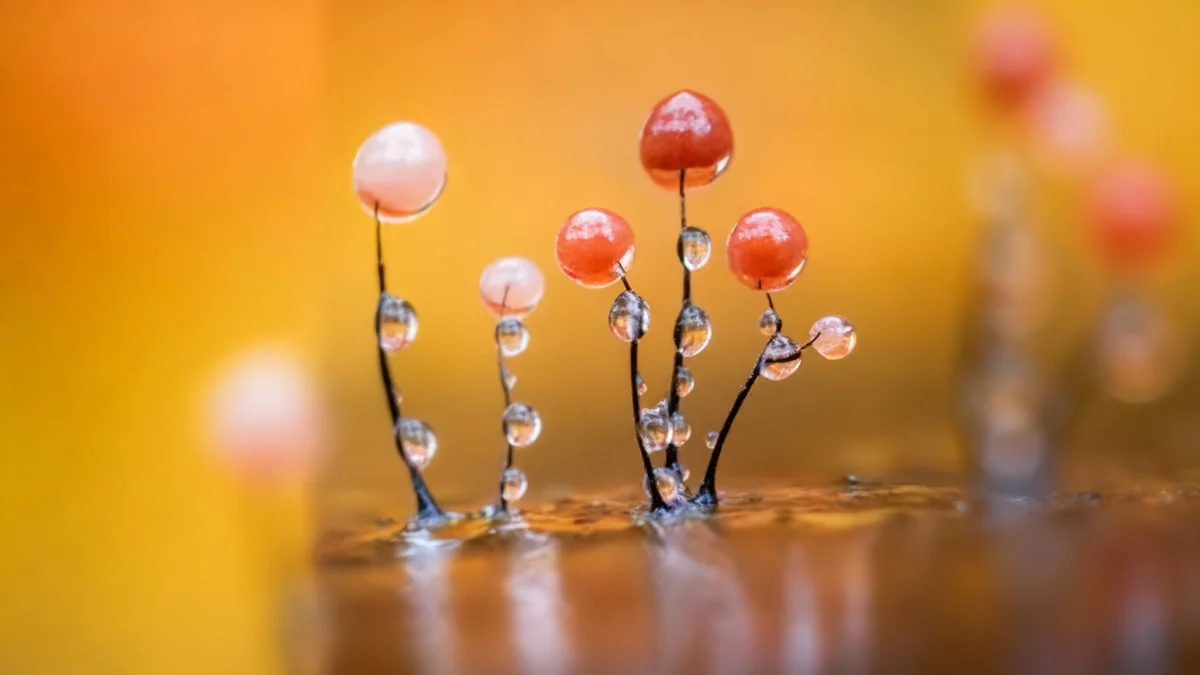



The intricate and often unseen world of slime mould is now visible thanks to the groundbreaking macro photography of Barry Webb. His images offer an unprecedented close-up view of these single-celled organisms, revealing structures and life that are otherwise invisible to the human eye. Webb's dedication to this unique subject has earned him significant recognition, including a recent people's choice award in the macro category of the British Photography Awards 2025.
Key Takeaways
- Barry Webb's macro photography brings the microscopic world of slime mould into focus.
- His technique involves focus bracketing, combining over 100 images for a single, sharp picture.
- Slime mould is a unique organism, not a plant, animal, or fungus, and plays a vital role in ecosystems.
- The organisms feed on bacteria, algae, and fungi, contributing to nutrient cycles.
- Slime mould has practical applications in urban planning simulations and dark matter research.
Bringing the Microscopic to Life
Barry Webb, a gardener by profession and a keen hobby photographer, began exploring the world of slime mould in 2019. The COVID-19 lockdown provided him with more time outdoors, leading to his deep dive into photographing these tiny organisms. He primarily focuses his work on areas west of London, capturing the vibrant and complex details of these often-overlooked life forms.
His photographic process is complex, relying on specialized equipment and techniques. Webb uses a high-powered macro lens to magnify his subjects. However, due to the extreme magnification, a single photograph cannot capture the entire organism in focus. This is where his advanced methods come into play, creating images that are both scientifically accurate and visually stunning.
"If you shrink yourself down to the size of a mite, and take a walk through the forest, this is how you would see slime mould," Webb explains, describing the immersive quality of his work.
Amazing Fact
Barry Webb once thought he saw dust on a slime mould, only to realize later, during composite image creation, that he had captured two tiny mites reaching skyward!
The Unique Nature of Slime Mould
Slime mould is a fascinating organism that defies easy classification. It is neither a fungus, a plant, nor an animal. Instead, it is more closely related to an amoeba. These single-celled organisms can be found in diverse environments, from lush forests to arid deserts, showcasing their adaptability and resilience.
Webb's photography specifically highlights the fruiting bodies of the slime mould. These are the parts where the most intense colors and dramatic structures appear. It is also from these fruiting bodies that spores are released, allowing the slime mould to reproduce and spread. The intricate patterns and vibrant hues captured in Webb's images reveal a hidden beauty in these microscopic structures.
Ecological Importance and Scientific Applications
Slime moulds play a crucial role in their ecosystems. They feed on bacteria, algae, and various types of fungi. This feeding behavior makes them an important part of the decomposition process, contributing to nutrient cycling in soils and forests. Without these tiny organisms, many ecological processes would slow down significantly.
Beyond their ecological contributions, slime moulds have also caught the attention of scientists for their problem-solving abilities. The Royal Horticultural Society (RHS) has noted their use in "incredible practical applications." These include simulations for urban transport mapping, where their growth patterns can mimic efficient network designs. They are even being studied in the search for dark matter, demonstrating their surprising utility in cutting-edge scientific research.
What is Focus Bracketing?
Focus bracketing is a photographic technique where multiple images are taken at different focal points. These images are then combined using software to create a single photograph with a much greater depth of field, ensuring that the entire subject, even a tiny one, is in sharp focus from front to back.
The Art and Science of Macro Photography
Capturing these minute subjects requires considerable technical skill and patience. Webb describes his setup as relatively small, involving a camera, a tripod, and a kneeling pad for comfort during long sessions. However, the true complexity lies in the photographic technique itself, especially when dealing with subjects so small that a single picture cannot bring them entirely into focus.
Webb employs a method called focus bracketing. This involves taking dozens, sometimes over a hundred, individual pictures. Each photo captures a tiny, distinct sliver of focus. These numerous images are then fed into specialized software, which meticulously combines them to create one final, perfectly sharp image. This process ensures that every detail of the slime mould, from its base to its uppermost structures, is rendered with clarity.
- Step 1: Position the camera with a macro lens very close to the slime mould.
- Step 2: Take numerous photos, each with a slightly different focal point.
- Step 3: Use specialized software to stack and combine these images.
- Step 4: The software aligns the sharpest parts of each image to create a single, fully focused picture.
Years ago, photographers had to manually adjust the focus for each of these hundred-plus shots. Today, technological advancements have automated much of this process, making it more accessible. "It's all clever stuff," Webb notes, highlighting how modern camera technology has streamlined this intricate art form. His work continues to reveal the hidden wonders of the natural world, inspiring both scientists and art enthusiasts alike.