Concerns over manipulated images and AI-generated fakes dominate modern conversations, but the practice of altering photographs is not a 21st-century invention. A new exhibition in Amsterdam reveals that photographers have been creating convincing and fantastical fakes since the 1860s, using techniques that were the analog predecessors to today's digital tools.
From humorous postcards to political propaganda and fraudulent spiritual encounters, the history of photography is filled with creative and deceptive image manipulation. The Rijksmuseum's exhibition, titled "Fake!", showcases this long tradition, proving that the line between reality and illusion has always been blurry.
Key Takeaways
- Photo manipulation dates back to the 1850s, long before digital software like Photoshop or modern AI tools existed.
- Early techniques included photomontage, composite printing, and double exposures to create impossible or humorous scenes.
- Motivations for faking images ranged from artistic expression and commercial humor to political satire and outright fraud, such as in "spirit photography."
- An exhibition at the Rijksmuseum in Amsterdam, "Fake! Early Photo Collages and Photomoderns," explores this history with works from 1860 to 1940.
The Birth of Photographic Deception
Almost as soon as photography was invented, practitioners began to push its boundaries beyond simple documentation. The idea of combining multiple images to create a single, seamless scene emerged as an early artistic and technical challenge. One of the first known examples predates the works in the Rijksmuseum's collection.
In 1857, photographer Oscar Gustave Rejlander created a complex allegorical image titled "Two Ways of Life." This ambitious work was not a single snapshot but a composite meticulously crafted from 32 separate negatives. Rejlander painstakingly printed each element onto a single large sheet of paper, a process that took weeks to complete.
What is a Composite Photograph?
A composite photograph is an image created by combining elements from two or more separate photographs. In the darkroom era, this was achieved by masking parts of the photographic paper and exposing it to different negatives one at a time. This allowed photographers to add clouds to a cloudless sky, place people in scenes where they never were, or create entirely imaginary scenarios.
Rejlander's creation immediately sparked debate. Some praised his artistic vision, while critics argued that such "productions" were deceptive and undermined the photograph's claim to truth. This early controversy set the stage for a conversation about authenticity that continues to this day.
Humor and Tall Tales in the Postcard Era
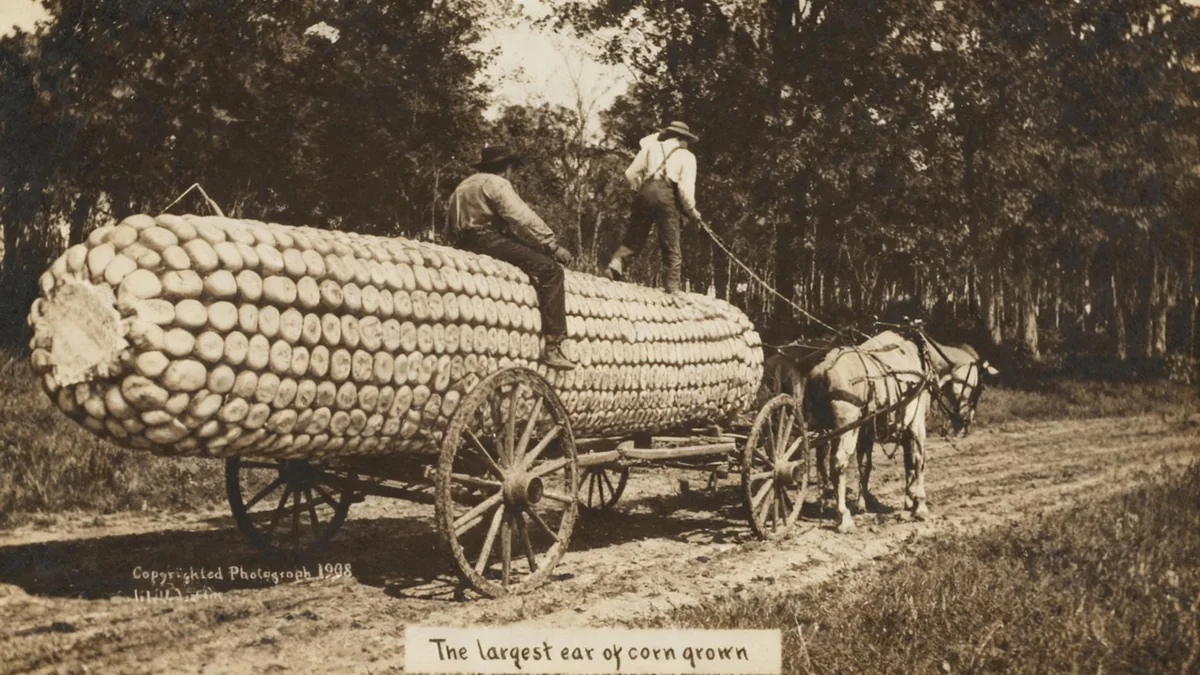
By the early 1900s, photo manipulation had become a popular tool for entertainment, especially in the booming postcard industry. Photographers created exaggerated and absurd scenes, known as "tall tale" postcards, that depicted impossible feats of agriculture and industry.
These images were designed to be humorous and were understood by the public as playful fictions. Popular subjects included:
- Farmers pushing wheelbarrows overflowing with a single giant potato.
- Hunters returning with impossibly large rabbits or fish.
- Gigantic ears of corn that dwarfed the people standing next to them.
One postcard from 1908, published by the Martin Post Card Company, shows two men casually carrying a massive flock of geese to market on a single pole. Another, from before 1908, depicts a car flying over Mulberry Bend Park in New York. While blatantly fake to a modern eye, these images were a source of amusement and regional pride, showcasing the supposed bounty of a particular town or state.
Hans Rooseboom, curator of photography at the Rijksmuseum, notes that while many of these images were clearly jokes, the line was not always clear. "Many photo collages and composites depict impossible, absurd, or humorous scenes that no one would have mistaken for reality," he stated. "Yet even then, the boundary between genuine and fake, believable and unbelievable, was often hard to see."
The Darker Side of Manipulation
While many early fakes were for fun, photographers also used manipulation for more serious and often deceptive purposes. Two prominent examples include political propaganda and so-called "spirit photography."
Propaganda and Political Satire
In the politically charged atmosphere of the 1930s, photomontage became a powerful weapon. Artist John Heartfield, a German anti-Nazi activist, used cut-and-paste techniques to create scathing critiques of the rising regime. One of his famous works for the magazine Arbeiter-Illustrierte-Zeitung shows Nazi propaganda minister Joseph Goebbels placing a Karl Marx beard on Adolf Hitler, a piece of political satire that would have been carefully examined by newsstand browsers of the era.
From Darkroom to Digital
The practice of adding clouds to landscape photos was common by the 1870s. Photographers could purchase stock negatives of dramatic skies to composite onto their own images, a technique remarkably similar to modern photographers using digital sky replacement tools in software today.
Exploiting Grief with Spirit Photography
Perhaps the most infamous use of early photo manipulation was spirit photography. In an era of high mortality rates, photographers exploited grieving families by claiming they could capture images of their deceased loved ones.
Using a simple technique of double exposure, these photographers would superimpose a faint, ghostly figure onto a portrait of a paying client. One of the most notorious practitioners was the American photographer William H. Mumler.
Despite evidence that one of his "ghosts" was a living person, Mumler was acquitted in a Manhattan court after claiming he "never used any trick or device" to create the images.
After his acquittal, Mumler produced his most famous work: a portrait of the recently widowed Mary Todd Lincoln with the ghostly apparition of her assassinated husband, President Abraham Lincoln, standing behind her. The image became a symbol of both a nation's and a widow's grief, all while being a calculated deception.
The "Fake!" exhibition at the Rijksmuseum runs until May 25, offering a fascinating look at how these early pioneers of manipulation set the stage for the visual culture we navigate today. It serves as a powerful reminder that questioning the authenticity of an image is not a new skill, but one that has been necessary for over a century.