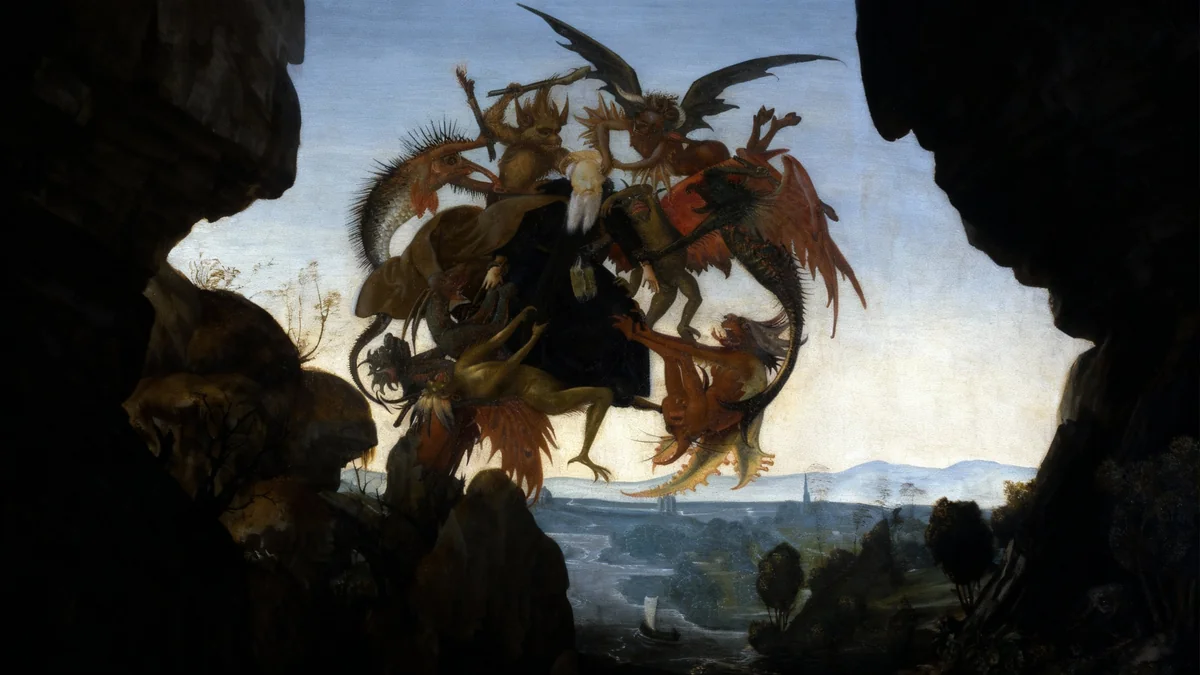


A remarkable discovery has brought to light what is now considered the earliest known painting by the Renaissance master Michelangelo Buonarroti. This work, titled "The Torment of Saint Anthony," was completed when the artist was just 12 or 13 years old, offering a rare glimpse into his prodigious talent during his formative years.
Key Takeaways
- "The Torment of Saint Anthony" is Michelangelo's first known painting.
- He created it at the age of 12 or 13, around 1487-88.
- The painting was not attributed to him until after its sale and restoration in 2008.
- It is the only Michelangelo painting in a public collection in North America, housed at the Kimbell Art Museum.
- Michelangelo studied fish market specimens to create realistic demonic creatures.
Early Beginnings of a Master
Michelangelo Buonarroti, born in 1475, would become one of the most influential figures in art history. However, his journey began far earlier than many realize. At an age when most children are focused on play, young Michelangelo was already deeply immersed in the world of drawing and painting.
His early studies included examining the works of other artists. One significant influence was Martin Schongauer, a 15th-century German engraver. Schongauer's engraving, "Saint Anthony Tormented by Demons," served as the inspiration for Michelangelo's first documented painting.
This early work, executed in tempera paint on a wood panel, demonstrates an extraordinary natural talent. It showcases a unique style and an early understanding of depth that set him apart, even at such a young age.
Did You Know?
Michelangelo's "The Torment of Saint Anthony" measures 18 1/2 x 13 3/4 inches, making it a relatively small but intensely detailed work.
A Hidden Masterpiece Uncovered
For centuries, the painting's true authorship remained a mystery. It was completed around 1487-88 but was generally attributed to the large Florentine workshop of Domenico Ghirlandaio when it went to auction. Michelangelo had joined Ghirlandaio's workshop as an apprentice in 1488, which might explain the initial attribution.
The pivotal moment came in 2008 after the painting was sold at auction. A conservationist at The Metropolitan Museum of Art in New York undertook a thorough restoration. This process involved carefully removing yellowed varnish and some unskillful overpaint that had obscured the original artwork.
During this restoration, a distinctive color palette and an unusual attention to depth began to emerge. These characteristics strongly hinted at Michelangelo's hand, prompting a re-evaluation of its origins.
"The unique composition that emerged after its restoration, backed by expert opinion, solidified the belief that it was indeed made by Michelangelo."
Expert Attribution and Confirmation
Art historians, including Everett Fahy, a long-serving curator at The Met, became convinced of the painting's authenticity. Their convictions were supported by conservator Michael Gallagher's meticulous work and the expert opinion of art historian and restorer Giorgio Bonsanti.
Bonsanti's assessment provided crucial backing for the attribution to Michelangelo. Without credible evidence to dispute these findings, the art world largely accepted the new attribution. This recognition elevated the painting's status dramatically.
The Story of Saint Anthony
The subject of the painting, "The Torment of Saint Anthony the Great," is derived from the 4th-century text, "Life of Saint Anthony," by Athanasius of Alexandria. It depicts the Egyptian hermit-saint levitating and being assailed by demons, whose torments he endures with steadfast faith.
A Unique Work in North America
Following its re-attribution, "The Torment of Saint Anthony" was acquired by the Kimbell Art Museum in Fort Worth, Texas. This acquisition is significant because it makes the painting the only known work by Michelangelo in a public collection in North America. This gives art enthusiasts on the continent a unique opportunity to view an early piece by the Renaissance master.
The Kimbell Art Museum highlights a fascinating detail about the painting's creation. Contemporary historians, such as Ascanio Condivi and Giorgio Vasari, who were Michelangelo's peers, recorded that the young artist went to great lengths to achieve realism.
To ensure the demonic creatures in his painting appeared authentic and terrifying, Michelangelo studied specimens from the fish market. He meticulously observed the colorful scales and various anatomical parts of fish to render his demons with striking veracity.
- The painting reveals Michelangelo's early commitment to realistic detail.
- His study of natural forms, even at a young age, was a hallmark of his artistic approach.
- This dedication to observation would define his later, more famous works.
Insights into a Developing Genius
It is possible that the famously perfectionist Michelangelo might not have wanted his name associated with this "amateur" work. This could be one reason why it was initially attributed to Ghirlandaio's workshop rather than directly to him.
However, for art historians and enthusiasts today, this painting is invaluable. It offers a rare and intimate insight into the earliest creative explorations of an artist who would go on to sculpt the David, paint the Sistine Chapel ceiling, and design St. Peter's Basilica.
The discovery of "The Torment of Saint Anthony" enriches our understanding of Michelangelo's artistic development. It underscores that even at a tender age, his visionary talent and commitment to his craft were already profoundly evident.
This painting stands as a testament to a genius in the making, providing a window into the mind of a young boy who would one day redefine art itself.