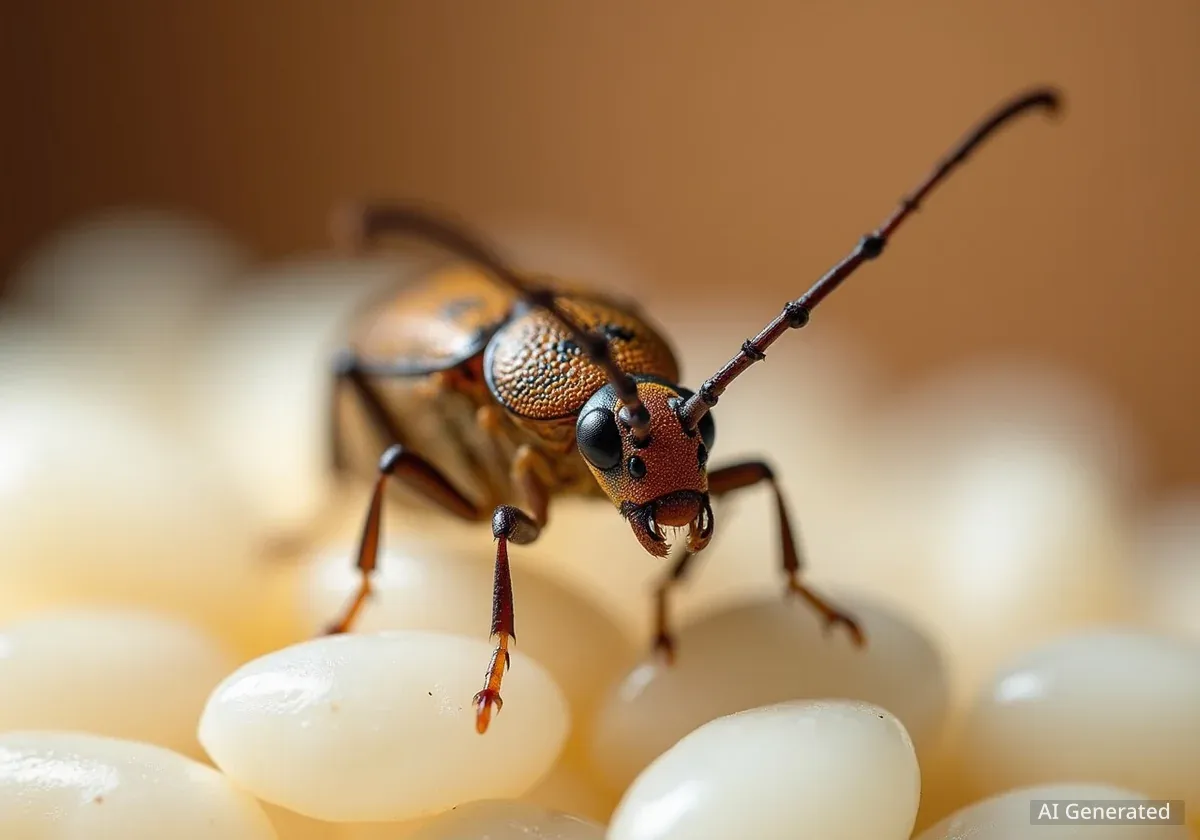




An image of a rice weevil on a single grain of rice has won the 2025 Nikon Small World photomicrography contest. This photograph provides new insights into the agricultural pest and highlights the intersection of scientific detail and artistic expression. Zhang You from Yunnan, China, captured the winning image.
Key Takeaways
- A rice weevil on a grain of rice won the 2025 Nikon Small World competition.
- Photographer Zhang You from China captured the winning image.
- The contest showcases the beauty and complexity of microscopic subjects.
- Over 1,900 submissions from 77 countries were received this year.
- Winning entries combine scientific rigor with visual impact.
Microscopic Detail Reveals Hidden Beauty
The winning photograph features a rice weevil, known scientifically as Sitophilus oryzae, with its wings spread. This particular detail is rare and difficult to capture. The image offers a fresh perspective on a common agricultural pest, revealing its intricate structure.
Zhang You, the winning photographer, emphasized the importance of detailed observation. He stated that understanding insect behaviors and mastering lighting are crucial for such work. You believes a successful entry blends both artistic vision and scientific accuracy.
“It pays to dive deep into entomology: understanding insects’ behaviors and mastering lighting. A standout work blends artistry with scientific rigor, capturing the very essence, energy, and spirit of these creatures.”
— Zhang You, 2025 Nikon Small World Winner
Interesting Fact
The winning image shows a rice weevil with its wings spread, a posture rarely observed and extremely difficult to prepare manually for photography.
You also shared that luck played a role in capturing his winning shot. He found the weevil naturally preserved with its wings open on a windowsill. This unexpected discovery made it possible to photograph a specimen that would otherwise be challenging to prepare.
The Nikon Small World Contest History
Nikon established its annual Small World contest in 1974. The competition aims to highlight the beauty and complexity of subjects viewed through a light microscope. Photomicrography involves attaching a camera to a microscope to capture high-resolution images of tiny objects.
The technique has a long history. British physiologist Richard Hill Norris used it in 1850 to study blood cells. Since the 1970s, photomicrography has increasingly been recognized as an art form. Advances in digital imaging have significantly enhanced the capabilities of this field in recent decades.
Background Information
Photomicrography is the art and science of taking photographs through a microscope. It allows researchers and artists to document the hidden details of the microscopic world, from biological cells to tiny insects and mineral structures.
For the 2025 competition, Nikon received over 1,900 submissions. These entries came from 77 different countries around the world. A panel of judges evaluated each submission based on several criteria. These included originality, informational content, technical skill, and visual impact.
Top Winners Showcase Microscopic Diversity
The contest recognized a total of 20 top winners, in addition to the grand prize. These images featured a wide array of subjects, demonstrating the vastness of the microscopic world. The entries ranged from biological samples to intricate natural formations.
Highlights from the Top Entries
- Second Place: Colonial algae (Volvox) spheres in a water droplet, captured by Jan Rosenboom.
- Third Place: Pollen caught in a garden spiderweb, photographed by John-Oliver Dum.
- Fourth Place: Heart muscle cells showing condensed chromosomes after cell division, by James Hayes.
- Fifth Place: Spores of a small tropical fern (Ceratopteris richardii), taken by Igor Siwanowicz.
Other notable entries included rat liver cells, sunflower trichomes, and slime molds releasing spores. One image showed a moth laying eggs, while another depicted a parasitic fungus invading a fly. These photographs offer both scientific value and striking visual appeal.
Zhang You also secured 15th place in the competition for another photograph. This entry showed a geometer moth laying eggs. The diversity of subjects and the skill of the photographers highlight the ongoing fascination with the unseen world.
The Nikon Small World contest continues to serve as an important platform. It reminds us that science and art can combine to reveal extraordinary details. These details often go unnoticed in everyday life but hold significant scientific and aesthetic value.
According to contest organizers, the competition aims to make complex scientific subjects accessible. By presenting them in a visually engaging way, the contest helps foster appreciation for microscopic research. The winning images inspire both scientists and the general public to look closer at the world around them.
The full list of winners and honorable mentions is available on the Nikon Small World website. The competition also includes a video category, with winners announced separately. These videos provide a dynamic view of microscopic life and processes.