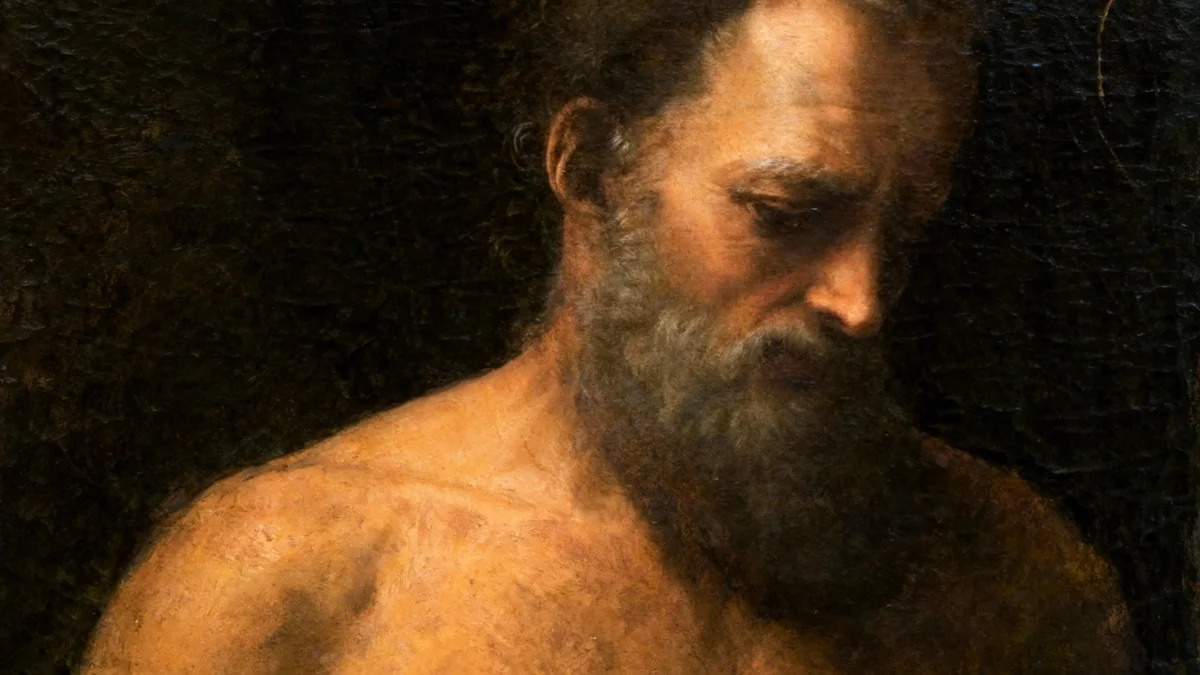


A prominent Raphael masterpiece, the 'Madonna della Rosa,' has long been the subject of debate regarding its authenticity. Now, artificial intelligence has provided new evidence suggesting that not all parts of the painting were created by Raphael himself. Specifically, the face of Saint Joseph in the upper left corner of the canvas appears to have been painted by another artist, likely from Raphael's workshop.
This discovery, made through advanced AI analysis, supports long-standing suspicions among art historians. It highlights how cutting-edge technology can shed new light on centuries-old artistic mysteries, offering a deeper understanding of classical works and their origins.
Key Takeaways
- AI analysis identified non-Raphael brushstrokes in the 'Madonna della Rosa' painting.
- The face of Saint Joseph is likely the work of another artist, possibly a pupil.
- This finding supports centuries of art historical debate about the painting's authenticity.
- Advanced machine learning offers new tools for art authentication.
AI's Microscopic Vision Reveals Hidden Details
Researchers from the UK and the US developed a specialized AI algorithm to analyze Raphael's artistic style. This technology was trained using authenticated Raphael paintings, allowing it to recognize the master's unique brushstrokes, color palette, and shading at an incredibly detailed level. The computer's ability to examine artwork at a microscopic scale far surpasses human visual capabilities.
Hassan Ugail, a mathematician and computer scientist involved in the study, explained the process. "Using deep feature analysis, we used pictures of authenticated Raphael paintings to train the computer to recognize his style to a very detailed degree, from the brushstrokes, the color palette, the shading, and every aspect of the work," he stated. This deep analysis capability is crucial for distinguishing subtle variations in artistic technique.
Accuracy in Art Authentication
The AI method used has previously demonstrated a 98 percent accuracy level in identifying Raphael paintings when analyzing entire artworks. This high level of precision underscores the potential of AI in art historical research.
Focusing on Individual Faces
While machine learning models often require extensive datasets for training, the researchers adapted a pre-trained architecture known as ResNet50, developed by Microsoft. They combined this with a traditional machine learning technique called a Support Vector Machine. This innovative approach allowed them to train the AI effectively even with a limited number of known Raphael works.
Instead of analyzing the entire painting at once, the team instructed the AI to examine individual faces within the 'Madonna della Rosa.' The results were striking. The faces of the Madonna, the Child, and St. John were all confidently attributed to Raphael's hand. However, the analysis of Saint Joseph's face yielded a different conclusion.
"When we tested the della Rosa as a whole, the results were not conclusive," Ugail noted. "So, then we tested the individual parts and while the rest of the picture was confirmed as Raphael, Joseph's face came up as most likely not Raphael."
Historical Suspicions Confirmed
The 'Madonna della Rosa' was created on canvas between approximately 1518 and 1520. For centuries, its full attribution to Raphael remained largely unquestioned, especially in Spain where it has resided for a significant portion of its history. The painting was first recorded in a Spanish monastery in 1667 before entering the Spanish national art museum's collection in 1857.
However, from the mid-1800s onwards, art critics and scholars began to voice doubts. They observed that the palette and execution of Saint Joseph's figure seemed to differ from the other figures in the composition, suggesting the involvement of Raphael's workshop members. These earlier suspicions now find strong backing from the AI's detailed analysis.
The Role of Raphael's Workshop
Raphael, like many master artists of his time, operated a large workshop with numerous pupils and assistants. It was common practice for these apprentices to contribute to paintings, often under the master's direction. Scholars have previously suggested that Giulio Romano, one of Raphael's prominent pupils, or even Gianfrancesco Penni, might have been responsible for parts of the 'Madonna della Rosa.' The AI's findings align with these historical hypotheses.
AI as an Art Historical Tool
This study demonstrates the growing importance of artificial intelligence in fields like art history and conservation. While AI cannot replace the comprehensive expertise of human art historians, it offers a powerful new tool for authentication and analysis. It provides objective, data-driven insights that complement traditional methods, such as examining provenance, pigments, and the physical condition of an artwork.
The research team emphasized that AI serves as an assistant, not a replacement for human experts. "This is not a case of AI taking people's jobs," Ugail clarified. "The process of authenticating a work of art involves looking at many aspects, from its provenance, pigments, condition of the work, and so on. However, this sort of software can be used as one tool to assist in the process."
This integration of technology promises to unlock further secrets hidden within the world's most treasured artworks, offering new perspectives on artistic creation and attribution. The research was published in the journal Heritage Science, marking a significant step in the application of AI to cultural heritage studies.
- AI provides objective data: The algorithm offers a consistent, unbiased method for analyzing brushstrokes and artistic styles, free from human subjectivity.
- Complements human expertise: Instead of replacing art historians, AI offers an additional layer of evidence, enriching ongoing scholarly debates.
- Unlocking new insights: The technology can reveal details too subtle for the human eye, potentially resolving long-standing mysteries about art creation.
The use of advanced computational methods in art history is a rapidly evolving field. From identifying hidden layers beneath painted surfaces to analyzing the composition of pigments, technology continues to expand our understanding of artistic masterpieces and their complex histories.