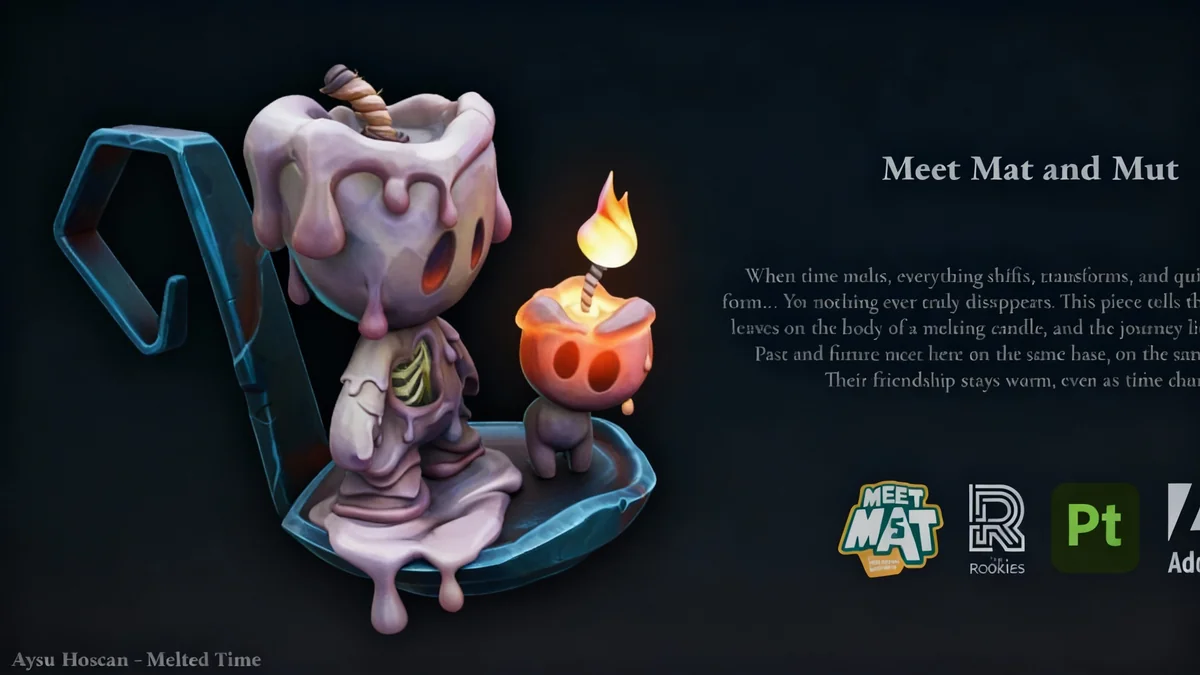
In a striking blend of technical skill and poignant storytelling, 3D artist Aysu Hoşcan has captured the abstract concept of time in a digital sculpture titled "Melted Time." The artwork, featuring a humanoid candle figure giving life to a smaller companion from its own melting wax, offers a visual metaphor for sacrifice, legacy, and the continuous flow between past and future.
Hoşcan, a self-taught artist who transitioned from a career as a veterinary technician, created the piece for a digital art competition. Her work demonstrates a sophisticated combination of stylized sculpting and a painterly texturing approach to convey deep emotional themes.
Key Takeaways
- 3D artist Aysu Hoşcan created "Melted Time," a digital sculpture symbolizing the passage of time.
- The artwork features two characters, Mat and Mut, representing the past and the future born from it.
- Hoşcan used a combination of ZBrush for sculpting and Substance 3D Painter for texturing and rendering.
- The project blends hand-painted aesthetics with physically-based rendering (PBR) techniques to achieve a unique, illustrative look.
- The artist transitioned into 3D art from a career as a veterinary technician, highlighting a unique path into the industry.
An Unconventional Path to Digital Art
Aysu Hoşcan's journey into the world of 3D art was not a traditional one. Before becoming a professional artist, she worked as a veterinary technician. Her entry into the digital art world began spontaneously when friends suggested they create a game together, sparking a newfound passion.
For the past year, she has worked professionally on realistic and semi-realistic props and weapons for the gaming industry. This professional work, she explains, provided a strong technical foundation that she now applies to her personal projects, where she explores a more stylized and painterly aesthetic.
"Most of the progress I've made so far comes from steady practice, discipline, staying curious, and my ongoing desire to learn," Hoşcan stated. This dedication is evident in her personal portfolio, which she uses to hone her stylized sculpting and texturing skills.
What is Stylized PBR?
Stylized Physically-Based Rendering (PBR) is an artistic approach that combines the exaggerated shapes and colors of stylized art with the realistic lighting and material properties of PBR. This allows artists to create fantastical worlds and characters that still react believably to light, giving them a tangible, grounded feel.
The Story of Mat and Mut
The concept for "Melted Time" originated from a desire to express complex emotions related to time's impact. Hoşcan envisioned a candle as the perfect symbol for this idea, as its melting is a simple and visible representation of continuity and decay.
The artwork tells the story of two characters. The main figure, Mat, is a candle that has been burning for a long time, weary from providing light alone. From its melting wax, a new, smaller figure named Mut is formed.
"Mut is a part of Mat, just as the future is shaped by the traces left by the past," Hoşcan explained. In a symbolic gesture, Mat gives a part of its flame to Mut, granting it life. Mat's melting form represents the past's final light, while Mut's fresh flame signifies a new beginning.
Sculpting Emotion in ZBrush
To bring Mat and Mut to life, Hoşcan began with organic sculpting in the digital software ZBrush. She followed a methodical process, starting with large, basic shapes and gradually refining them into smaller, more intricate details. This workflow, she notes, helps maintain clarity and control over the model.
A key goal was to create a flowing, organic feel to the wax. To achieve this, she primarily used a specific tool called the "Cue Buildup" brush, which she found produces a cleaner result than more common brushes. For more controlled wax drips, she utilized the "Folly Hair" brush.
To create the distinct, gravity-affected drips on the candle figure, Hoşcan masked and extracted parts of the main model, added thickness, and then refined their shapes. This multi-step process was essential to achieving a natural, stylized flow.
The details, from the texture of the wax to the extinguished wick on Mat's head, were all sculpted to reinforce the central theme. Even the wick inside Mat's chest is visible, grounding the fantastical character in the reality of how a candle is constructed.
Achieving a Painterly Finish
The texturing phase was critical for establishing the artwork's unique, illustrative look. Working in Substance 3D Painter, Hoşcan blended hand-painted techniques with PBR principles. This hybrid approach was challenging but essential for the final emotional impact.
She began with a base color and then used the model's Thickness Map—a data map that calculates the volume of an object—to create natural color transitions in the wax. Colors were layered using a light generator to simulate how light would realistically interact with the surface.
Two key components for the candle effect were Subsurface Scattering (SSS) and Emissive maps.
- Subsurface Scattering (SSS): This technique simulates light penetrating the surface of a translucent object, like wax, and scattering inside. Hoşcan applied stronger SSS to thinner areas, like the tips of drips, to make them appear more translucent.
- Emissive Maps: These maps dictate which parts of the model emit their own light. They were used to create the glow of the flame and the subtle light radiating through the thinner parts of the wax body.
"The roughness details were very important to show that the model was not only hand-painted but also supported by physical material behavior," Hoşcan noted, explaining her choice to make the bottom of the drips shinier, as if the wax were still fresh.
Rendering and Final Thoughts
For the final render, Hoşcan stepped out of her comfort zone. Instead of her usual tool, Marmoset Toolbag, the competition required her to render directly within Substance 3D Painter using its Iray engine. This presented a significant learning curve, especially in balancing the SSS and emissive effects under new lighting conditions.
Despite the technical and time constraints of the competition, Hoşcan found the process incredibly rewarding. "This project gave me a new perspective, both technically and creatively," she said. "It also opened space in my portfolio for a more personal work that reflects my own story and interpretation."
Her advice to aspiring artists is simple but powerful: be patient, experiment constantly, and engage with creative communities. "Feedback from others often shows details you might not notice on your own," she concluded. "And most importantly, never stop trying."