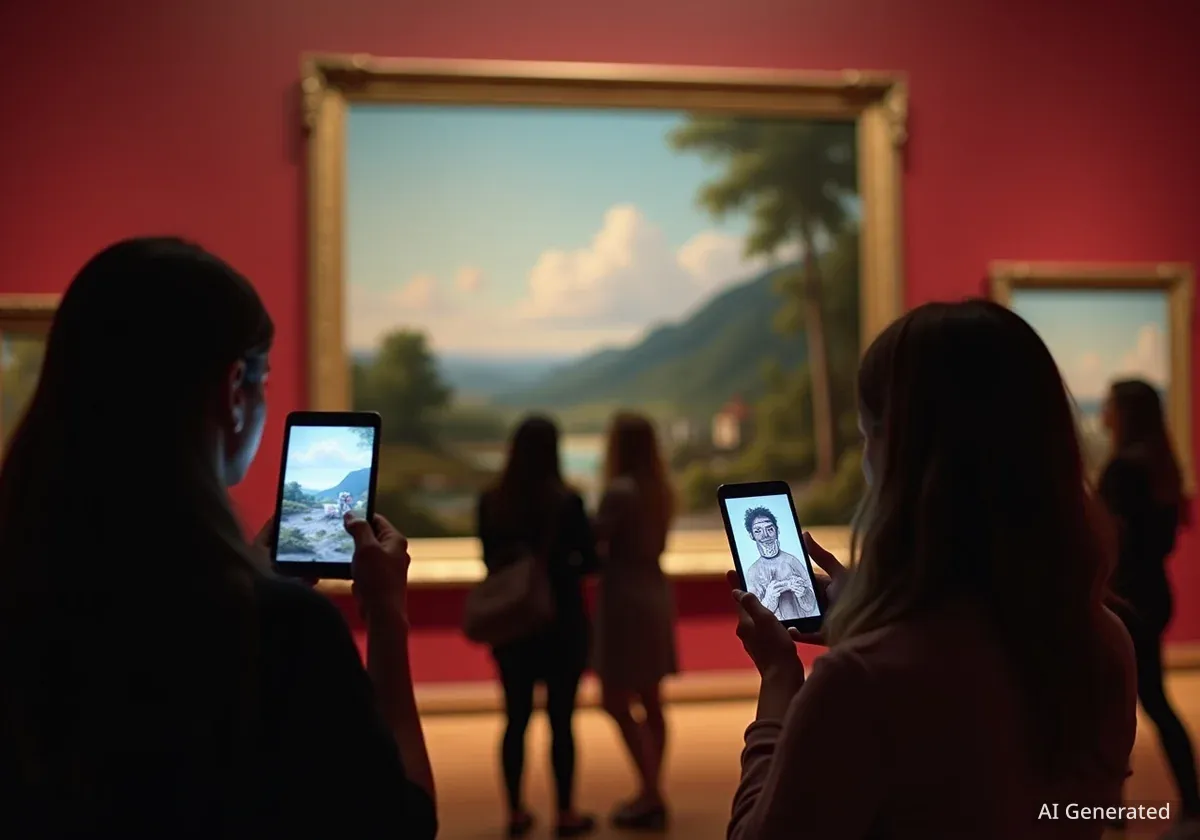

Seventeen Native artists conducted an unsanctioned digital intervention at the Metropolitan Museum of Art’s American Wing on Indigenous Peoples’ Day, October 13. They used augmented reality (AR) to overlay Indigenous cultural imagery onto 19th-century paintings within the gallery. This project, titled ENCODED: Change the Story, Change the Future, runs until December 31. It aims to challenge existing narratives in American art and question whose stories are prioritized for display.
Key Takeaways
- Native artists used augmented reality (AR) for an unsanctioned exhibition at the Met.
- The project, ENCODED, digitally altered 19th-century American paintings.
- It aims to highlight Indigenous perspectives and question museum display practices.
- The intervention coincides with the American Wing's centenary.
- Artists involved expressed varied views on institutional engagement.
Augmented Reality Transforms American Art
The digital intervention, ENCODED: Change the Story, Change the Future, was co-curated by filmmaker Tracy Renée Rector and an anonymous Indigenous co-curator. The non-profit media and design lab Amplifier collaborated on the project. Visitors can experience the intervention through a self-guided tour on their phones. By holding up their devices, they activate virtual transformations over selected artworks in the American Wing and outside the museum.
The project digitally superimposed various images. These included cosmological figures, pow-wow dancers, and layers of ivy. These digital additions appeared over traditional 19th-century American paintings. The original artworks featured generic landscapes, portraits of wealthy settlers, and large historical scenes. This approach directly questions the narratives presented by the museum's existing collection.
Project Details
- Title: ENCODED: Change the Story, Change the Future
- Dates: October 13 - December 31
- Location: Metropolitan Museum of Art, American Wing
- Technology: Augmented Reality (AR) via smartphones
- Co-curators: Tracy Renée Rector and an anonymous Indigenous co-curator
Museum's Ongoing Efforts and Critiques
The ENCODED project launches as the American Wing marks its centenary. This timing brings into focus fundamental questions about what American art represents. It also asks who determines what art is considered worthy of public display. The intervention highlights a perceived lack of space for Indigenous perspectives within mainstream institutions.
The Metropolitan Museum of Art has made some efforts to include Native art. In 2020, the museum appointed Patricia Marroquin Norby as its first associate curator of Native American art. In 2021, a new display of the Charles and Valerie Diker collection opened. This collection features 139 works from over 50 tribes. However, these works are in a separate area of the American Wing.
Earlier this year, the museum also opened a survey exhibition for Ojibwe Abstract Expressionist painter George Morrison. This exhibition runs until May 31, 2026. Curated by Norby, it was installed in a room next to the Diker collection. This placement keeps Morrison's work separate from his 20th-century New York contemporaries, such as Helen Frankenthaler and Jackson Pollock. Critics argue this segregation limits the integration of Native art into the broader narrative of American art history.
Historical Context
The American Wing's centenary provides a backdrop for this intervention. It prompts reflection on how art institutions have historically presented American culture. For many years, Indigenous art and perspectives were largely excluded or marginalized in such major museums. Recent efforts by the Met represent a step towards addressing these historical omissions, but artists argue more is needed.
Artists' Perspectives on Institutional Engagement
Nicholas Galanin, a Tlingit and Unangax̂ artist, contributed several works to ENCODED. He expressed skepticism about current institutional practices. Galanin stated,
"Institutions have a responsibility to care for the community that they represent, or have taken culture from."
Galanin's previous work, Anax Yaa Nadéin (it is flowing through it) (2022), criticizes how Native cultural objects are often stolen and sanctioned by Western institutions. This contrasts with the criminalization of Native people who try to reclaim these same objects. Research by ProPublica supports this critique. It shows that only 15% of the 139 Indigenous works in the Diker collection have complete or solid records of origin. The Native American Grave Protection and Repatriation Act (NAGPRA) was updated in 2023. This update requires greater deference to tribal knowledge and authority when returning human remains, sacred objects, and other cultural items.
Galanin believes museums can be adaptable when they choose. "Museums are nimble when they really want to be—this is how they get their things done," he added.
Diverse Views Among Participating Artists
Not all artists involved in ENCODED view the Met as an adversary. Amelia Winger-Bearskin, a Seneca-Cayuga artist who uses artificial intelligence (AI), described a more complex relationship with the institution. She recounted growing up in New York and having a positive connection with the Met. Her son took classes there, and a friend once led an art and tech incubator within the museum.
Winger-Bearskin stated, "The Met has always taught me how to interact with it. I think it’s set up for these types of interactions—building this AR layer on top of it to expand these conversations." This highlights a spectrum of opinions among Indigenous artists regarding how to engage with major cultural institutions.
The Impact of Digital Interventions
The digital interventions are both playful and thought-provoking. For example, Shinnecock photographer Jeremy Dennis overlaid an image of the White House onto a painting of the Parthenon. This act symbolizes a perceived disregard for Native sacred sites, similar to the creation of Mount Rushmore on the Black Hills. Priscilla Dobler Dzul digitally adorned Thomas Crawford’s sculpture Mexican Dying Girl (1846-48) with a florally decorated funerary big cat skin.
Other artists used wordplay and historical context to make their points. Mer Young placed a photograph of We'wha, a Zuni two-spirit artist and spiritual leader, over Childe Hassam’s painting Avenue of the Allies, Great Britain (1918). Hassam's painting depicts European and Latin American flags supporting US involvement in World War I. Young's intervention comments on the historical lack of allyship for queer Indigenous people, playing on the modern LGBTQIA2S+ term "allyship."
Tracy Renée Rector emphasized the artists' autonomy in the project. "I wanted to make sure the artists could represent themselves as they wanted," Rector said. She noted that a central theme was cosmology, not just responding to American masters, but creating new narratives and showing ways of resistance.
Rector also referenced a previous Met initiative from about five years ago. That project offered Native perspectives on artworks through placards, but these are no longer on display. Rector hopes institutions like the Met will reintroduce such counter-balances. She concluded, "As we know history is often told by the winners, or those in power."