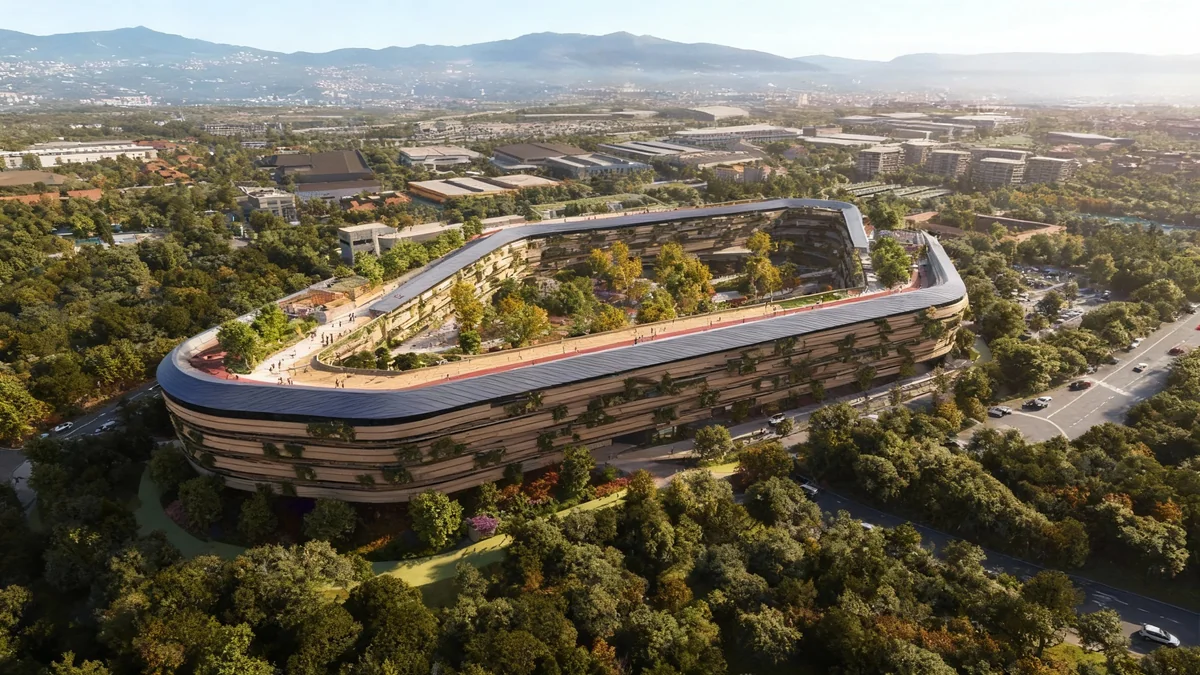

Zaha Hadid Architects has revealed its design for the new Malpensa Hospital in northern Italy. This major healthcare facility will serve approximately one million residents between Milan and Varese, integrating advanced medical technology with a focus on natural light and green spaces.
The innovative design centers around multi-level gardens and landscaped rooftops, aiming to create a calming and healing environment for patients and visitors. This project consolidates existing services from the Gallarate and Busto Arsizio hospitals into a single, modern campus.
Key Takeaways
- New Malpensa Hospital designed by Zaha Hadid Architects in northern Italy.
- Project will serve one million residents, consolidating existing hospital services.
- Features multi-level gardens, courtyards, and landscaped rooftops for a calming environment.
- Modular structure allows for future expansion and technological adaptation.
- Emphasizes human-centric design, ecological regeneration, and local heritage.
A New Vision for Healthcare Architecture
The Lombardy Regional Health Authority commissioned the project after an international competition. Zaha Hadid Architects secured the design contract, collaborating with Italian practice Studio Plicchi, engineering firm RINA, and built environment consultants WSP.
The hospital will span five stories, including a basement level. These floors will house a comprehensive range of facilities, including outpatient and inpatient services, maternal and infant care wards, diagnostic and therapy zones, clinics, and laboratories.
Project Scale
The new Malpensa Hospital will serve approximately one million local residents, consolidating services from two existing hospitals into one state-of-the-art facility.
A key aspect of the design is its integration with outdoor spaces. These facilities will encircle various gardens and courtyards, ensuring natural light and views are accessible throughout the building.
Integrating Nature and Public Pathways
A central pathway will cut through the ground floor of Malpensa Hospital, serving as a public route. This path will connect a plaza at the main entrance with the internal gardens and courtyards, creating an open and welcoming atmosphere.
Further outdoor spaces will be available on landscaped rooftop terraces. These green roofs offer additional areas for patients and visitors to relax and connect with nature, contributing to a tranquil hospital setting.
"The new hospital's design addresses three fundamental priorities: meeting the region's growing demand for healthcare, integrating advanced medical technology with human-centric design and ensuring the community has access to medical services of the highest quality," stated Zaha Hadid Architects.
The design team emphasized the hospital's modular structure. This allows for future expansion and adaptation to new technologies, ensuring the facility can meet the evolving healthcare needs of the region for decades to come.
Sustainable Design and Community Connection
The exterior of the hospital will feature aluminum cladding. Curved elements will protrude from the facades, forming planters that further integrate greenery into the building's aesthetic. This approach extends the natural elements beyond the ground level.
About Zaha Hadid Architects
Zaha Hadid Architects is a globally renowned architectural firm known for its distinctive, fluid, and often futuristic designs. Founded by the late Zaha Hadid, the practice has completed numerous high-profile projects worldwide, ranging from cultural centers to residential skyscrapers.
Inside, the hospital will feature warm and inviting materials. Wood and textile linings will define interior spaces, creating a comfortable environment. Dedicated areas for social, educational, and cultural activities aim to foster connections with local communities.
Ecological Regeneration and Future Adaptability
The landscaping plan for Malpensa Hospital involves more than just aesthetics. It includes the preservation of existing woodlands on the site. New wetlands and bioswales will be established to capture and reuse stormwater, promoting environmental sustainability.
This focus on ecological regeneration aligns with the firm's broader commitment to sustainable design practices. The hospital represents a comprehensive approach to integrating healthcare innovation, preserving local heritage, and promoting ecological responsibility.
"The project represents the holistic integration of healthcare innovation, local heritage preservation and ecological regeneration, creating an inclusive and sustainable campus to serve its community today while adapting to the needs of tomorrow," the architects added.
The Malpensa Hospital project showcases a modern approach to healthcare infrastructure. It prioritizes patient well-being through design that embraces nature, while also ensuring the facility is prepared for future medical advancements and community growth.
Beyond Malpensa: Recent Projects
- Residential Skyscraper, Dubai: Plans for a new residential tower featuring a distinctive lattice structure.
- Greater Bay Area Sports Centre, Guangzhou, China: A recently completed major sports complex.
These projects highlight Zaha Hadid Architects' continued influence in global architecture, pushing boundaries in design and functionality across various sectors.