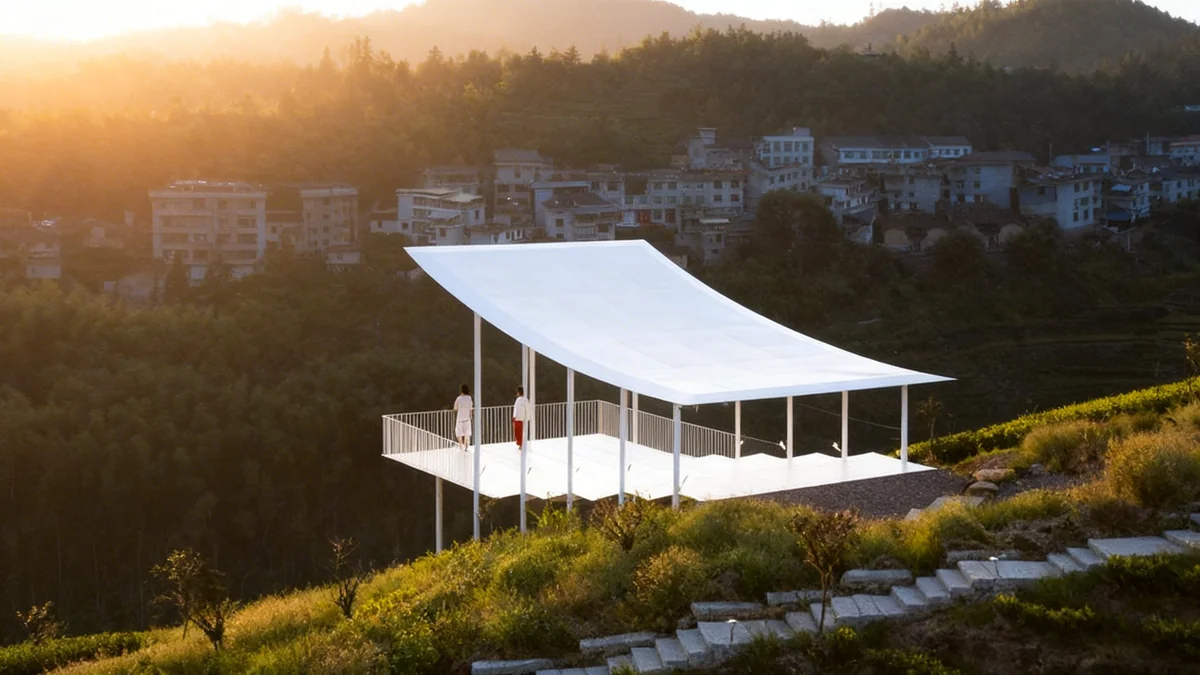
A striking new architectural installation, the Floating Pavilion, has officially opened its doors to visitors in Songyang County, Zhejiang Province, China. Perched at an elevation of 500 meters, the structure offers panoramic views across expansive tea terraces, blending modern design with the ancient landscape.
The pavilion, designed by Studio RE+N, aims to provide a unique vantage point for appreciating the region's natural beauty while offering a moment of quiet contemplation. Its slender, white form appears to hover above the fields, creating a sense of lightness and transient beauty.
Key Takeaways
- The Floating Pavilion is located 500 meters above sea level in Songyang County, China.
- It features a lightweight, 'floating' design, minimizing intervention on the natural tea terraces.
- The structure offers a dynamic viewing experience, revealing the panorama as visitors descend.
- Prefabricated steel components were used due to challenging terrain, transported by carts and cable systems.
- The pavilion serves as both a scenic landmark and a functional access point for tea farmers.
Design Inspired by Nature and Local Culture
The architects behind the Floating Pavilion focused on a principle of minimal intervention. Their goal was to create a structure that felt like an organic extension of the cultivated landscape rather than an imposition. This approach is evident in how the pavilion's path follows existing tea-picking routes, making it feel integral to the area.
The site, located within the Organic Tea Valley of Xinxing Town, was previously only accessible by narrow, steep field paths. The design team recognized the importance of integrating the new structure with these traditional routes, enhancing both visitor experience and local utility.
Understanding Songyang County
Songyang County is known for its picturesque landscapes and rich agricultural heritage, particularly its tea cultivation. The region's terraced tea mountains are a significant part of its cultural and economic identity. Projects like the Floating Pavilion aim to enhance tourism while respecting the area's natural and cultural integrity.
A Dynamic Viewing Experience
Visitors to the Floating Pavilion embark on a journey that transitions from compression to release in terms of visual exposure. Upon entering, only a distant scene is visible, framed by the roof's edge. As one descends along the stepped platforms inside, the surrounding mountains and daylight gradually come into full view.
The lowest level of the pavilion offers a complete panorama of the tea valley below. This carefully calibrated spatial rhythm is achieved through the precise curvature of the roof and its interaction with the natural slope of the terrain. The stepped platforms themselves are designed to respond to the terraced landscape, providing various spots for rest and contemplation.
"'Floating' describes both a structural condition — a thin roof suspended above the ground — and a quality of time in this place, where mist drifts, light shifts, and one pauses briefly on the mountain, as in a fleeting moment of respite," explained a representative from Studio RE+N, highlighting the poetic intent behind the design.
Innovative Construction in Challenging Terrain
The construction of the Floating Pavilion presented significant logistical challenges due to the steep terrain. Traditional heavy machinery could not be used at the summit, requiring an innovative approach to building.
The solution involved prefabricating steel components off-site. These components were then transported to the mountain peak using a combination of wheeled carts and cable systems. This method allowed for efficient construction while minimizing disruption to the delicate environment.
Construction Facts
- Area: 85 square meters
- Completion Year: 2025
- Lead Architects: Yuting Zhang, Pu Zhang
- Structural Engineer: Lihui Feng
The roof itself employs a thin composite sandwich construction. This design features a steel grid embedded between upper and lower steel plates, resulting in a blade-like profile with tapering edges. This structure cleverly integrates structural logic, drainage, and visual control into a single elegant form.
Inside, platforms cantilever from a single transverse beam, supported by wedge-shaped stiffeners. Semicircular gaps between the platform edges and columns allow natural light to filter in from below. Slender steel tension cables between the columns ensure safety without obstructing the pavilion's transparent feel.
Lighting and Environmental Integration
The pavilion's lighting design further enhances its integration with the natural environment. Custom cylindrical luminaires are installed at the base of the columns, projecting light upward along the curved roof. This creates a gentle glow that evokes the mist often seen drifting above the tea mountain at night.
The exterior's matte metal skin is designed to register seasonal shifts in ambient color. It appears verdant in spring and summer, reflecting the lush tea leaves. During autumn and winter, when fog often blankets the mountains, the pavilion takes on a cloud-like appearance, blending seamlessly with its surroundings.
More Than a Landmark: A Community Asset
Since its completion, the Floating Pavilion and its accompanying path have quickly become an integral part of the daily life for both villagers and visitors. It serves as a popular spot for walking, pausing, and witnessing the sunrise and sunset over the tea valley.
Beyond its aesthetic appeal, the project also provides improved access for tea farmers, particularly during harvest season. This dual functionality underscores the design's ambition: to be a light and restrained intervention that guides perception of the natural landscape while gradually becoming a part of that landscape through use and community integration.
The pavilion stands as a testament to how modern architecture can enhance natural beauty and serve local communities, all while maintaining a delicate footprint on the environment.