
Smiljan Radić, the acclaimed Chilean architect, has been awarded the prestigious Pritzker Architecture Prize. This recognition highlights a career marked by experimental designs and a unique approach to integrating structures within their natural and cultural landscapes. Radić's work often challenges conventional architectural norms, creating spaces that are both thought-provoking and deeply connected to their surroundings.
Key Takeaways
- Smiljan Radić receives the Pritzker Architecture Prize.
- His career features experimental designs and contextual architecture.
- Notable projects include the Pite House and VIK Winery in Chile.
- Radić designed the 2014 Serpentine Gallery Pavilion in London.
- Collaborations extend to fashion, with a stage for Alexander McQueen.
A Career Defined by Experimentation
Radić's architectural journey is characterized by a consistent pursuit of unconventional forms and materials. He often draws inspiration from abstract art and existing structures, reinterpreting them through his own lens. This experimental approach has resulted in buildings that defy easy categorization, pushing the boundaries of what architecture can be.
His designs are not merely aesthetic exercises. They engage with the environment, culture, and history of their locations. Radić's work frequently incorporates natural elements, making his buildings feel like extensions of the landscape rather than intrusions.
Early Works and Chilean Roots
One of Radić's early notable projects is the Pite House, completed in Chile in 2005. This residence dramatically hangs off a cliffside in Papudo, featuring multiple concrete volumes. A cantilevered pool extends out, offering expansive views of the water below. The interior emphasizes open-plan living and large windows, maximizing its connection to the dramatic coastal setting.
Interesting Fact
The Pritzker Architecture Prize is often considered the highest honor in architecture, recognizing architects whose work demonstrates a combination of talent, vision, and commitment.
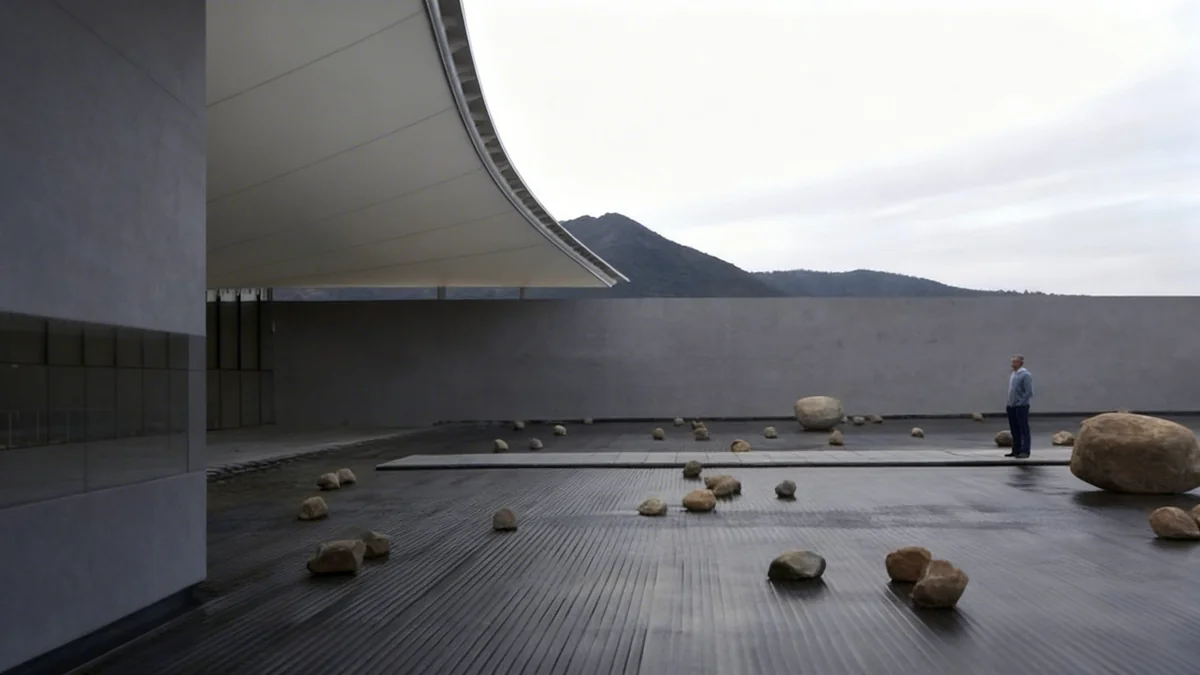
Another significant Chilean project is the VIK Winery in Millahue, completed in 2014. This structure cleverly integrates into the landscape, with much of the building located underground. A low-lying, stretched fabric roof covers the visible portions. The entrance features a unique rock garden, designed by Radić and his wife, sculptor Marcela Correa, leading visitors through stone pathways to the transparent facade.
International Recognition and Public Installations
Radić gained significant international attention with his design for the 2014 Serpentine Gallery Pavilion in London. This temporary structure, shaped like a doughnut, was crafted from a thin layer of white fiberglass. A metallic wedge protruded from its side, adding to its distinctive appearance.
"For me, this pavilion is a folly, and the folly historically is a romantic place, a place of extravagance and a place of atmosphere," Radić stated when the pavilion debuted. "So this pavilion had to both occupy and create a symbolic place."
This quote encapsulates Radić's philosophy, viewing architecture as capable of creating profound, symbolic experiences. The pavilion exemplified his ability to create compelling public spaces with minimal yet impactful forms.
Cultural Hubs and Geometric Explorations
In Concepción, Chile, Radić collaborated with Eduardo Castillo and Gabriela Medrano on the Teatro Regional del Bíobío, finished in 2018. The theater's concrete structure features an offset design, covered by a white skin made of polytetrafluoroethylene (PTFE). This material becomes semi-transparent at night, revealing the illuminated interior and creating a striking visual effect.
Architectural Context
Radić often references historical and artistic influences, from Le Corbusier's abstract paintings to Kazuo Shinohara's geometric houses, integrating these inspirations into his modern designs.
His residential projects also showcase a deep engagement with geometry and repetition. The Prism House + Terrace Room, built in 2020 near Conguillío National Park, consists of two triangular volumes connected by a broad deck. Radić described this project as "an exercise in repetition and replication," drawing inspiration from Kazuo Shinohara's 1974 Prism House.
The same year saw the completion of the House for the Poem of the Right Angle. This house features unusual, protruding angles and forms, directly inspired by an abstract painting by architect Le Corbusier. Its twelve-centimeter-thick reinforced concrete walls create an assemblage of skylights, curved walls, and a prominent cantilever, all encircling a central courtyard. The interior is lined with wood, providing warmth against the concrete.
Collaborations Beyond Traditional Architecture
Radić's innovative approach extends beyond conventional building projects. He has a long-standing collaboration with the fashion brand Alexander McQueen, designing stages for their shows. In 2021, he created a bulbous stage for an Alexander McQueen Spring Summer 2022 show in London. This marked the brand's return to physical presentations after a 20-year hiatus and the COVID-19 pandemic.
Working with structural specialist ES Global and creative agency Gainsbury&Whiting, Radić developed a steel tensile structure that housed rows of wooden chairs for guests. This project demonstrated his versatility and ability to create immersive environments for diverse purposes.
Public Art and Biennial Installations
Most recently, in 2023, Radić collaborated with architect Nicolás Schmidt to create a reflective, inflatable installation for the Chilean architecture biennial in Santiago. Located in the Plaza de la Cultura, the structure was held down by multiple external weights. Its cavernous interior accommodated chairs and screens for various presentations, serving as a dynamic public space for cultural exchange.
Smiljan Radić's Pritzker Prize win acknowledges a career dedicated to architectural exploration. His portfolio, ranging from private homes to public pavilions and fashion stages, consistently reflects a unique vision that enriches both the built environment and the cultural landscape.