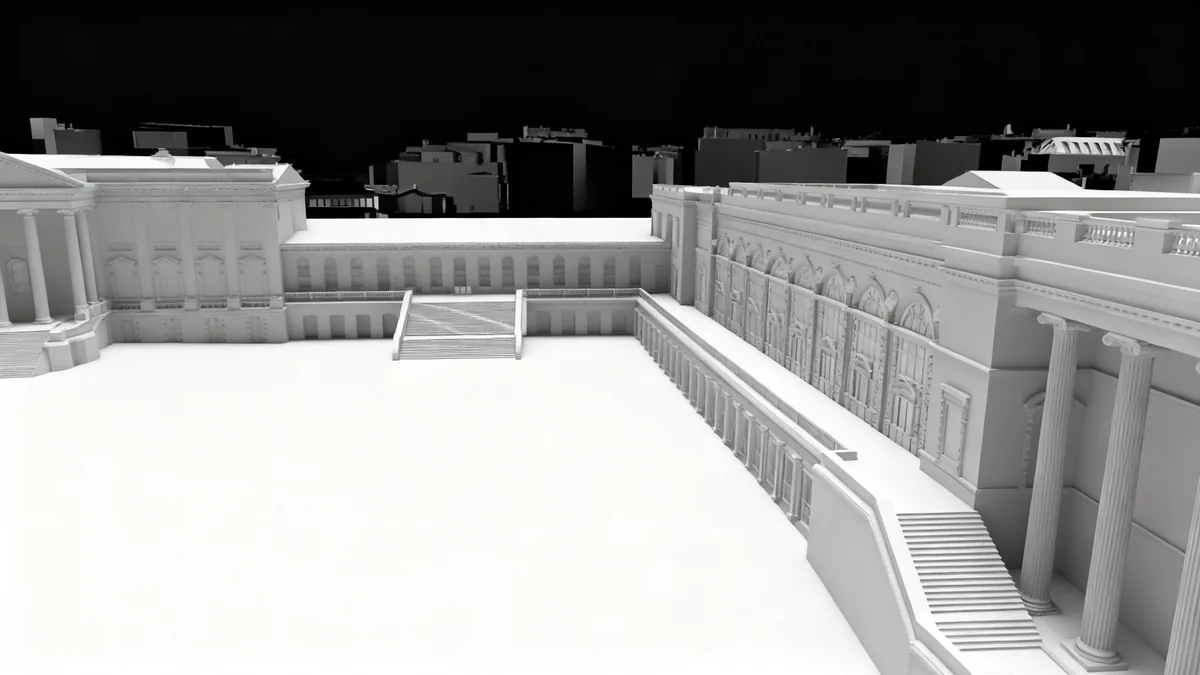
A proposed redesign for the White House East Wing is drawing significant attention, with critics highlighting its departure from the architectural symmetry long central to the historic complex. The new plans, which include a massive ballroom, are poised for approval by a commission whose board includes allies of the former president.
The design, developed by Shalom Baranes Associates, would dramatically alter the scale and visual balance of the White House grounds. An analysis of the plans reveals an East Wing footprint larger than both the Executive Residence and the West Wing combined, a shift from the historical architectural hierarchy.
Key Takeaways
- New East Wing footprint is larger than the Executive Residence and West Wing combined.
- The design features 29-foot-tall arched windows and a grand staircase.
- The east portico of the new design is off-center, breaking classical symmetry.
- The proposed ballroom could accommodate over 1,000 guests.
- The new garden is larger and alters the South Lawn driveway.
A Shift in Architectural Harmony
The White House complex has historically embodied classical architectural principles, with symmetry playing a fundamental role. The East and West Wings traditionally flanked the central Executive Residence, each connected by a colonnade. Their footprints were largely comparable and smaller than the main presidential home.
The proposed East Wing, however, introduces a new scale. At approximately 90,000 square feet, it is designed to be three times larger than the previous East Wing, which was demolished in October. This expansion includes a ballroom capable of holding at least 1,000 people.
Fact Check
- The new East Wing's planned footprint is larger than the Executive Residence and the West Wing combined.
- The proposed design features 29-foot-tall arched windows.
- The new south portico is more than double the width of the Executive Residence's south portico.
Redefining the White House Landscape
The scale of the proposed East Wing extends beyond the building itself. A new garden design, featuring a grid of stone pathways, will be larger than the previous Jacqueline Kennedy Garden. This expansion would push into the South Lawn, requiring an alteration to the once-circular driveway.
Basile Baudez, an associate professor in architectural history at Princeton University, commented on the design's impact.
"We have a building that displays much more monumentality and wealth than the main house,"Dr. Baudez stated, adding that the design treats what was originally a secondary building of the White House complex as a primary one.
Asymmetry in Design Details
Classical architecture places strong emphasis on symmetrical design, particularly in features like porticoes, which typically sit at the center of a building facade. The Executive Residence itself demonstrates this principle with its centered north and south porticoes.
However, the new East Wing design departs from this tradition. Its east portico, intended as a main entrance to the ballroom, is positioned off-center. This design element, while reportedly modeled after porticoes on the nearby Treasury building, contrasts with the Treasury building's own symmetrical placement of its three porticoes.
Historical Context
The White House grounds have long adhered to a symmetrical pattern, with main roads and structures converging on the Executive Residence. The original East and West Wings were designed to complement the central building, maintaining a visual balance that the new plans appear to disrupt.
Impact on Visual Dominance
Another significant design change is the south portico of the new East Wing. It would be more than double the width of the Executive Residence's south portico, a defining feature often seen as a backdrop for official ceremonies and a primary entrance for formal events.
This amplified scale for the East Wing's south portico creates a visual dominance that conflicts with the established symmetry of the White House property. Such a change could fundamentally alter how the various components of the complex relate to each other visually.
Architectural Evolution and Change
The project has seen changes in its architectural leadership. The initial architect, James McCrery, known for his classical approach, reportedly scaled back his involvement as the vision for the ballroom grew larger. Ultimately, Shalom Baranes Associates took over the design work.
Mr. Baranes is recognized for designing other government buildings and for a more modern architectural style. His updated plans have removed a pediment from the south portico and modified doors and windows, but the extensive footprint of the proposed East Wing remains a central feature.
The National Capital Planning Commission, whose board includes allies of the former president, is expected to approve the design. This decision will mark a notable moment in the architectural history of the White House, introducing a structure that significantly redefines the complex's long-standing aesthetic principles.
- The proposed East Wing is roughly 90,000 square feet.
- It is three times larger than the East Wing it replaces.
- The new garden design is larger than the previous Kennedy garden.