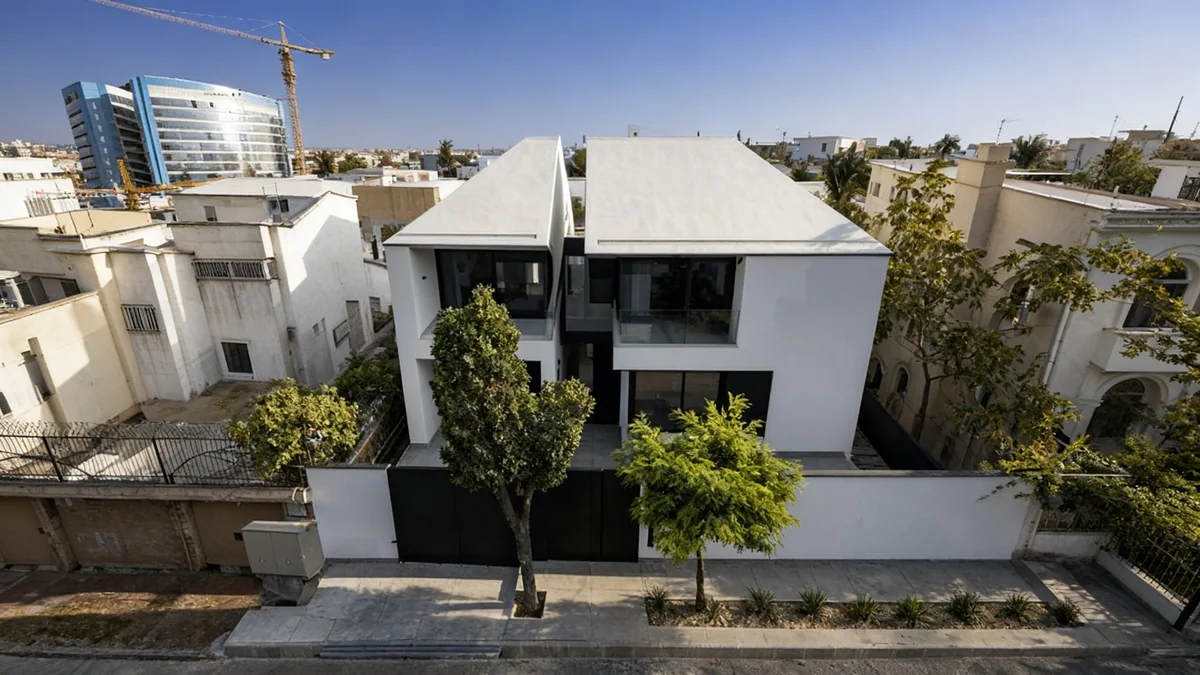
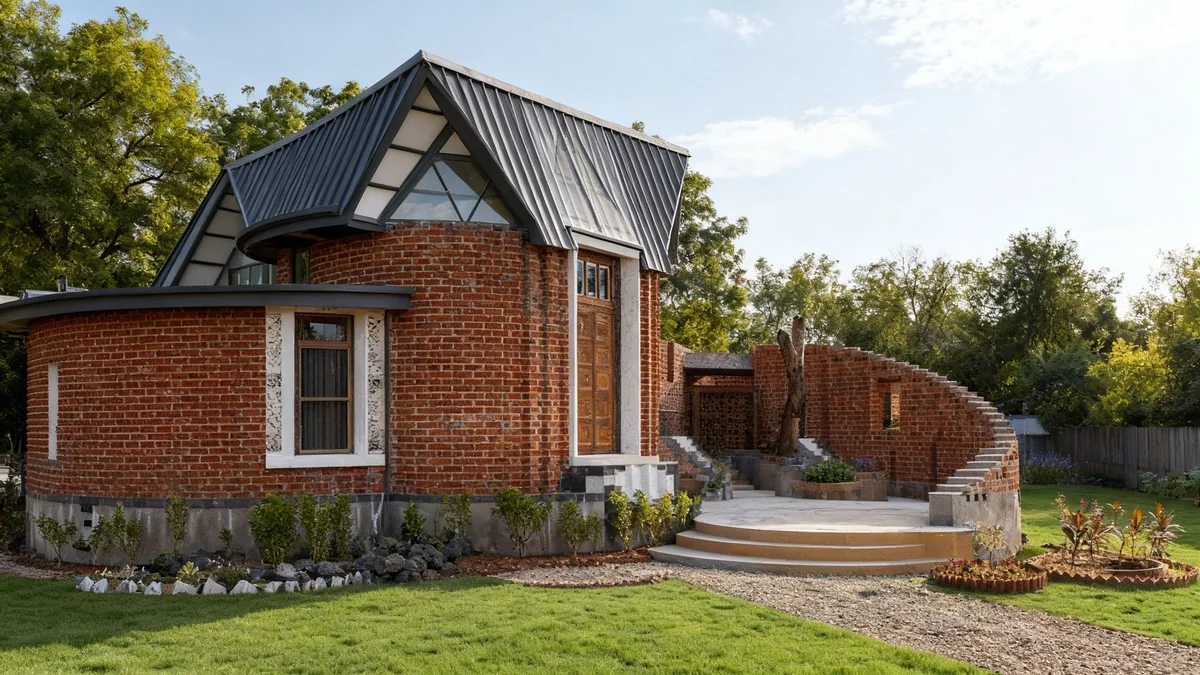
A striking residential villa in Tehran, Iran, is challenging traditional architectural norms while maintaining a familiar silhouette. Designed by NextOffice under lead architect Alireza Taghaboni, the Shahrak Villa, completed in 2021, spans 910 square meters and reinterprets the classic pitched-roof house through a series of intentional subtractions and carvings, creating a dynamic interplay of interior and exterior spaces.
Key Takeaways
- Shahrak Villa in Tehran reinterprets traditional pitched-roof architecture.
- A central 'fissure' creates spatial connections and enhances natural light.
- The design emphasizes fluid transitions between public and private zones.
- Negative spaces, courtyards, and terraces are integral to the living experience.
- The project blends familiar forms with innovative spatial organization.
Reimagining a Classic Form
The Shahrak Villa initially appears to be a conventional pitched-roof house. This deliberate choice connects it visually to its surroundings and common architectural expectations. However, the design team did not aim for mere replication. Instead, they sought to extract new spatial possibilities from this well-known framework.
The approach avoids rejecting the established typology. It focuses on transforming and reinterpreting it. This results in a fresh architectural perspective, offering something new within a recognizable shape.
Project Snapshot
- Architects: NextOffice – Alireza Taghaboni
- Location: Tehran, Iran
- Area: 910 m²
- Completion Year: 2021
The Central Fissure: A Spatial Mediator
A key element of this innovative reinterpretation is a deep fissure carved into the building's mass. This incision establishes an active dialogue between the two sides of the site. It functions as more than just a formal cut.
This central opening acts as a spatial mediator. It organizes movement throughout the house, guides visual connections, and shapes the overall living experience. It creates a series of spatial sequences, leading residents and visitors from the exterior to the interior. It also transitions from more public areas to increasingly private zones within the villa.
"The fissure functions not simply as a formal incision but as a spatial mediator that organizes movement, visual connections, and the lived experience of the house."
The fissure also serves practical purposes. It allows natural light to penetrate deep into the structure. It also improves ventilation, creating a healthier indoor environment. This design choice strengthens the connection between the building and the natural ground it occupies.
Subtraction and Carving: Defining Space Through Voids
The Shahrak Villa maintains the familiar outline of a pitched-roof structure. However, this form undergoes multiple acts of subtraction and carving. These deliberate removals create a variety of negative spaces across different exterior zones.
These voids manifest as semi-enclosed courtyards, expansive terraces, and intermediate spaces. These areas offer opportunities for pause and transition. They are not merely empty spaces but integral parts of the design, enriching the outdoor experience.
Architectural Context
Pitched roofs are common in many residential designs, offering practical benefits like efficient water runoff and often a sense of traditional comfort. The Shahrak Villa's innovation lies in taking this familiar form and applying modern design principles to create complex, multi-layered spaces within it, challenging expectations of what a 'traditional' house can be.
The same logic extends to the organization of the interior. Internal spaces are not defined solely by solid partitions. Their relationship to these voids and openings plays a crucial role. This creates a highly interconnected yet diverse sequence of spaces.
The result is a layered and fluid experience of inhabitation. Residents move through a series of distinct environments, each offering a unique perspective and interaction with the overall structure. This thoughtful design blurs the lines between inside and outside, public and private, creating a truly unique living environment in Tehran.
Design Team and Engineering Expertise
The success of the Shahrak Villa is a testament to a collaborative effort. Alireza Taghaboni led the project as the principal architect. The design team included Majid Jahangiri, Farideh Agha Mohammadi, Mehran Motamedi, Meysam Feizi, Atefe Lotfollahi, Masoud Soufiani, Mohammad Reza Gholami, Elaheh Babaei, Asal Karami, and Saba Salehi, along with Ehsan Ahani.
Specialized engineering and consulting were crucial. Energy Arta Eurasia handled the electrical systems. Afshin Masoudi provided structural engineering expertise. Faraz Beygi managed the project, ensuring smooth execution from concept to completion.
- Lead Architect: Alireza Taghaboni
- Design Team: Majid Jahangiri, Farideh Agha Mohammadi, Mehran Motamedi, Meysam Feizi, Atefe Lotfollahi, Masoud Soufiani, Mohammad Reza Gholami, Elaheh Babaei, Asal Karami, Saba Salehi, Ehsan Ahani
- Electrical Engineering: Energy Arta Eurasia
- Structural Engineering: Afshin Masoudi
- Project Management: Faraz Beygi
This collaboration highlights how complex architectural visions come to life. It combines creative design with precise engineering and meticulous project oversight. The Shahrak Villa stands as a notable example of contemporary residential architecture in Iran, pushing boundaries while respecting context.