
Ken Moholt-Siebert, a Santa Rosa-based architect, is leading a remarkable project to reconstruct the Fountain Grove Round Barn, an iconic landmark destroyed in the 2017 Tubbs Fire. Five years into the painstaking effort, Moholt-Siebert and his wife, winemaker Melissa Moholt-Siebert, are now seeking community support to complete the ambitious undertaking, aiming for a summer finish.
Key Takeaways
- Santa Rosa architect Ken Moholt-Siebert is rebuilding the Fountain Grove Round Barn, lost in the 2017 Tubbs Fire.
- The replica is being constructed on a hillside above his vineyard, visible from Highway 101.
- The project is in its final stages, with a completion goal set for summer.
- Community fundraising events are underway to cover remaining costs, particularly for fire-resistant roof panels.
- The original barn, built in 1899, was commissioned by Japanese winemaker Kanaye Nagasawa, known as 'The Wine King of California'.
A Community's Loss, A Vision's Rebirth
The Tubbs Fire of 2017 devastated many parts of Santa Rosa, including the Moholt-Siebert's home and the cherished Fountain Grove Round Barn. The loss of the barn left a significant void in the community's landscape and collective memory.
Ken Moholt-Siebert, described by his wife Melissa as a "dreamer," felt a deep connection to the history of Sonoma County. He decided to resurrect the Round Barn on their property, specifically on land above their upper vineyard that was "not useful for most other purposes."
His motivation was clear. "If I placed it in that location," he stated, "the landmark would be restored, and I could offer it as a kind of act of healing and love to this community." The new barn is being built a little over a mile north of the original site.
Fire's Devastation
- The Tubbs Fire, which started on October 8, 2017, was one of California's most destructive wildfires.
- It destroyed over 5,600 structures, including the original Fountain Grove Round Barn.
- The fire caused an estimated $1.2 billion in damages.
Construction Nears Completion
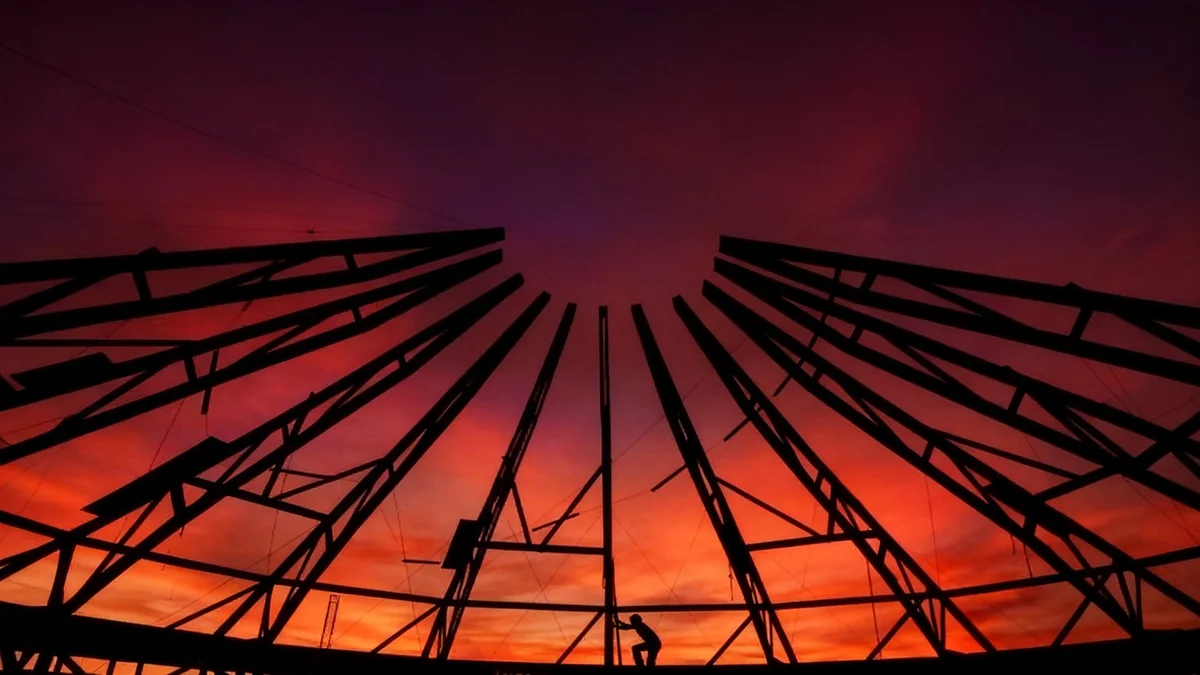
Moholt-Siebert has dedicated the past five years to meticulously recreating the barn. He has largely worked without heavy machinery, lifting rafters into place using a manual pulley system. The replica is a true-to-size rendition of the original structure.
Late last November, just before the rainy season, Moholt-Siebert successfully installed the roof trusses, a major milestone. January brought unseasonably dry and beautiful weather, allowing him to install four rings of purlins—the horizontal beams to which the roof panels will attach.
The project is now on the home stretch. The architect aims to complete the barn by the end of summer, bringing his long-term vision to fruition.
"He did it by stretching his fire insurance as far as he could, using his own land, designing it himself, and building it himself, with just a little help." – Melissa Moholt-Siebert on her husband's dedication.
Community Rallies for Final Push
With the project nearing completion, the Moholt-Sieberts' funds for the work are dwindling. They are now reaching out to the community for assistance to finish Round Barn 2.0. The most significant remaining cost is for the roof panels, an insulated metal material chosen for its superior fire resistance, costing an estimated $60,000.
Two key fundraising events are planned:
- Wednesday, March 4: Homerun Pizza in Larkfield will donate 15% of all sales, dine-in or takeout, to the Round Barn rebuild. The Moholt-Sieberts will be present from 4 p.m. to 8 p.m. to share stories and answer questions.
- Saturday, March 7: A more formal fundraiser will take place from 5 p.m. to 7 p.m. at the Parish Hall of the Church of the Incarnation, 550 Mendocino Ave. in downtown Santa Rosa. Tickets are $100 and include appetizers, wines from Melissa's Ancient Oak Cellars, and presentations on the project.
How to Support the Rebuild
Homerun Pizza Fundraiser:
- When: Wednesday, March 4
- Where: 484 Larkfield Center, Larkfield-Wikiup
- What: 15% of all sales donated to the project.
Formal Fundraiser Event:
- When: Saturday, March 7, 5 p.m. to 7 p.m.
- Where: Parish Hall, Church of the Incarnation, 550 Mendocino Ave., Santa Rosa
- What: Appetizers, Ancient Oak Cellars wines, project presentations.
- Ticket Price: $100
The Legacy of Kanaye Nagasawa
The original Fountain Grove Round Barn held a rich history, commissioned in 1898 by Kanaye Nagasawa. Nagasawa, the scion of a samurai family, was the first Japanese immigrant to permanently reside in the United States, settling in Santa Rosa in 1875.
In the late 19th century, Nagasawa managed a 2,000-acre utopian settlement called The Brotherhood of New Life, which included an internationally recognized vineyard. After the community's founder, Thomas Lake Harris, returned to Scotland in 1892, Nagasawa inherited the land.
He achieved remarkable success with the vineyard, producing over 200,000 gallons of wine annually at its peak. This earned him the moniker "The Wine King of California" in Japan. The 72-foot-diameter, 16-sided barn was built to house the vineyard's workhorses, standing for 118 years as a sentimental landmark.
Kanaye Nagasawa's Impact
- Born into a samurai family in Japan.
- First Japanese immigrant to permanently reside in the U.S.
- Managed a 2,000-acre vineyard, producing 200,000+ gallons of wine annually.
- Known as "The Wine King of California" in Japan.
- Commissioned the original Round Barn in 1898.
A Symbol of Resilience and Heritage
The legacy of Kanaye Nagasawa, however, also includes a tragic chapter. Despite his success, due to the California Alien Land Law, his property was taken from his nephew Tomoki Ijichi and his wife Hiro after Nagasawa's death in 1934. In 1942, following the attack on Pearl Harbor, Tomoki, Hiro, and their children, Kosuke and Amy, were relocated to an internment camp in Rohwer, Arkansas, for the duration of World War II.
Karen Ijichi Perkins, Kosuke Ijichi's daughter, who now lives in Oakland, visited the Moholt-Siebert ranch last fall with her siblings and cousins. She described the rebuilt barn as "an immense project" and "beautiful."
Ken Moholt-Siebert emphasized that the barn's history is deeply connected to the Ijichi family. "It's really theirs, not mine," he said. "I mean, it's a community story. But they're the beginning of it." He noted that Nagasawa's story, as "one of the first people to leave Japan and explore the world outside of it," makes the Round Barn's history unique and special.
While the rebuilt barn cannot restore what the family lost materially, Moholt-Siebert hopes it can serve as a symbolic step toward healing. "In a symbolic way, maybe it can be a step in the right direction."