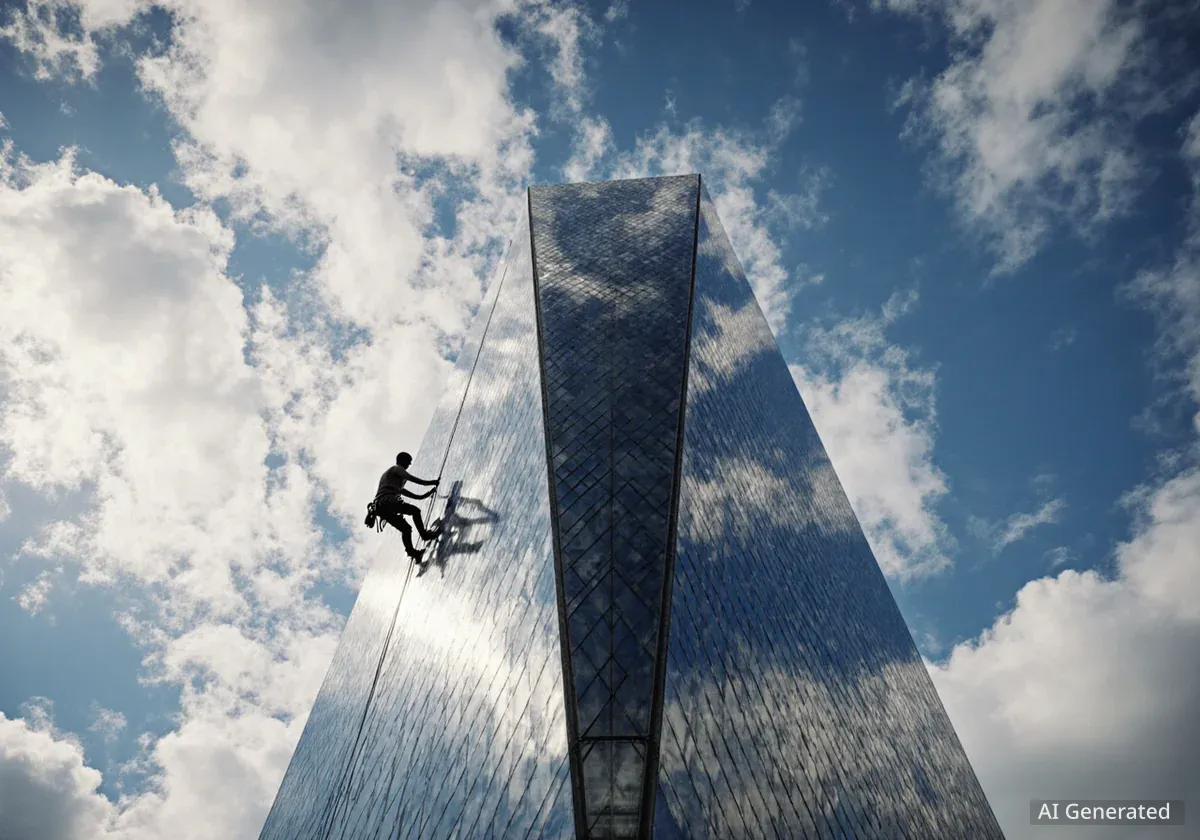

American rock climber Alex Honnold successfully free soloed the Taipei 101 skyscraper today, completing the 1,667-foot ascent without ropes or safety equipment. The daring climb in Taiwan's capital captivated a global audience, streamed live by Netflix.
Honnold, known for his groundbreaking free solo of El Capitan, reached the summit of the 101-story building in just one hour and 32 minutes. Crowds gathered below cheered him on, marking a historic moment in urban climbing.
Key Takeaways
- Alex Honnold free soloed Taipei 101, climbing without ropes.
- The ascent took one hour and 32 minutes.
- Taipei 101 stands at 1,667 feet with 101 floors.
- The event was broadcast live by Netflix.
- Honnold hopes his climb inspires others to pursue meaningful goals.
A New Challenge: Skyscraper vs. Rock Face
Honnold has long expressed interest in scaling a skyscraper, noting the distinct challenges compared to natural rock faces. The Taipei 101 presents a different kind of technical climb, with its unique architectural features.
The building's exterior is designed with eight stacked segments, evoking the image of bamboo. These segments, each comprising eight stories, require precise and deliberate movements from climbers.
Taipei 101 Facts
- Height: 1,667 feet (508 meters)
- Floors: 101
- Former Record: Was the world's tallest building until surpassed by the Burj Khalifa.
- Design: Eight stacked segments resembling bamboo.
- Built for Resilience: Engineered to withstand strong earthquakes and typhoons.
Honnold's climb was originally scheduled for Saturday but was delayed by a day due to poor weather conditions. He commented that the inclement weather made the experience feel more like a traditional rock climbing expedition, adding to the sense of adventure.
"It really feels like we've been here on a climbing expedition, climbing in the mountains, because of the weather swirling and the rain and the wind and everything," Honnold stated in a post-climb news conference. "It makes the whole experience of coming to Taipei and climbing feel like a grand adventure."
The Groundbreaking El Capitan Ascent
Alex Honnold rose to global fame for his 2017 free solo of El Capitan in Yosemite National Park. This 3,200-foot granite monolith was considered an impossible feat without safety gear. His climb was documented in the Oscar-winning film "Free Solo."
El Capitan's near-vertical cliffs and smooth surfaces offer few natural handholds, making it an extremely technical climb. Honnold spent over a year training and repeatedly ascended the route with ropes to memorize every move.
El Capitan's Significance
The first successful ascent of El Capitan was in 1958, using ropes. Honnold's free solo marked a new era in climbing, pushing boundaries previously thought unbreakable. Climbers like Tommy Caldwell called it "the moon landing of free-soloing."
The rigorous preparation for El Capitan underscores Honnold's approach to free soloing. He views these climbs not as reckless stunts but as calculated risks, meticulously planned and practiced.
Taipei 101's Unique Engineering
Taipei 101 is not just a tall building; it is an engineering marvel designed for its challenging environment. Taiwan experiences frequent earthquakes and typhoons, necessitating advanced structural solutions.
The skyscraper uses reinforced concrete, combining the compressive strength of concrete with the tensile strength of steel. This allows the building to be flexible enough to sway with winds and tremors, yet rigid enough to resist them.
Tuned Mass Damper
A key innovation within Taipei 101 is its tuned mass damper. This massive, orb-like device acts as a pendulum, counteracting swaying motions caused by strong winds or seismic activity. It helps stabilize the building, even during extreme weather events.
Today, Taipei 101 serves multiple purposes, housing retail and office spaces. It is also a popular tourist attraction, offering an observation deck on its upper floors that provides panoramic views of the city.
The Human Element: Family and Inspiration
Despite his perilous climbs, Honnold maintains that his family is his top priority. He has two young children who, he says, are largely unaware of his free solo adventures.
"I don't think they even know what dad does. I don't think they know what climbing is when we're bouldering, kind of climbing small rocks," Honnold shared. "They'll play in the forest and they'll play around, but I don't think climbing means anything to them yet."
His wife, Sanni McCandless, was present during the Taipei 101 climb, waving to him from inside the building as he ascended. She later joked about having a "panic attack the entire time," highlighting the immense pressure involved.
Honnold hopes his achievements inspire others. He believes people take different messages from his climbs, often finding the motivation to pursue their own goals.
Honnold's Philosophy
Honnold reflects on the film "Free Solo" and its impact. He notes that viewers often find personal inspiration, seeing his climbs as a reminder that their "time is finite and they should use it in the best way, the most meaningful way that they can."
Precedents in Urban Climbing
While Honnold is the first known person to free solo Taipei 101, he is not the first to climb it. In 2004, urban climber Alain Robert, known as the "French Spiderman," ascended the skyscraper with ropes during its opening.
Robert completed his climb in four hours, battling rainy weather and slippery surfaces. He provided commentary on Honnold's ascent, expressing confidence in the American climber's abilities.
Robert has a long history of climbing famous landmarks, often without safety equipment. His resume includes the Empire State Building, the Petronas Towers, and the Eiffel Tower. He has faced arrest over 120 times for his stunts.
The "French Spiderman"
Alain Robert, 63, is a pioneer in urban climbing. He has scaled numerous global landmarks, sometimes free solo. He told Honnold on a podcast to take breaks during the Taipei 101 climb, advice Honnold seemed to follow.
Honnold's climb of Taipei 101 adds another chapter to his legendary career. It demonstrates his ongoing commitment to pushing the boundaries of human achievement, both in nature and in the urban landscape.