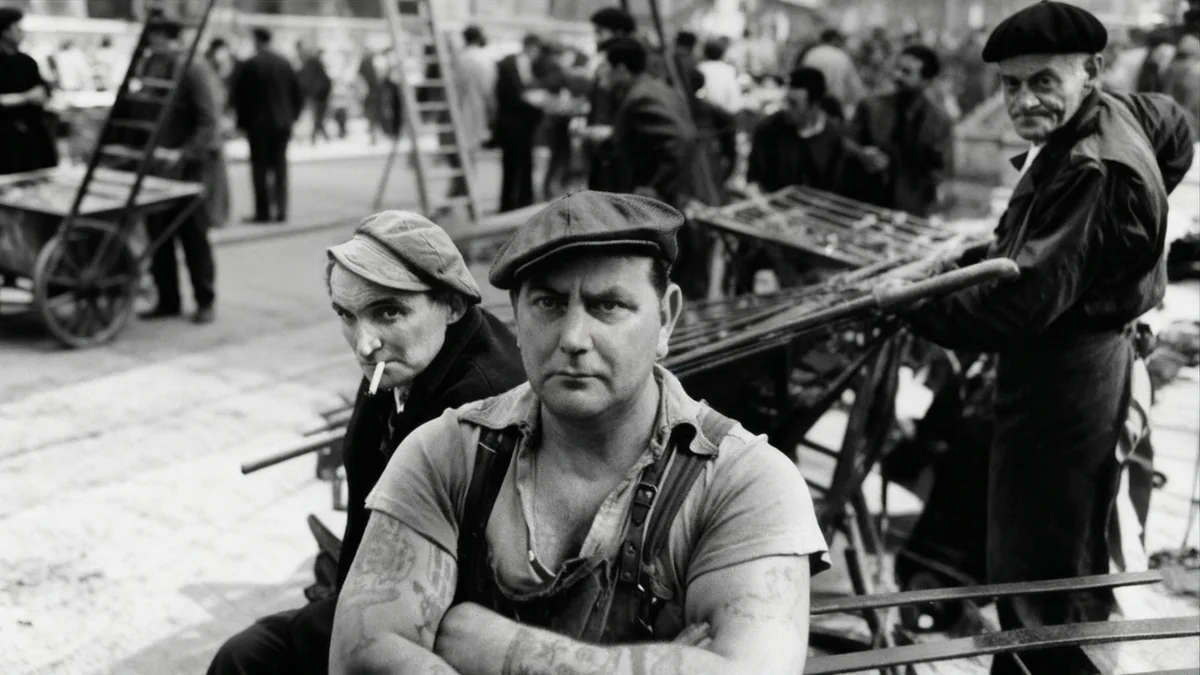




Henri Cartier-Bresson's influential 1955 photographic collection, "The Europeans," is receiving renewed attention over 70 years after its initial publication. A new exhibition at the Paris foundation dedicated to the photographer is bringing the vintage prints and contact sheets from this significant work into the public eye, alongside an elegant new edition of the book.
Key Takeaways
- "The Europeans" by Henri Cartier-Bresson, originally published in 1955, is now on exhibition in Paris.
- The collection features 114 photographs captured across Europe during a period of significant post-war change.
- Cartier-Bresson's work aimed to show both the unique aspects and underlying unity of European cultures.
- The exhibition includes original vintage prints and contact sheets, offering a deeper look into the creative process.
A Post-War Photographic Journey
Cartier-Bresson embarked on an extensive journey across Europe in the early 1950s. His travels were often assignments for leading publications of the era, including Paris Match, Harper’s Bazaar, Life, and Holiday magazines. These assignments took him to various corners of the continent, capturing moments that would later form the backbone of "The Europeans."
In 1951, his lens explored rural Italy, his native France, and Britain. The following year, he documented the solemn crowds gathered in Trafalgar Square for King George VI's funeral in London, before moving on to Dublin and the Irish countryside. By 1953, he had traversed Greece, Austria, and Germany. His photographs from Hamburg captured festive, if somewhat weary, New Year's revelers, contrasting sharply with the still-visible scars of World War II in Cologne, where shattered buildings stood beside gleaming new shops.
"He was living the life of a photo reporter," stated Clément Chéroux, director of the Fondation Henri Cartier-Bresson and curator of the exhibition. "There is barely a month without travel abroad."
Europe in Transition
The period Cartier-Bresson documented was one of profound transformation for Europe. The continent was actively redefining itself after the devastation of World War II. Key political and economic structures were emerging, laying the groundwork for future unity.
Historical Context
- 1949: NATO and the Council of Europe were established.
- 1950: Robert Schuman announced the plan for what would become the European Union.
- 1955: Germany was formally divided into two nations, and the Warsaw Pact was solidified, marking the deepening of the Cold War.
Cartier-Bresson began compiling images for "The Europeans" in 1950. By the time the book was released five years later, the geopolitical landscape had significantly shifted. His photographs captured this evolving reality, portraying a continent grappling with both historical wounds and a future being actively constructed.
The Creation of 'The Europeans'
The idea for a book specifically focused on Europe came from his publisher, Stratis Eleftheriadis, known as Tériade. Cartier-Bresson recounted a process of collaborative selection, where he presented a suitcase full of photographs to Tériade. Together, they meticulously chose the 114 images that would ultimately appear in the book.
One working title considered for the book, according to letters in the foundation's archive, was "images of the old world in the decisive moment." This title aptly reflects the book's core theme: capturing a continent caught between its ancient heritage and the rapid pace of post-war reconstruction.
A Photographer's Eye for Change
The very first photograph in the collection, taken on the outskirts of Athens, cleverly juxtaposes ancient Greek ruins with modern industrial smokestacks. This image immediately signals Cartier-Bresson's thematic exploration of the old and the new. Another striking image captures the complex scaffolding beneath a new bridge between Genoa, Italy, and Monte Carlo, symbolizing Italy's vigorous post-war rebuilding efforts. This photograph is not just a record of construction; it is also an abstract study of rhythm and energy.
Unity Amidst Diversity
A remarkable aspect of "The Europeans" is how Cartier-Bresson managed to convey a sense of unity across diverse cultures. While individual captions reveal the specific locations, many images, when viewed without them, present a shared human experience that transcends national borders. This is particularly poignant given that just a few years earlier, millions of Europeans had been engaged in devastating conflict.
Cartier-Bresson, who himself served in the French army and spent almost three years as a prisoner of war in Germany, subtly suggested through his work that the commonalities among Europeans were more powerful than their differences.
Chéroux noted this inherent "tension" in the work: "Cartier-Bresson was simultaneously trying to capture the specificity of each country he visited, but at the same time show that there’s a kind of unity."
Enduring Relevance Today
For critics like David Campany, creative director of the International Center of Photography in New York, "The Europeans" captures a moment "hanging in the balance." The book's open-ended nature allows for varied interpretations, making it a timeless piece of art.
More than seven decades later, as Europe navigates new geopolitical challenges and the post-war consensus faces increasing scrutiny, the photographs offer a timely reflection. The exhibition, running through May 3 at the Fondation Henri Cartier-Bresson in Paris, serves as a powerful reminder of the ambitious vision behind a united Europe.
"They remind us that it was a dream to build a community of countries that had been at war for so many decades," Chéroux concluded. "And we should be careful not to destroy this amazing entity we have created."