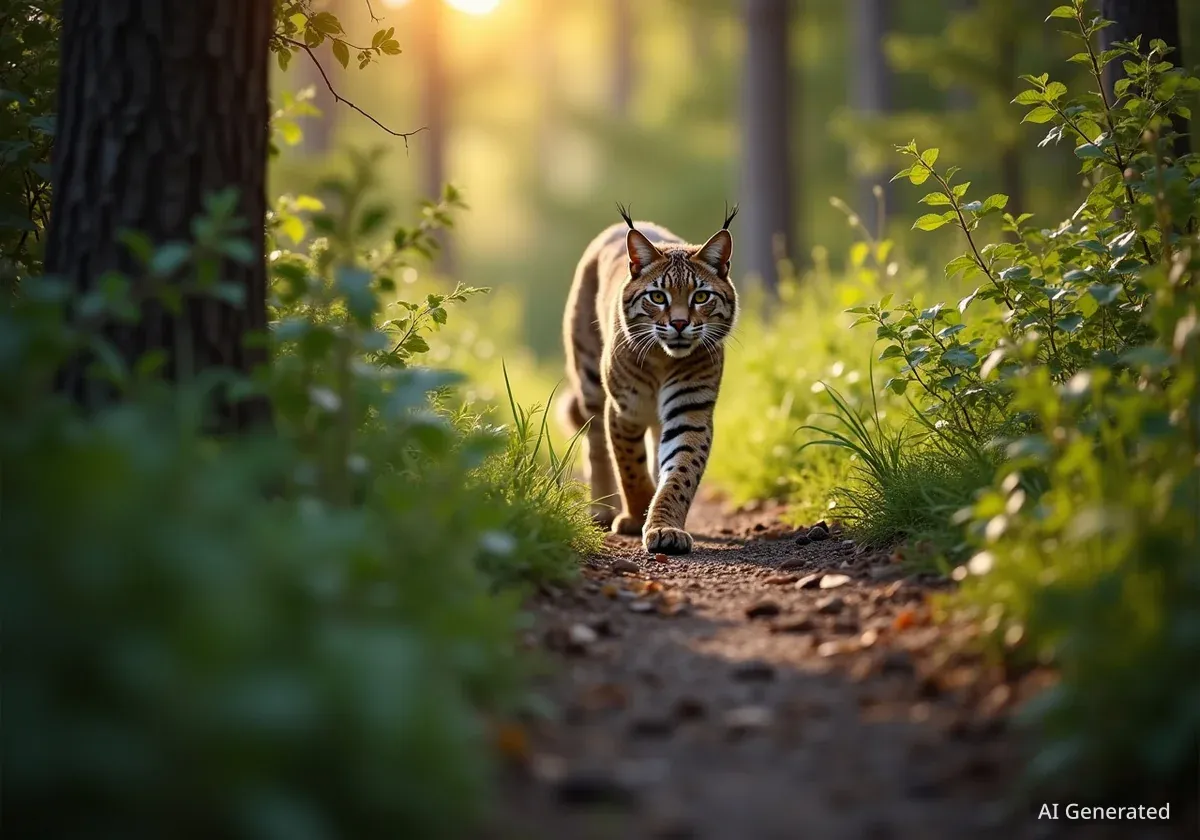


Award-winning wildlife photographer Steve Winter has successfully documented elusive bobcats in New Jersey, providing rare insights into these wildcats. His work includes sharp, high-resolution images of bobcats in their natural habitats, even under challenging conditions such as nighttime and snow. One of his photographs, featuring a bobcat kitten, is featured on the cover of the 2025 / Issue 3 of Nature Conservancy Magazine.
Key Takeaways
- Steve Winter used wireless photo traps to capture bobcats in New Jersey.
- Bobcats were reintroduced to New Jersey after vanishing 50 years ago.
- The Nature Conservancy's Johnsonburg Swamp Preserve is a key habitat for bobcats.
- Winter's photographic methods involved specialized camera traps and lenses.
- Bobcats are cultural symbols representing persistence and independence.
Documenting New Jersey's Wild Bobcats
Steve Winter, a photojournalist known for his work with big cats, focused his recent efforts on the bobcat population in New Jersey. These animals are notoriously difficult to photograph. They are stealthy, avoid human contact, blend seamlessly into their surroundings, and move with remarkable speed and agility. Winter's dedication allowed him to overcome these challenges, resulting in a collection of striking images.
His project took place at The Nature Conservancy’s Johnsonburg Swamp Preserve, located approximately 60 miles northwest of New York City. This preserve, spanning over 700 acres, serves as a vital sanctuary within what is known as "Bobcat Alley." This corridor of protected land is being developed by The Nature Conservancy and its partners in northwestern New Jersey to link critical migratory habitats.
"50 years ago," Nature Conservancy Magazine reported, "bobcats vanished from the State of New Jersey. Wildlife scientists reintroduced them, but to survive a changing climate and increasing urbanization, these felines will need more room to roam."
Bobcat Reintroduction in New Jersey
Bobcats (Lynx rufus) disappeared from New Jersey decades ago due to habitat loss and other factors. Conservation efforts led to their reintroduction. Today, these animals face ongoing threats from climate change and urban expansion. The creation of protected corridors like "Bobcat Alley" is crucial for their long-term survival and ability to adapt to environmental changes.
Innovative Photography Techniques
To photograph the elusive bobcats, Winter employed specialized equipment and techniques. He set up wireless camera traps along narrow pathways frequented by the animals. These traps were equipped with ultra-wide 10-24mm lenses and housed in weatherproof casings to protect against the elements.
The camera systems were designed to trigger five-frame bursts when a bobcat broke an infrared beam. Flash units were used to control the aperture, ensuring well-lit, sharp images even in low-light conditions. This method allowed Winter to capture intimate moments without direct human interference, which is essential for documenting such shy creatures.
Challenges of Wildlife Photography
- Elusiveness: Bobcats are naturally secretive and avoid humans.
- Camouflage: Their fur helps them blend into forests and snowy landscapes.
- Speed and Agility: Capturing clear images of fast-moving animals is difficult.
- Weather: Rain can limit animal movement and affect equipment.
- Technical Issues: Wireless equipment can be unpredictable in remote areas.
The Patience Required for Bobcat Photography
Winter described the project as taking "longer than I thought," noting that bobcats are "a bit skittish." Weather, apart from heavy rain, did not significantly impact the bobcats' movements. He observed that the camera flash would sometimes cause bobcats to pause briefly before continuing on their way. Younger, sub-adult bobcats occasionally showed curiosity, stopping to sniff the camera boxes.
Despite decades of experience and numerous international awards, Winter still encounters technical difficulties. He referred to wireless equipment malfunctions as "voodoo." His persistent efforts have yielded significant results, providing valuable visual documentation for conservationists and wildlife officials. These photographs highlight the bobcat species' recovery and its natural beauty in the wild.
Steve Winter's Distinguished Career
Born in Indiana, Steve Winter began his career at the Black Star agency before transitioning to nature photography. For over 30 years, he has been a contributing photographer for National Geographic Magazine. He specializes in documenting big cats around the world.
Winter has received widespread recognition for his work. He was named BBC Wildlife Photographer of the Year and BBC Wildlife Photojournalist of the Year. He also received top nature story honors from World Press Photo. Additionally, Winter is a two-time winner of Picture of the Year International’s Global Vision Award. In 2022, he established Big Cat Voices, an initiative dedicated to advocating for large felines.
Winter states, "My contribution is through storytelling: photos, magazine articles, and documentary films." He hopes his work will inspire audiences to support the protection of big cats globally.
Bobcats as Cultural Symbols
Beyond their ecological importance, bobcats hold symbolic meaning in various cultures. In Native American traditions, the bobcat often represents qualities such as persistence, independence, and clear vision. However, they can also symbolize greed or selfishness in some narratives.
In contemporary culture, bobcats serve as mascots for several sports teams, including Texas State University and Ohio University. Alex Snyder, the senior photo editor at The Nature Conservancy, is a graduate of Ohio University’s School of Visual Communication. Snyder expressed enthusiasm for the project, stating, "I jumped at the chance to work on a story about bobcats."
Bobcat Alley: A Crucial Corridor
"Bobcat Alley" is a term used by The Nature Conservancy to describe a vital corridor of protected land in northwestern New Jersey. This area connects critical migratory habitats between the Kittatinny and Highlands mountains, which are subranges of the Appalachian Mountains. This greenway allows iconic mammals like black bears, red foxes, and state-endangered bobcats to thrive and move safely.
The Enduring Allure for Wildlife Photographers
The challenge of photographing bobcats attracts many wildlife photographers. While bobcats sometimes appear in casual trail camera footage, obtaining sharp, in-focus images is much rarer. Randy Robbins, a California-based wildlife photographer, recounted his three-year effort to capture a bobcat image, finally succeeding with an infrared-triggered camera trap.
Sarah Killingsworth, a wildlife conservation photographer and filmmaker from Marin County, California, highlights the adaptability of bobcats. She notes that bobcats live throughout the Bay Area, adapting to increasingly urban environments due to development.
Killingsworth told Bay Nature in 2021, "Bobcats are without question my favorite species to watch and photograph. That passion has led me to observe the same bobcats over years, including a truly special mother who has raised multiple litters of kittens in a suburban environment."
She captured an image of bobcat kittens on a fence and tree limb in a suburban setting by using a long lens from across the street. This demonstrates the patience required to document these animals, often waiting for them to appear and behave naturally. Such dedication is key to revealing the lives of these often-unseen predators.