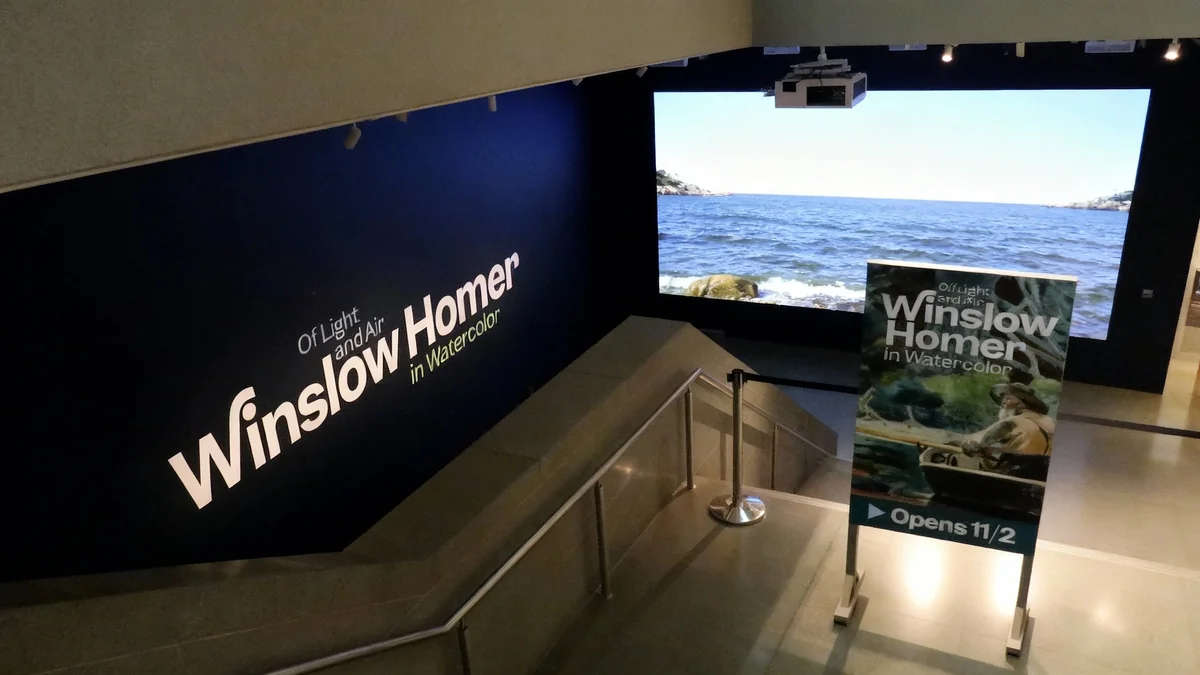
The Museum of Fine Arts, Boston (MFA), is currently hosting a major exhibition dedicated to the renowned New England painter Winslow Homer. Titled “Of Light and Air: Winslow Homer in Watercolor,” this rare display features a comprehensive collection of his watercolors, oil paintings, and sketches, some of which have not been seen in public for nearly five decades. The exhibition opened on November 2 and will run until January 19, 2026.
Key Takeaways
- Rare exhibition of Winslow Homer's watercolors at MFA Boston.
- Showcases Homer's artistic journey from youth to old age.
- Features delicate watercolors, some rarely exhibited due to light sensitivity.
- Includes interactive elements to reveal hidden details in Homer's work.
- Exhibition runs until January 19, 2026, then moves to Houston in 2027.
A Deep Dive into Homer's Legacy
Winslow Homer, born in Boston and raised in Cambridge, became famous for his landscape and maritime paintings. His connection to New England is strong, but his travels also took him to Florida, the Caribbean, and England, influencing his diverse body of work. The MFA holds a significant collection of Homer's art, largely due to his local popularity during his lifetime.
The current exhibition draws primarily from the MFA's own extensive holdings. It also includes select loans from institutions like Maine's Bowdoin College Museum of Art and the Portland Museum of Art. These loans sometimes include personal items, such as Homer's paint palette and brushes, offering a tangible connection to the artist.
Did You Know?
The MFA's earliest acquisition of a Winslow Homer piece was the oil painting "The Fog Warning" in 1894, considered contemporary art at the time.
The Fragility of Watercolor Masterpieces
Many of Homer’s watercolors are particularly sensitive to light. This inherent fragility means they are rarely displayed for extended periods. Special measures have been implemented within the exhibition galleries to minimize light exposure, including a strict prohibition on flash photography.
Christina Michelon, one of the exhibition's co-curators, explained that the museum had been planning this extensive display for years. They waited for the right opportunity to bring together such a vast collection of Homer’s works, allowing visitors to appreciate his artistic evolution across different life stages and seasons depicted in his art.
"What’s really interesting to us was the fact that he is using watercolor almost like oil painting," Michelon stated, highlighting Homer's experimental approach during the peak of his career.
Exploring Homer's Artistic Journey
The exhibition is organized into six distinct rooms, each focusing on a different aspect of Homer's career. Located on the museum’s basement level within the Anne and Graham Gund Gallery, the journey begins with "Origins." This section explores Homer's early life, his Boston roots, and the influence of his mother, Henrietta, whose own artworks are also on display.
Visitors can see Homer's early drawings and prints from his time as a young illustrator. These include journalistic sketches from his experiences on the frontlines of the American Civil War. This initial section provides crucial context for understanding his later artistic development.
From Atlantic Shores to the North Woods
Subsequent galleries delve into specific themes in Homer's work. A dedicated room, "Atlantic Shores," showcases his iconic seascapes, capturing the raw power and beauty of the ocean. This is followed by a gallery focusing on his art from "The North Woods," depicting rugged landscapes and outdoor life.
Visitors will recognize familiar New England locales in his paintings, such as Gloucester and Manchester-by-the-Sea. His later works often feature Prouts Neck in Scarborough, Maine, where he spent his final years and maintained a home and artist’s studio. These settings were crucial to his artistic output.
Homer's Connection to New England
Winslow Homer (1836–1910) was born in Boston, Massachusetts, and raised in Cambridge. He later resided in Belmont, further cementing his deep ties to the region. His final years were spent in Prouts Neck, Maine, a location that heavily influenced his late maritime works.
Uncovering Hidden Details with Interactive Displays
One engaging feature of the exhibition is an interactive element. It uses facsimiles to demonstrate what Homer’s watercolors look like underneath their mats. The mat is the border that frames the artwork, often obscuring the edges.
Michelon explained that lifting a mat can reveal much about the artist’s process. This includes changes they made, notes they added, and even evidence of color loss over time. This interactive display helps visitors understand the challenges of preserving delicate watercolors and how colors can fade.
- Examine Brushstrokes: Michelon encourages guests to look closely for intricate details.
- Compare Mediums: The exhibition places watercolors next to oil paintings and drawings.
- See Fading Effects: Interactive elements show how colors change over decades.
The MFA has been fortunate in preserving much of the vibrancy of its nearly 50 Homer watercolors, many of which came into its possession early. However, Michelon acknowledges that some pieces have lost color. This fact is important for understanding Homer’s original artistic intentions.
She cited an example, the watercolor "Clamming." When framed, it appears to depict an overcast afternoon. However, lifting the mat reveals a "riotous pinkish sky," suggesting an early morning or dusk setting. This transformation highlights the impact of light and time on the artworks.
A Lasting Impression
As visitors exit the exhibition, they have the opportunity to engage with a life-size cutout of Homer’s "The Blue Boat." This popular watercolor, frequently featured in MFA branding, is recreated for photo opportunities, complete with oars and a watercolor-dappled backdrop.
This "once-in-a-generation" exhibition requires timed-entry tickets, which can be reserved online or purchased at the museum. The MFA operates six days a week, closed on Tuesdays. Adult admission is typically $30, with various discounts available. After its run in Boston, the exhibition will travel to the Museum of Fine Arts, Houston, from June 13 to September 19, 2027.