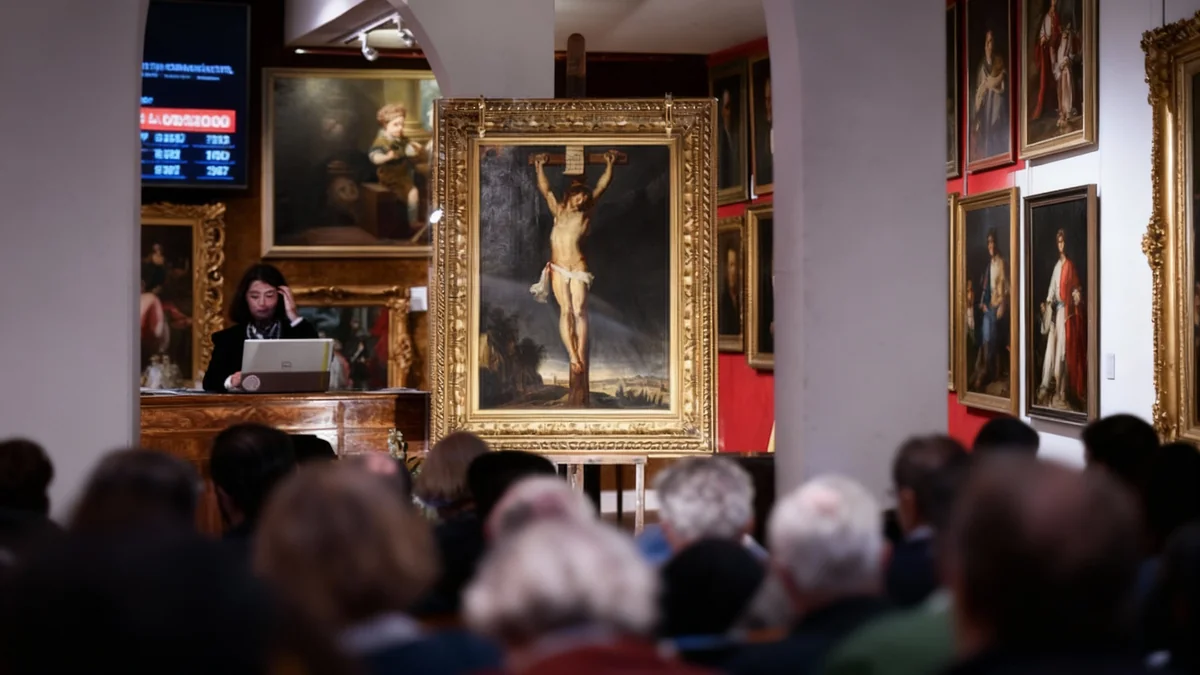

A long-lost painting by the Flemish master Peter Paul Rubens, depicting Christ on the Cross, sold for almost €2.3 million at an auction in Versailles, France, on Sunday. The artwork had been discovered in a private mansion in Paris, hidden for centuries before its recent reappearance.
The sale price significantly exceeded initial expectations, highlighting the enduring value and historical importance of Rubens's work. The discovery and subsequent authentication of the painting have captivated the art world.
Key Takeaways
- Peter Paul Rubens's 'Christ on the Cross' sold for €2.3 million.
- The painting was found in a Paris mansion after being hidden for over 400 years.
- The artwork was authenticated by leading art historians through advanced analysis.
- It depicts a unique portrayal of Christ's crucifixion by Rubens.
A Masterpiece Rediscovered in Paris
Auctioneer Jean-Pierre Osenat made the remarkable discovery last year while preparing a Paris mansion for sale. He immediately recognized the potential significance of the canvas. The painting, created in 1613, portrays Jesus Christ on the cross, a recurring theme in Rubens's extensive body of work.
Mr. Osenat described the piece as "a masterpiece" from a period when the 17th-century Flemish master was "at the height of his talent." The painting measures 105.5 by 72.5 centimeters (42 by 29 inches), a size suitable for a private collection rather than a large church commission.
Interesting Fact
The total price, including buyer's premium and fees, reached €2.94 million ($3.41 million).
Authentication and Historical Context
The journey from discovery to auction involved extensive authentication. German art historian Nils Büttner, a renowned expert on Rubens, played a crucial role in verifying the painting's authenticity. His research confirmed it was indeed a genuine work by the baroque master.
The auction house also confirmed its provenance through scientific methods. These included detailed X-ray imaging and pigment analysis. Such techniques help trace the painting's history and confirm its age and materials.
"It’s the very beginning of baroque painting, depicting a crucified Christ, isolated, luminous and standing out vividly against a dark and threatening sky," Jean-Pierre Osenat stated, emphasizing the painting's artistic significance.
Unique Depiction of Christ
Nils Büttner highlighted a unique aspect of this particular crucifixion painting. Rubens often depicted crucifixions, but rarely showed "the crucified Christ as a dead body on the cross." This specific artwork, according to Büttner, is singular in its portrayal.
"So this is the one and only painting showing blood and water coming out of the side wound of Christ, and this is something that Rubens only painted once," Büttner explained before the auction. This detail makes the painting a significant addition to Rubens's known works.
The Painting's Mysterious Journey
Very little was known about the painting's history until its recent rediscovery. Historical records only show that a contemporary of Rubens had created an engraving of it. Later historians cataloged the existence of this engraving, and through it, the painting, even though they had not seen the original.
According to the auction house, the painting was acquired by 19th-century French academic painter William-Adolphe Bouguereau. It then remained within his family for generations, passing down through inheritance, which explains its long disappearance from public view.
Background on Peter Paul Rubens
Peter Paul Rubens (1577–1640) was a Flemish artist regarded as the most influential artist of the Flemish Baroque tradition. He is known for his Counter-Reformation altarpieces, portraits, landscapes, and historical paintings of mythological and allegorical subjects. He ran a large studio in Antwerp and produced a vast number of works for a diverse international clientele, including European royalty and nobility.
Impact on the Art Market
The sale of 'Christ on the Cross' for €2.3 million demonstrates the strong demand for works by Old Masters, especially those with a compelling discovery story. The pre-sale estimate for the painting was between €1 million and €2 million, which the final bid surpassed comfortably.
Such sales not only bring significant financial returns but also reignite interest in classical art. They often lead to further research into an artist's oeuvre and historical context. The art market continues to see robust activity for rare and authenticated pieces from celebrated artists.
Art Market Trends
- Old Masters' Appeal: Works by historical artists continue to command high prices.
- Provenance Matters: A clear, authenticated history significantly boosts a painting's value.
- Discovery Stories: Unearthing 'lost' masterpieces generates immense public and collector interest.
- Scientific Analysis: Modern techniques like X-ray and pigment analysis are crucial for authentication.
The rediscovery and successful auction of Rubens's 'Christ on the Cross' serve as a reminder of the many artistic treasures that may still lie hidden, waiting to be brought back into the light of appreciation.