
November brings a wave of captivating art and design exhibitions across the globe, offering diverse perspectives on creativity, culture, and our relationship with the world. From monumental sculptures to architectural retrospectives and explorations of ecological themes, these shows invite audiences to engage with groundbreaking works and influential ideas.
Key Takeaways
- Global art scene features major retrospectives and innovative installations.
- Exhibitions explore themes ranging from pop culture and social contributions to ecology and material transformation.
- Notable shows include KAWS: FAMILY in San Francisco, Shigeru Ban in Kraków, and Gerhard Richter in Paris.
- Design takes center stage with a focus on Italian radical design and influential maestros.
KAWS: A Family Affair in San Francisco
The SFMOMA in San Francisco hosts KAWS: FAMILY, the artist's first major museum exhibition on the West Coast. This show spans three decades of KAWS's work, highlighting his ability to connect with shared human emotions and collective culture. Visitors can explore a wide range of his creations, including paintings, drawings, and sculptures.
At the heart of the exhibition stands FAMILY (2021), a monumental bronze sculpture that brings together KAWS's well-known characters. These figures display gestures of tenderness and fragility, reflecting universal experiences of care and connection. KAWS reinterprets familiar animated icons, transforming nostalgia into a space for reflection, empathy, and shared cultural memory.
Exhibition Detail
- Artist: KAWS
- Location: SFMOMA, San Francisco, USA
- Dates: November 15th, 2025 — May 3rd, 2026
Meriem Bennani's 'Sole Crushing' in Paris
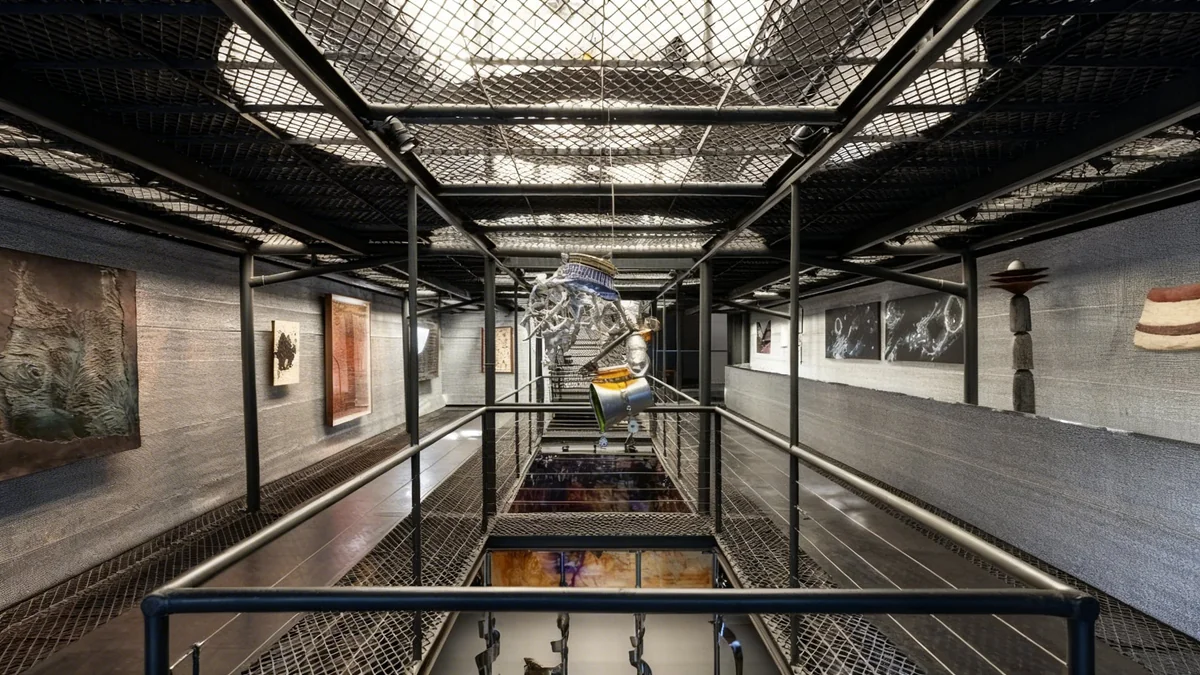
Lafayette Anticipations in Paris features Meriem Bennani's solo exhibition, Sole Crushing. Bennani transforms the Fondation into a resonant instrument with a multi-floor sound installation. Over two hundred flip-flops create a composition that blends orchestral harmony with the energy of collective noise.
As the flip-flops strike surrounding surfaces, they evoke the pulse of crowds, reminiscent of protests, stadiums, or traditional gatherings like dakka marrakchia. This simple, familiar sound becomes a meditation on community and individuality. The exhibition, reimagined from its 2024–25 presentation at Fondazione Prada, includes a new soundtrack by Reda Senhaji (Cheb Runner) and a site-specific design tailored to Lafayette Anticipations' architecture.
"The sound of hundreds of flip-flops creates a unique, immersive experience that speaks to both individual and collective human rhythms." — A visitor to the exhibition.
Shigeru Ban: Architecture with Social Purpose in Kraków
The Manggha Museum of Japanese Art and Technology in Kraków presents an exhibition dedicated to Pritzker Prize-winning architect Shigeru Ban. This show, spanning two floors, highlights Ban's innovative use of materials, particularly wood and cardboard.
The exhibition traces Ban's work across various contexts, from private homes and corporate buildings to public institutions and humanitarian projects. His designs often respond to crises like earthquakes and wars. Original models from Japan, France, and Ukraine, along with reconstructions, drawings, and photographs, illustrate Ban's balance of structural experimentation, spatial clarity, and social commitment.
Architectural Innovation
Shigeru Ban is renowned for his disaster relief architecture, utilizing readily available and often unconventional materials to create dignified and safe shelters for communities affected by natural disasters.
Paola Pivi's Imaginative World in Perth
At the Art Gallery of Western Australia (AGWA), Paola Pivi — I Don’t Like It, I Love It transforms the Brutalist spaces into a vivid, imaginative world. Pivi is known for her surreal scenarios, such as feathered polar bears and zebras in snow, which explore themes of coexistence, empathy, and environmental fragility.
The exhibition features new commissions, including a giant inflatable comic cell created with Big Nate creator Lincoln Peirce, three new polar bears, and a rooftop installation of suspended trays filled with colored liquid that interacts with light and space. Pivi combines joy with reflection, inviting viewers to experience art as a space for connection and wonder.
Galerie Philia Celebrates a Decade with 'STRATES'
To mark its tenth anniversary, Galerie Philia presents STRATES, a major exhibition across two brutalist landmarks in Noisy-le-Grand, Paris. These include Jacques Kalisz’s Mont d’Est parking structure and Ricardo Bofill’s Espaces Abraxas. The exhibition gathers one emblematic work from each Philia artist, showcasing a decade of dialogue between art, design, and architecture.
Set within the sculptural concrete spirals of Kalisz and the theatrical facades of Bofill, STRATES explores how memory and projection shape both objects and places. The project also activates Mont d’Est’s evolving public realm through installations and workshops with artists, extending Philia’s commitment to architecture as context and community as medium.
Did You Know?
Ricardo Bofill's Espaces Abraxas is a striking example of postmodern architecture, known for its monumental scale and theatrical design elements.
Wes Anderson: The Archives in London
The Design Museum in London offers rare access to Wes Anderson’s personal archives, revealing over thirty years of the filmmaker’s creative world. This landmark exhibition, the first of its kind in Britain, features more than 600 objects. These include storyboards, polaroids, puppets, costumes, and miniature sets, tracing the evolution of Anderson’s craft and collaborations.
Visitors can explore highlights such as the pink model of The Grand Budapest Hotel, vending machines from Asteroid City, Margot Tenenbaum’s FENDI fur coat, and the stop-motion puppets from Fantastic Mr. Fox. These artifacts illuminate Anderson’s devotion to detail and design, demonstrating how his handmade sensibility and visual precision have shaped a whimsical and deeply human cinematic universe.
Juergen Teller: 'you are invited' in Athens
The Onassis Foundation’s new Athens space hosts Juergen Teller: you are invited, a wide-ranging view of Teller’s evolving photographic practice. The exhibition brings together photographs, videos, and new, previously unseen images from the 1990s to today. It traces Teller’s distinctive blend of intimacy and irony across portraits, still lifes, and personal scenes.
Alongside his iconic images of figures like Iggy Pop and Kate Moss, the show reflects a deepened emotional register shaped by recent experiences. These include photographing Pope Francis at a women’s prison and documenting Auschwitz’s 80th liberation anniversary. Balancing humor and gravity, Teller’s work explores faith and fragility with an openness that is both personal and universal.
Learning from Design Maestros in Tokyo
21_21 DESIGN SIGHT presents Learning from Design Maestros, an exhibition directed by Noriko Kawakami and Kaoru Tashiro. This show reflects on six visionary figures whose ideas continue to shape how we think about design and life: Bruno Munari, Max Bill, Achille Castiglioni, Otl Aicher, Enzo Mari, and Dieter Rams.
Through films, archival materials, and key works, the exhibition reveals how these designers fused creativity, teaching, and social awareness to redefine their disciplines. It also highlights the perspective of Shutaro Mukai, whose friendships with Bill and Aicher helped establish Japan’s Science of Design. By revisiting these masters’ lessons, the exhibition invites visitors to consider how design remains a vital means of understanding and shaping the world.
Jeff Koons: Porcelain Series in New York
Gagosian presents Porcelain Series, an exhibition of new sculptures and paintings by Jeff Koons. This is the first show dedicated entirely to this body of work. Koons draws on imagery from the everyday to the mythological, transforming familiar forms into radiant, reflective icons that explore beauty, desire, and cultural memory.
His mirror-polished stainless-steel sculptures, crafted through advanced digital and mechanical processes, invite viewers into their gleaming surfaces, blurring the line between object and observer. The accompanying paintings layer natural landscapes, gestural brushwork, and metallic leafing with motifs from art history, creating luminous compositions that bridge centuries of visual tradition. Across both mediums, Koons reflects on humanity’s enduring pursuit of transcendence through art.
Aston Martin's Legacy at Petersen Automotive Museum
The Petersen Automotive Museum in Los Angeles opens Performance and Prestige: A History of Aston Martin. This new exhibition traces the British company’s evolution from its 1913 origins. Installed in the Meyers Gallery, the presentation gathers more than a dozen vehicles that embody the changing language of speed and craftsmanship defining Aston Martin for over a century.
This Aston Martin exhibition is the first in the museum’s history. The collection of models is organized to convey the shifting priorities of automotive design, from the pragmatic, streamlined sculpting of post-war racing prototypes to the expressive surfaces of contemporary hypercars.
Gerhard Richter Retrospective at Fondation Louis Vuitton
Fondation Louis Vuitton presents a sweeping retrospective dedicated to Gerhard Richter, one of the most influential artists of the past century. Bringing together 275 works spanning more than six decades, the exhibition offers an unparalleled view of Richter’s practice. It includes early photo-based paintings, his final abstractions, glass and steel sculptures, and overpainted photographs.
Tracing his lifelong engagement with both image and material, the exhibition reveals how Richter continually redefined painting’s possibilities, filtering reality through photography, memory, and abstraction. Organized chronologically, it highlights the artist’s restless experimentation and his enduring fascination with perception, history, and the act of making. This presentation stands as the most comprehensive exploration to date of Richter’s vision.
'FUNGI: Anarchist Designers' Challenges Perspectives
FUNGI: Anarchist Designers reimagines mushrooms not as materials for human use but as autonomous collaborators in shaping the world. Curated by anthropologist Anna Tsing and architect-artist Feifei Zhou, the exhibition at Rotterdam’s Nieuwe Instituut challenges human-centered narratives of 'sustainable design.'
It positions fungi as unruly co-designers that flourish in the margins and ruins of capitalism. Through installations, sculptures, sound, and multimedia works, many created with scientists, the exhibition explores how fungi connect species, environments, and economies. It rejects polished notions of eco-innovation, embracing decay and unpredictability as creative forces, and invites visitors to reconsider design as a shared, anarchic process among humans and other living beings.
Ruth Asawa: A Retrospective at MoMA
The Museum of Modern Art (MoMA) in New York celebrates Ruth Asawa’s six-decade career with Ruth Asawa: A Retrospective. Asawa once stated, "I’m not so interested in the expression of something. I’m more interested in what the material can do." The exhibition gathers nearly 300 works across mediums, including wire and bronze sculptures, drawings, and prints.
From her early studies at Black Mountain College to her San Francisco studio, Asawa explored the possibilities of humble materials like paper and wire, creating forms that merge abstraction and representation. Deeply committed to community and arts education, she saw creativity in every act. This retrospective honors her vision, inviting viewers to experience the quiet radicalism of an artist who found infinite variation in the simplest of means.
'Alchimia: The Revolution of Italian Design' in Milan
Alchimia. The Revolution of Italian Design is the first comprehensive retrospective devoted to the Milanese collective founded by Alessandro and Adriana Guerriero in 1976. Following its debut in Berlin, the exhibition returns to Milan in an expanded form with a new display conceived by Alessandro Guerriero himself.
This poetic 'carpet-raft' invites visitors into the group’s imaginative, utopian world. Active until 1992, Alchimia emerged during a time of social transformation, fusing design, architecture, art, fashion, and performance into a free-spirited laboratory of experimentation. Rejecting the constraints of functionalism through their concept of 'banal design,' the collective reasserted design’s emotional and symbolic potential. Featuring over 150 works, the exhibition traces Alchimia’s radical redefinition of design as a space for irony, storytelling, and visionary thought.
Cerith Wyn Evans: 'Forms in Space…' in Lisbon
MAAT: Museum of Art, Architecture and Technology in Lisbon presents Forms in Space… by Light (in Time), a monumental installation by Cerith Wyn Evans. This work consists of an intricate network of white neon suspended in the Oval Gallery, unfolding as both sculpture and a choreography of light, tracing rhythm and motion through space.
Joined by sound pieces, installations, and videos, the exhibition reveals the conceptual depth and sensory precision that define Wyn Evans’s practice. The Welsh artist’s work originated with experimental cinema and has expanded with influences from music, literature, and philosophy to create experiences that are cerebral and atmospheric.
Adam Pendleton: 'Who Owns Geometry Anyway?'
Friedman Benda presents Who Owns Geometry Anyway?, an exhibition by Adam Pendleton. This marks the artist’s first collaboration with the gallery and his debut exploration of furniture as form. Known for weaving together expressionism, minimalism, and conceptual rigor, Pendleton reimagines geometry as both language and structure.
Circles, squares, and triangles—recurring motifs in his paintings and sculptures—reappear here in wood, onyx, and granite, transformed into functional objects that merge precision with poetics. The works engage the surrounding architecture through painted geometric interventions, creating a total environment that blurs the line between art and design. Pendleton’s installation reflects on form, tension, and openness, suggesting that geometry, like meaning, is always contingent, shifting, and shared.
'Histories of Ecology' at MASP in São Paulo
In the year Brazil hosts COP30, MASP presents Histories of Ecology, an exhibition that broadens the idea of ecology beyond the climate crisis. It encompasses the intertwined relationships between human and more-than-human worlds. Bringing together works by 116 artists, many from the Global South, the exhibition examines how colonialism, environmental racism, and capitalism have shaped contemporary ecological realities.
It also foregrounds resilience, solidarity, and interconnectedness. Rejecting the notion of 'nature' as something separate from society, it instead proposes ecology as a living network of forces—fluid, relational, and constantly transforming. Organized into five thematic sections, Histories of Ecology traverses spiritual, territorial, and planetary dimensions, inviting viewers to imagine more inclusive ways of inhabiting the world and to see the future as a shared, collective endeavor.
Janet Echelman: 'Radical Softness' in Sarasota
Radical Softness offers an intimate view of Janet Echelman’s remarkable career, tracing her evolution from early experiments in drawing, painting, and textiles to the monumental net sculptures that have transformed cityscapes worldwide. Known for using ancient fishing-net techniques alongside advanced engineering, Echelman creates vast, floating forms that make wind, light, and motion visible.
These are poetic expressions of humanity’s connection to the natural world. The exhibition explores her use of softness as both material and philosophy, revealing how pliancy, transparency, and suspension become acts of strength and empathy. Featuring works from across four decades, alongside new cyanotypes, Radical Softness reflects on the power of art to unite people and invite stillness within the rhythms of contemporary life.