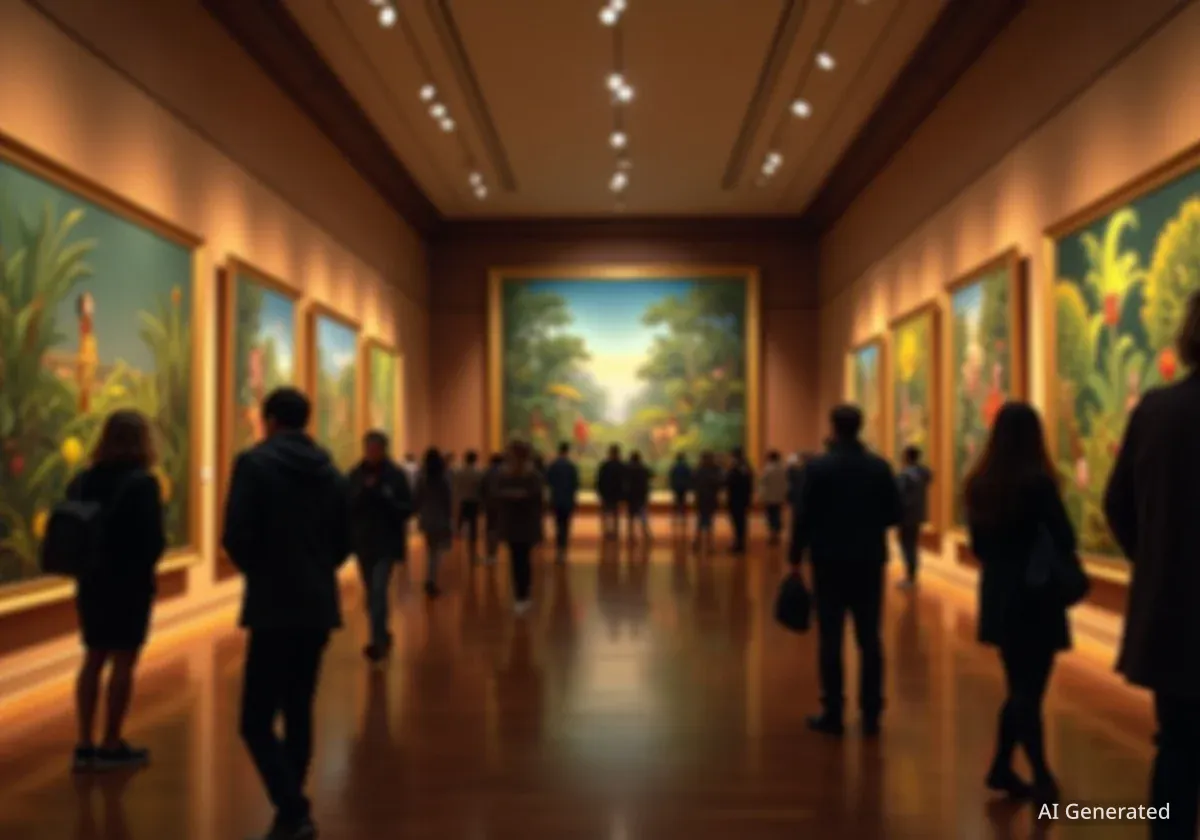
A major retrospective celebrating the works of French post-impressionist Henri Rousseau has opened at the Barnes Foundation in Philadelphia. Titled "Henri Rousseau: A Painter's Secrets," the exhibition features nearly 60 paintings from various institutions worldwide. Rousseau, a self-taught artist of the late 19th and early 20th centuries, faced ridicule and financial struggles during his lifetime. Despite these challenges, his unique vision and distinctive style have secured his place as a celebrated figure in art history, with his works now highly sought after by major museums globally.
Key Takeaways
- The Barnes Foundation is hosting "Henri Rousseau: A Painter's Secrets."
- The exhibition features almost 60 paintings from global collections.
- Rousseau was a self-taught artist who faced significant criticism and debt.
- His unique style, including jungle scenes, is now highly valued.
- The exhibition explores the hidden aspects of Rousseau's life and art.
Rousseau's Life of Struggle and Unwavering Belief
Henri Rousseau's life was marked by considerable hardship. Born in Laval, France, his family lost their home due to debt. As a young man, he worked for a lawyer and began studying law. However, he was convicted of embezzling funds from his employer. To avoid prison, he joined the army.
For most of his life, Rousseau worked as a low-level customs clerk in Paris. He retired in his 50s to dedicate himself fully to painting. Even after retirement, legal troubles continued to plague him, including unpaid debts for art supplies and a conviction for bank fraud, which led to a brief imprisonment.
"Rousseau's ambition outstripped his success in his lifetime," stated Nancy Ireson, a curator at the Barnes Foundation. "Rousseau had terrible things said about him in the press. Journalists said that he painted with his feet, with his eyes closed. They called him all sorts of things. He didn't sell his works. Yet he keeps making art. He clearly has this unshakable self-belief."
Artist Persistence
Despite harsh criticism and financial difficulties, Rousseau continued to paint. This highlights his strong belief in his artistic vision, even when public opinion was against him. His dedication eventually led to posthumous recognition.
Navigating Legal Challenges
During his trial for bank fraud, Rousseau's defense leveraged his reputation as a naive artist. Christopher Green, who co-curated the exhibition, noted that his advocate presented one of Rousseau's paintings in court. The advocate argued, "Could somebody who painted a picture like this really have known what a check was?" This strategy proved effective, resulting in a suspended sentence for Rousseau.
This incident suggests that Rousseau may have knowingly used his public image to his advantage. His perceived simplicity in art translated into a perceived lack of criminal sophistication in the courtroom. This unique defense strategy worked in his favor, allowing him to avoid a harsher penalty.
The Barnes Foundation's Extensive Collection
The Barnes Foundation holds the largest collection of Rousseau paintings in the world. This significant holding makes it an ideal venue for such a comprehensive exhibition. The Musée de l’Orangerie in Paris, which possesses the second-largest collection, collaborated with the Barnes Foundation to organize this retrospective.
The exhibition brings together almost 60 works. These pieces are on loan from various institutions globally, showcasing the widespread appreciation for Rousseau's art today. This collaboration underscores the international importance of Rousseau's legacy.
Post-Impressionism Explained
Post-Impressionism emerged in the late 19th century as a reaction against Impressionism's naturalistic depiction of light and color. Artists like Rousseau, Van Gogh, Cézanne, and Gauguin explored more subjective, symbolic, and emotional expressions through their work, using bold colors, distorted forms, and personal interpretations of reality. Rousseau's unique self-taught style stands out within this movement.
The Mysteries Within Rousseau's Canvases
The title of the exhibition, "A Painter's Secrets," refers not only to Rousseau's guarded personal life but also to the enigmatic qualities of his art. His paintings often present more questions than answers. His compositions are characterized by a flattened perspective, resembling folk art. Most figures face directly forward, with very few shown in profile.
Despite their apparent simplicity, Rousseau's works display sophisticated draftsmanship and precise brushwork. He used color in an inspired way. For example, in his famous painting "The Sleeping Gypsy," borrowed from the Museum of Modern Art in New York, a multicolored pinstriped dress is echoed by the subject's hair and the strings of a lute.
Jungle Scenes and Fantasy Elements
A significant portion of Rousseau's work features fantastical elements. His jungle paintings, which became popular later in his life, exhibit bizarre shifts in perspective and proportion. These scenes often include gigantic flowers, trees that defy botanical logic, deformed animals, and incongruous figures. One notable example depicts an American Indigenous person fighting a gorilla in what appears to be a botanical garden.
Rousseau never traveled outside France. He had no direct experience of a jungle environment. His inspiration came from local sources.
"What we do know is that Rousseau was really inspired by visits to the botanical gardens in Paris," Ireson explained. "He went often to the Jardin des Plantes, which is in the city, and there he would enter the hot houses. He really loved seeing those different species of plant."
Inspiration from Home
Rousseau's famous jungle scenes were not based on real travel. Instead, he drew inspiration from the botanical gardens and natural history museums in Paris. He would visit these places to observe exotic plants and taxidermied animals, fueling his imagination for his fantastical landscapes.
Christopher Green described Rousseau as a "story giver, not a storyteller." He noted that Rousseau provides the elements for a narrative but does not explicitly dictate its meaning. "It's very suggestive and sometimes quite ambiguous," Green added. This ambiguity invites viewers to interpret the works themselves, contributing to their lasting appeal.
Posthumous Recognition and Lasting Legacy
Rousseau's extraordinary self-belief sustained him throughout his career. He remained undeterred by criticism and lack of commercial success.
"It's just extraordinary, the chutzpah of the man. The complete refusal ever to be discouraged," Green remarked. "It can only come from a faith in what he was doing."
It took 15 years after Rousseau's death in 1910 for his talents to gain widespread recognition. This breakthrough was partly due to strategic dealmaking. Berthe "Comtesse" de Delaunay sold "The Snake Charmer" to collector Jacques Doucet. The condition of the sale was that the painting would be bequeathed to the Louvre Museum upon Doucet's death. This happened in 1925.
Once "The Snake Charmer" entered France's national collection, Rousseau's reputation was cemented for the next century. His distinctive style, once dismissed as naive, became celebrated. Today, his works are considered masterpieces, influencing generations of artists and captivating audiences worldwide.
The exhibition "Henri Rousseau: A Painter's Secrets" will remain on view until February 22, 2026. It offers a rare opportunity to explore the complex life and enduring art of a painter who forged his own path against significant odds. Visitors can see iconic works such as "The Sleeping Gypsy," "Unpleasant Surprise," and "The Snake Charmer" brought together for the first time. Other notable pieces include "Fight between a Tiger and a Buffalo" and "The Merry Jesters," which was famously used in Rousseau's defense during his fraud trial.
- Exhibition Duration: On view until February 22, 2026.
- Key Works on Display: "The Sleeping Gypsy," "Unpleasant Surprise," "The Snake Charmer."
- Influence: Rousseau's art influenced Surrealists and other avant-garde artists.
- Global Loans: Paintings from the Guggenheim Museum, MoMA, Musée d'Orsay, and more.