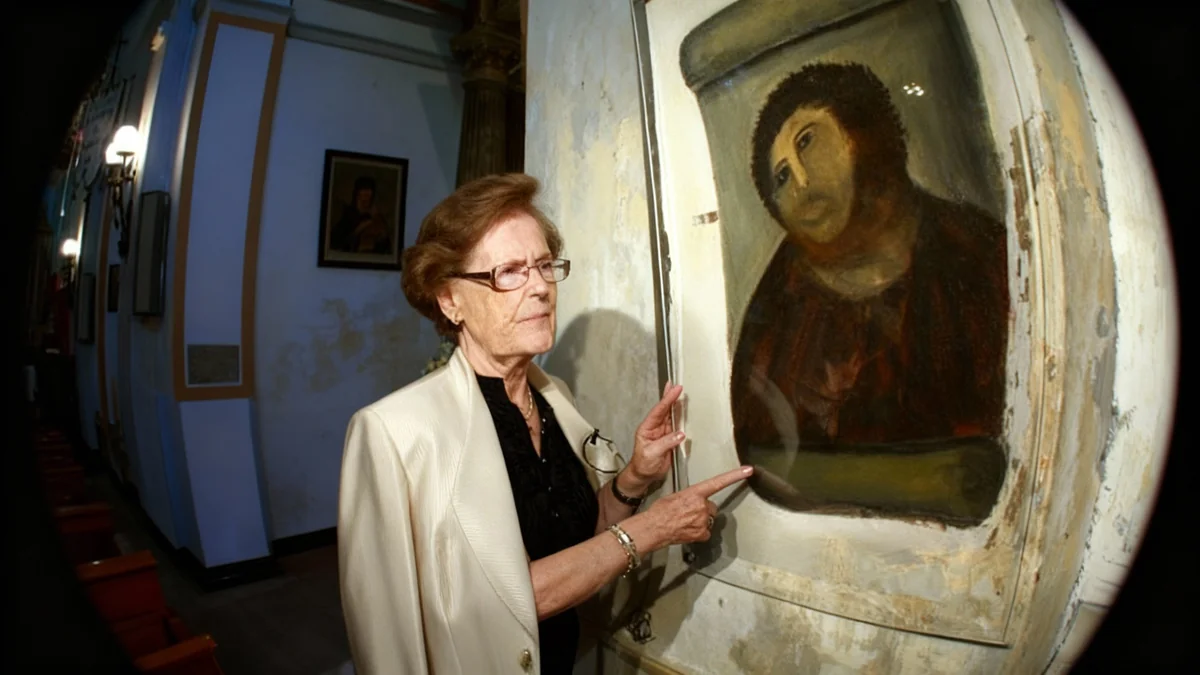


Cecilia Giménez, the Spanish woman whose amateur restoration of the 19th-century 'Ecce Homo' fresco in Borja gained her global notoriety, has passed away at the age of 94. Her well-intentioned but widely criticized work in 2012 transformed a local church mural into an international sensation, ultimately bringing unexpected tourism and economic benefits to her small town.
Key Takeaways
- Cecilia Giménez, the amateur restorer of the 'Ecce Homo' fresco, died at 94.
- Her 2012 restoration, dubbed 'Monkey Christ', became a global internet meme.
- The artwork transformed Borja, Spain, into a significant tourist destination.
- The 'restoration' has generated over €600,000 for the local community.
- Giménez's story inspired an opera and provided local employment.
From Local Church to Global Meme
In 2012, Cecilia Giménez, then an 81-year-old amateur artist, decided to take on the restoration of Elías García Martínez's 'Ecce Homo' mural. The artwork, depicting Jesus with a crown of thorns, had adorned the walls of the Santuario de Misericordia church in Borja for over a century. Giménez's efforts, however, did not go as planned.
The resulting image, which many described as resembling a 'monkey' or 'hairy potato', quickly went viral. Social media exploded with memes and jokes, turning the small Spanish town into an overnight internet phenomenon. The initial reaction was a mix of shock, ridicule, and widespread amusement.
Interesting Fact
The original 'Ecce Homo' mural was painted by Elías García Martínez, a local artist, in the 19th century. Its title translates to 'Behold the Man', words spoken by Pontius Pilate about Jesus.
The Unexpected Economic Boom for Borja
What began as a source of embarrassment for some in Borja soon transformed into a remarkable economic opportunity. Tourists, drawn by the internet buzz, began flocking to the town to see the now-famous 'Monkey Christ' firsthand. The church, initially overwhelmed, started charging a small admission fee to manage the crowds.
This steady stream of visitors has had a profound impact on Borja's economy. According to local officials, the 'Ecce Homo' phenomenon has generated more than €600,000 for the community. These funds have been crucial in supporting local services, including providing places at Borja's care home for elderly residents.
"Cecilia was a devoted mother and a fighter, a strong woman, but above all we should talk about her generosity which has won her the whole world’s affection," a statement from the local church read.
Tourism and Infrastructure Boost
The surge in tourism was so significant that airlines like Ryanair reportedly added special flights to Zaragoza, the nearest airport, to accommodate the increased demand. Today, thousands of people continue to visit Borja annually, eager to witness the unique artwork.
The fame of the mural has also created local employment. The sanctuary-museum, which houses the artwork, now employs two caretakers, a direct result of the increased visitor numbers. This unexpected lifeline has helped a small, quiet town thrive.
Giménez's Personal Journey and Legacy
Initially, the intense scrutiny and mockery took a toll on Giménez. Reports indicated she suffered from severe anxiety, losing 17 kilograms during the initial storm of publicity. However, she soon discovered an upside to her newfound notoriety.
People began showing interest in her other artistic works. She sold her paintings on eBay, generously donating the proceeds to a Catholic charity. This demonstrated her philanthropic spirit and resilience in the face of public criticism.
Background on 'Ecce Homo'
The 'Ecce Homo' fresco is not a world-renowned masterpiece but a humble piece of local religious art. Its transformation by Cecilia Giménez highlights how art, even in its most unexpected forms, can spark global conversations and have tangible local impacts.
An Opera Inspired by Her Story
The story of Cecilia Giménez and the 'Monkey Christ' even made its way to the stage. In 2023, an opera titled 'Behold the Man' (the English translation of 'Ecce Homo') premiered at Opera Las Vegas. Written by US public relations expert Andrew Flack, with music by Paul Fowler, the opera celebrated the unlikely tale.
Giménez, due to her advanced age and health, was unable to attend the premiere, but her niece represented the family on opening night. This adaptation into an opera further cemented her place in popular culture and demonstrated the profound impact of her actions.
A Lasting Homage in Borja
Eduardo Arilla, the mayor of Borja, paid tribute to Giménez, highlighting her difficult life. She was widowed at a young age and raised two disabled children, one of whom tragically died from muscular dystrophy. Arilla emphasized the positive legacy she leaves behind for Borja.
The mayor announced plans to honor Giménez by naming the 'Ecce Homo' center after her. There is also consideration for naming a street or a square in her memory. These gestures underscore the community's appreciation for the woman who, through an accidental act of artistic intervention, brought unprecedented fame and prosperity to their town.
- The 'Ecce Homo' center will be named after Cecilia Giménez.
- Local officials are considering naming a street or square in her honor.
- Her legacy is seen as a testament to her generosity and impact on Borja.
Cecilia Giménez's story is a unique blend of mishap, internet fame, and genuine community benefit. Her passing marks the end of an era for a woman who inadvertently became a global cultural icon, leaving behind a legacy that continues to draw visitors and support the town she called home.