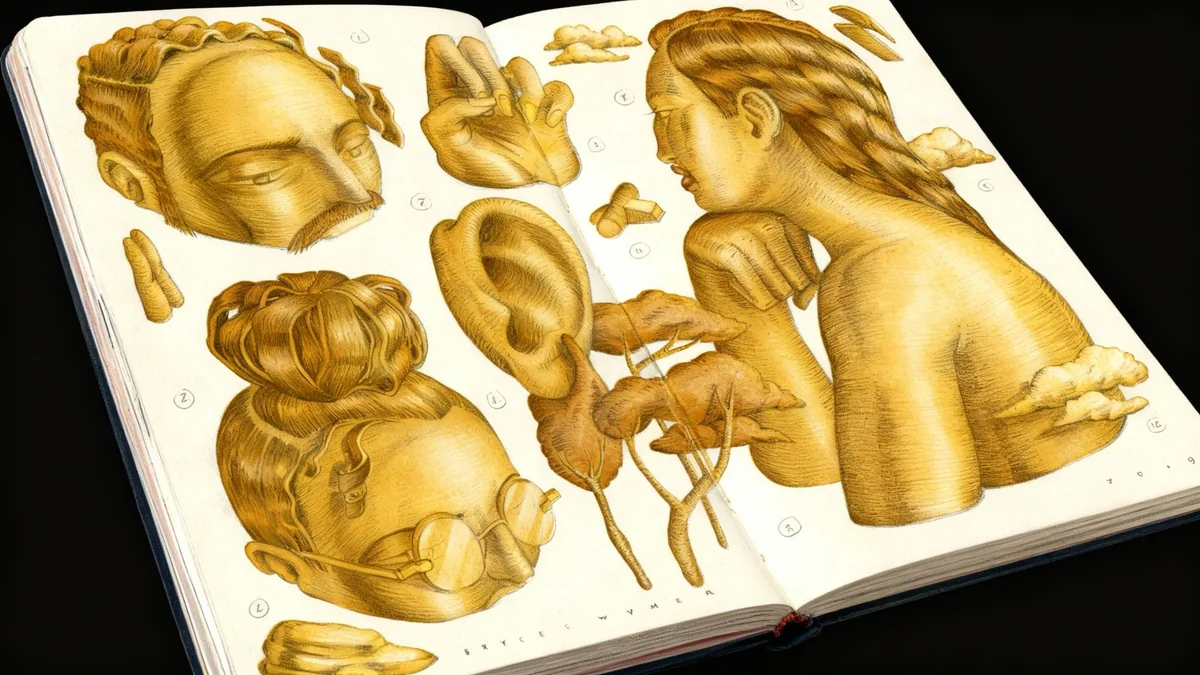
Brooklyn-based artist Bryce Wymer continues to captivate audiences with his distinctive style, blending social realism with surreal elements in his latest body of work. Known for his murals, paintings, and illustrations, Wymer's art delves into complex human interactions and power structures, often through a lens of anxiety and solitude. His sketchbooks serve as the foundational space for these evocative compositions.
Key Takeaways
- Bryce Wymer's work combines social realism and surrealism.
- Sketchbooks are central to his creative process, acting as a 'playground'.
- His art explores themes of social interaction, power, and emotional complexity.
- Figurative motifs in minimal environments highlight vulnerability and control.
- Wymer draws inspiration from Social Realism, connecting it to collective experience.
The Pivotal Role of Sketchbooks in Creative Development
For Bryce Wymer, sketchbooks are more than just notebooks; they are an essential part of his artistic identity. He has maintained this practice since middle school, initially filling pages with graffiti tags, DIY show flyer concepts, and zine layouts. Today, these books are a constant companion, providing a sense of grounding for his creative thoughts.
Wymer emphasizes the importance of carrying a sketchbook at all times. He feels 'untethered' without one, highlighting its critical role in his daily artistic exploration. This continuous engagement allows him to capture ideas as they emerge, fostering a direct connection to his immediate inspirations.
Artist's Workflow
- Wymer typically fills three to four sketchbooks each year.
- Ideas often originate in small formats before potentially scaling up.
- The transition from small sketch to large canvas presents a 'tension' he enjoys navigating.
From Concept to Canvas: Navigating Artistic Tension
The journey of an idea from a small sketchbook drawing to a larger canvas is a dynamic process for Wymer. He notes that some concepts lose their 'raw energy' when translated to a grander scale. This tension between initial spontaneity and final execution is a compelling aspect of his work.
This 'in-between space' is where an idea first takes shape and where it ultimately finds its final form. Wymer finds this phase particularly engaging, as it allows for experimentation and refinement without the pressure of immediate public display. It is a space for freedom and artistic growth.
Figurative Exploration of Emotional Complexity
Wymer's recent artistic focus has been on figurative motifs. These works delve into 'quiet tension and emotional complexity.' He places these figures within sparse, minimal environments, which serves to amplify the underlying social dynamics at play.
The figures often convey vulnerability and explore perceptions of control, or the lack thereof. This strategic placement allows the viewer to concentrate on the emotional states and interactions between the subjects, rather than being distracted by elaborate settings.
"More than anything, the sketchbook is my playground, free from expectations or fear of failure. In any artistic practice, it’s important to have a space where very few rules exist."
Understanding Social Realism
Social Realism was an art movement that gained prominence between the World Wars. It focused on depicting the lives of everyday people, often highlighting them as heroes in the face of societal or governmental adversity. Artists in this movement aimed to draw attention to social and economic conditions.
Wymer's use of flat planes of saturated color in his contemporary aesthetic is a direct nod to this historical movement. He sees Social Realism as deeply connected to collective emotional experiences, which he reinterprets through his unique visual language.
Merging Analog and Digital Techniques
Wymer's creative process seamlessly integrates both analog and digital techniques. While his initial ideas germinate in traditional sketchbooks, he often leverages digital tools to refine compositions and explore color palettes. This hybrid approach allows for both the tactile intimacy of drawing and the expansive possibilities of digital manipulation.
His distinctive use of bold hues and geometric puzzles is a hallmark of his style. These elements contribute to the enigmatic and often dreamlike quality of his narrative compositions. Mysterious light sources further enhance the sense of intrigue and contemplation within his pieces.
The Artist's Philosophy: Freedom from Failure
Wymer views his sketchbook as a personal 'playground.' This space allows him to experiment without the burden of external expectations or the fear of failure. This philosophy is crucial for any artist, providing an environment where creativity can flourish uninhibited.
The freedom to explore new ideas and take risks is what keeps his artistic practice vibrant and continuously evolving. This unconstrained approach is evident in the diverse and often surprising elements found within his emotive works.
- Wymer's art often features disjointed figures.
- His compositions are characterized by bold hues.
- Themes of anxiety, mystery, and solitude are frequently explored.
Wymer's ongoing commitment to his sketchbooks and his unique artistic vision ensures that his work remains fresh and relevant. By blending historical influences with contemporary concerns, he creates art that resonates with viewers on a deep emotional and intellectual level.
His work continues to evolve, pushing boundaries while maintaining a core focus on the human condition and the subtle complexities of social interaction. This dedication to exploration makes his artistic journey compelling to follow.