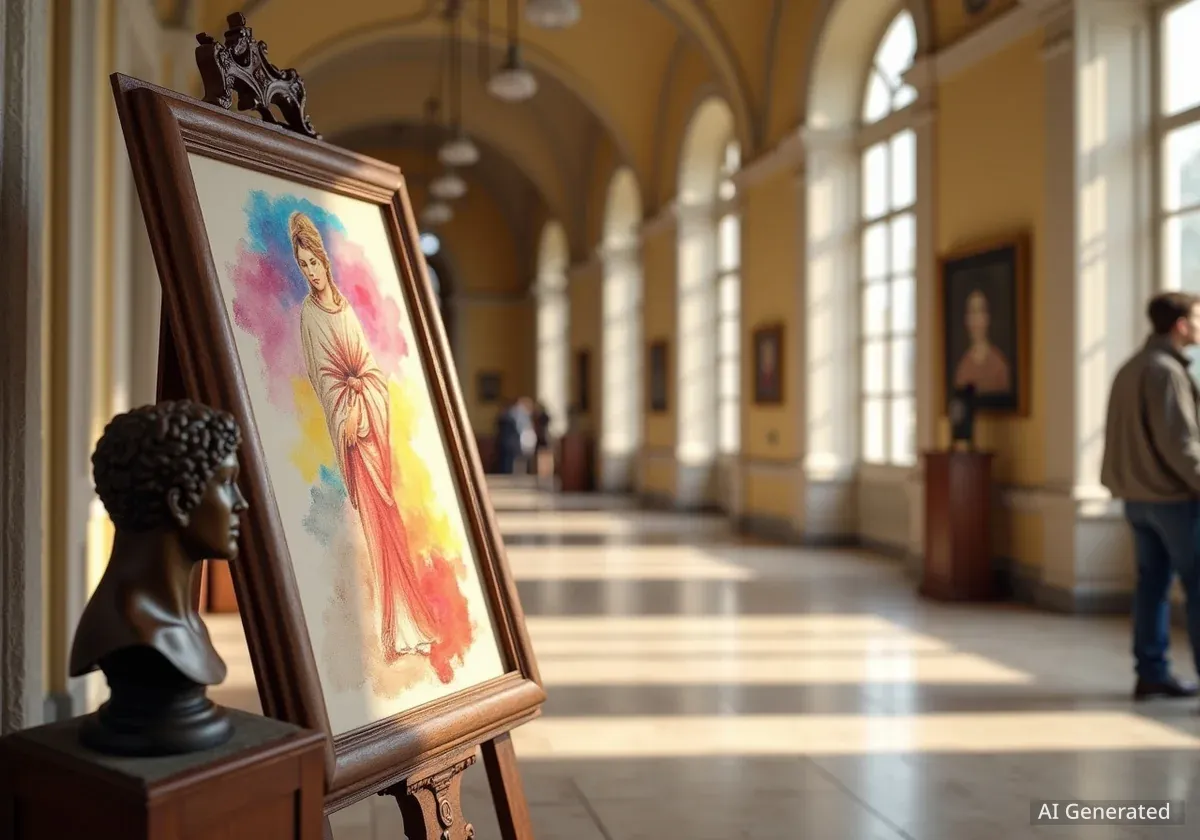
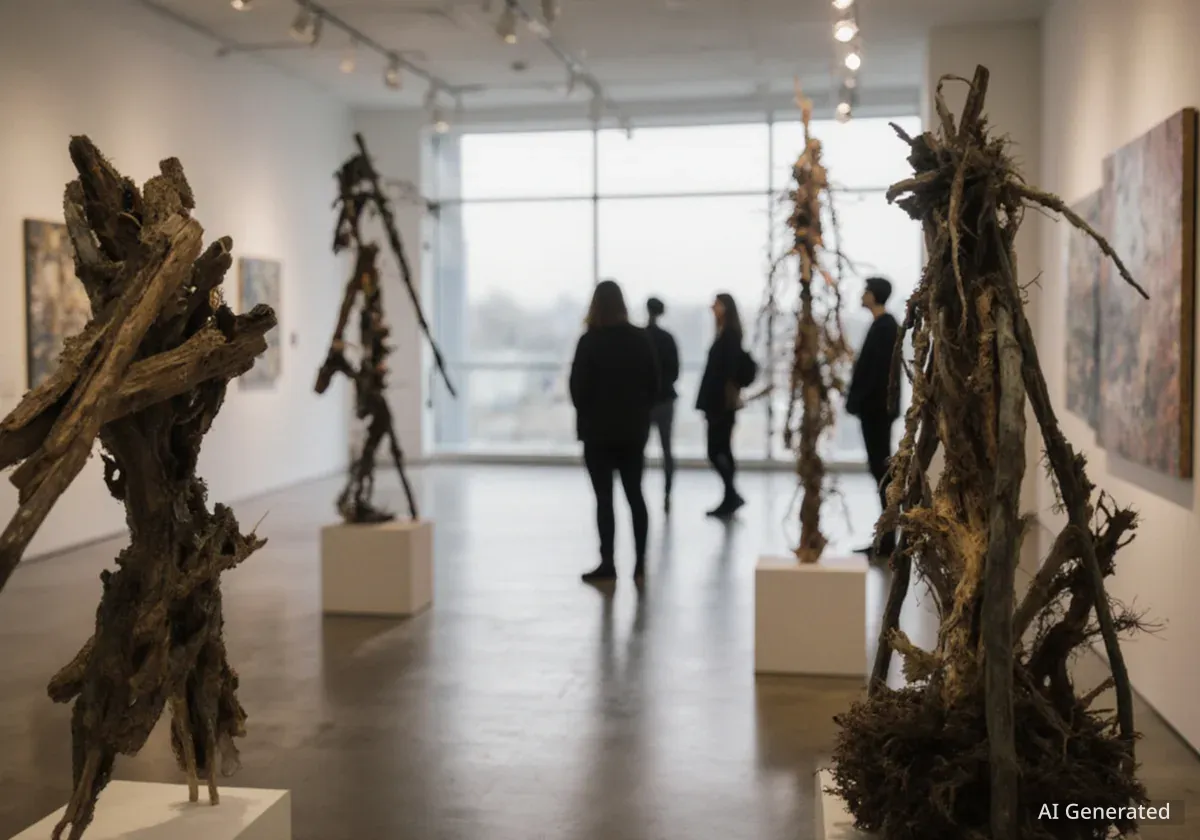
Harvard College Observatory is preparing for a unique event that will blend art and science. Artist Greg Wyatt has donated 50 stippled watercolor portraits of notable scientists and two bronze sculptures of Galileo Galilei to Professor Avi Loeb's office. This significant gift will transform Loeb's research space into an art exhibit, aiming to inspire students and researchers.
Key Takeaways
- Artist Greg Wyatt donated 50 watercolor portraits and 2 sculptures to Harvard.
- The artwork will be unveiled on November 13, 2025, at Harvard College Observatory.
- Each watercolor includes an inspiring quote from a scientific pioneer.
- The gift aims to inspire future generations in science and art.
- A new musical piece will premiere at the unveiling event.
A Fusion of Artistic Generosity and Scientific Inspiration
Greg Wyatt's donation is a substantial contribution to the Harvard College Observatory. The collection features 50 meticulously crafted stippled watercolor portraits, each depicting a distinguished scientist. Alongside these portraits are two bronze sculptures of the renowned astronomer Galileo Galilei. This generous act, according to Wyatt, was inspired by Professor Avi Loeb's scientific work.
The donated pieces are scheduled for delivery to Professor Loeb's office by the end of this week. A public unveiling ceremony is planned for November 13, 2025. This event will not only showcase the artwork but also feature a new musical composition. David Ibbett, the brilliant composer in residence, will present this piece with his ensemble, celebrating the intersection of art and science.
Interesting Fact
Greg Wyatt's donation includes 50 stippled watercolor portraits of prominent scientists and 2 bronze sculptures of Galileo Galilei. This collection will be permanently housed in Professor Avi Loeb's office at Harvard College Observatory.
The Educational Impact of Art in Science
Professor Loeb expressed deep gratitude for Wyatt's gift, noting its potential to transform his office into a unique art museum. He emphasized the educational value of the watercolors for his students and postdocs. Each portrait is paired with an inspiring insight from the featured scientific pioneer. This combination of visual art and profound wisdom serves as a constant source of motivation.
Wyatt's stippled watercolors are characterized by their composition of many small dots that harmoniously form a larger, intricate pattern. Professor Loeb draws a key lesson from this technique: the importance of ignoring noise to notice the signal in scientific research. He explains that the signal often represents anomalies in data, while noise can come from environmental factors or even colleagues resistant to unexpected ideas.
"Where the world ceases to be the scene of our personal hopes and wishes, where we face it as free beings: admiring, asking, observing, there we enter the realm of art and science."
— Albert Einstein, as quoted on one of Greg Wyatt's watercolors
Premature dismissal of anomalies can hinder scientific discovery. For example, the object 1I/`Oumuamua was widely considered a comet despite lacking evidence of gas or dust. This assumption, according to Loeb, reduced the drive to collect crucial data between November 2017 and January 2018, leaving its true nature unknown. He argues that the psychological tendency to dismiss the unusual can lead to prolonged ignorance rather than breakthroughs. Given the limited time interstellar objects spend in our solar system, utilizing all available observatories for their study is crucial. This message was central to a new White Paper submitted to the International Astronomical Union by Professor Loeb, Omer Eldadi, and Gershon Tenenbaum.
The Artist's Perspective: Crafting Stippled Watercolors
Greg Wyatt's journey into stippled watercolor portraits began at age fourteen, influenced by his father, a Professor of Painting and Art History. He was introduced to the blind contour method of drawing, which emphasizes seeing and physically experiencing form rather than just copying appearances. This method, advocated by instructor Kimon Nicolaides, trains the artist's coordination between eye, mind, and hand.
Background on Blind Contour Drawing
The blind contour method involves drawing an object's outline without looking at the paper, focusing only on the object itself. This exercise enhances visual perception and strengthens the connection between observation and drawing, prioritizing the process over a polished outcome.
Wyatt initially produced abstract images with this method. However, consistent practice sharpened his visual perception and hand-eye coordination. For stippled watercolors, artists choose between cold-pressed and hot-pressed paper. Cold-pressed paper is textured and moderately absorbent, suitable for traditional subjects. Wyatt prefers hot-pressed watercolor paper because its lower absorbency allows for slower drying times, providing more control for mixing pigments and achieving fine details, essential for anatomical forms and three-dimensional portraits.
The stippled watercolor process demands precision and patience. Artists often use a rapidograph pen, known for its fine lines, instead of a pencil. This specialized instrument allows for the placement of many small dots to build tones, textures, and forms. Artists focus on dot placement to create effects of light and shadow, moving away from traditional shading techniques. This slow, deliberate process enables artists to select pigments that enhance spatial depth around natural forms. Cool tones can suggest shaded areas, while warmer hues highlight features.
- Cool tones: Used for shaded areas.
- Warmer hues: Used to bring out highlights.
- Dot direction: Follows natural contours of the face to support anatomical forms.
Layering colors enriches the portrait. Instead of blending on a palette, artists place complementary or contrasting dots side by side. The viewer's eye then optically mixes these colors from a distance, creating a pointillistic effect. This technique adds vibrancy and texture while maintaining the crispness of individual dots. To define edges, artists vary dot size and concentration: smaller, tighter dots for sharp features like eyes and lips, and larger, more diffuse dots for softer transitions on cheeks and hair. The result is a luminous, detailed portrait that reveals its meticulous dot-by-dot craftsmanship upon closer inspection.
Historical Artistic Parallels: Pointillism and its Influence
Wyatt also admires nineteenth-century French pointillist painters like Georges Seurat and Paul Signac. Seurat's revolutionary technique involved applying small, distinct dots of pure color, relying on the viewer's eye to optically mix them. This method produced luminous, shimmering effects and subtle tonal gradations, rooted in scientific theories of color and perception.
Pointillism in Art
Pointillism, pioneered by Georges Seurat, is a painting technique where small, distinct dots of pure color are applied to a canvas. The viewer's eye blends these colors optically from a distance, creating luminous and textured effects.
Paul Signac, a key figure in pointillism's development, worked with Seurat to refine the technique into Neo-Impressionism. Signac expanded on the method, using broader, more expressive brushstrokes composed of small, distinct touches that still relied on optical blending. His vibrant, carefully arranged colors brought luminosity to his seascapes and Mediterranean views. Henri Matisse also experimented with pointillism early in his career, influenced by Signac and the Neo-Impressionists. Matisse used small, distinct strokes and dabs of pure color to capture shimmering light, but he employed the technique more freely, treating color as an emotional force rather than a purely optical effect.
Creating a stippled watercolor portrait of Galileo Galilei combines artistic technique with historical reverence. Incorporating Galileo's own quotations elevates the artwork beyond a simple likeness, turning it into a meditation on his enduring vision. For example, his quote, "All truths are easy to understand once they are discovered; the point is to discover them," resonates with the stippling process itself. Each rapidograph pen dot becomes an act of artistic patience and an echo of the artist's pursuit of discovery, binding the visual and intellectual together. By surrounding Galileo's image with his words, the portrait invites viewers to engage with his thoughts, his science, and his timeless search for truth.
Professor Avi Loeb's Journey: From Farm to Harvard
Professor Avi Loeb's personal journey, detailed in his bestselling book "Extraterrestrial," offers insight into his scientific curiosity. He grew up on a family farm in Beit Hanan, Israel, a village south of Tel Aviv. His childhood involved tending pecan, orange, and grapefruit trees, and caring for chickens. His father, David, was a skilled problem solver, maintaining farm machinery and mending appliances. Loeb recalls his father climbing onto their roof in 1969 to ensure good reception for the Apollo 11 lunar landing.
Growing up in Israel during the 1960s and 1970s meant living through periods of conflict, including the Sinai War (1956), the Six-Day War (1967), and the Yom Kippur War (1973). This environment fostered an awareness of the nation's survival depending on careful choices. The free atmosphere of the farm inspired Loeb's early writings and philosophical interests.
His grandfather, Albert, fled Nazi Germany in 1936, moving to Beit Hanan. His name was changed to David. Loeb's mother, Sara, from Haskovo, Bulgaria, survived World War II due to Bulgaria's resistance to deporting its Jewish population. She later emigrated to Israel in 1948, meeting Loeb's father in Beit Hanan. Sara, a locally renowned baker and knitter, also pursued intellectual interests, earning a PhD in comparative literature. She encouraged Loeb's curiosity and introduced him to philosophy, particularly existentialism. He dreamed of a life of thought, often reading philosophy in the quiet hills of the farm.
Loeb's path took a detour due to mandatory military service in Israel. He was selected for the Talpiot program, which combined defense research with intense military training. While wearing the Israeli Air Force uniform, he underwent various combat courses and academic studies in physics and mathematics at Hebrew University in Jerusalem. He realized that while philosophy asked fundamental questions, science offered a more direct route to answers.
From Plasma Physics to Astrophysics at Princeton and Harvard
After military service, Loeb sought a creative research path. He developed a theory for a novel scheme using electric discharge to propel projectiles, leading to a patent. This project grew into an international effort, receiving funding from the United States' Strategic Defense Initiative (SDI), also known as "Star Wars." This work formed the basis of his PhD dissertation in plasma physics, which he completed at age twenty-four.
A chance encounter with physicist Arie Zigler led Loeb to consider postgraduate work at the Institute for Advanced Study (IAS) in Princeton, New Jersey. After meeting Marshall Rosenbluth, the "pope of plasma physics," and then Freeman Dyson, Loeb was introduced to astrophysicist John Bahcall. Bahcall offered Loeb a prestigious five-year fellowship at IAS, on the condition that he study astrophysics. Loeb accepted, despite his limited knowledge of the field, then focused on terrestrial plasmas.
Bahcall's offer, a significant risk given Loeb's background, proved pivotal. Loeb quickly immersed himself in astrophysics, pioneering research on how atomic matter in the universe transformed into plasma, a state common in stars. After three years at IAS, he applied for junior faculty positions, including one at Harvard's astronomy department. He was the second choice but gladly accepted, reasoning that he could always return to his father's farm or philosophy if tenure was not granted. He arrived at Harvard in 1993 and received tenure three years later.
The Enduring Connection Between Life, Philosophy, and Science
Professor Loeb believes John Bahcall saw a kindred spirit in him, someone who also sought fundamental truths through physics and astronomy. Loeb realized that his "arranged marriage" to astrophysics had reconnected him with his original love for philosophy. Astronomy, he argues, addresses questions previously confined to philosophy and religion, such as the origins of the universe and life. Contemplating the vastness of space also provides a framework for understanding "what is a life worth living?"
His personal life also reflects this journey. A blind date in Tel Aviv in 1997 led to his marriage to Ofrit Liviatan two years later. They raised two daughters near Boston. Loeb sees a causal chain from his grandfather's escape from Germany to his own family life, suggesting a thin line between philosophy, theology, and science. He has come to appreciate science slightly more than philosophy, valuing its dialogue with nature through experiments. The success of Einstein's theory of relativity, he notes, was confirmed by empirical data, not just its elegance.
Loeb's unusual life path, marked by freedom and diverse experiences, prepared him for his scientific encounters, including the study of 'Oumuamua. He advocates for interdisciplinary approaches in academia, recognizing that without support, unique ideas can be lost. Throughout his career, he has benefited from opportunities extended by others and is committed to helping young people realize their potential, even if it means challenging conventional thinking. He believes children's honest inner compasses offer a valuable perspective in scientific exploration, leading to audacious possibilities, such as the idea that 'Oumuamua was not a naturally occurring phenomenon.
"It was not just the Church that resisted the heliocentrism of Copernicus."
— Tycho Brahe, as quoted on a Greg Wyatt watercolor