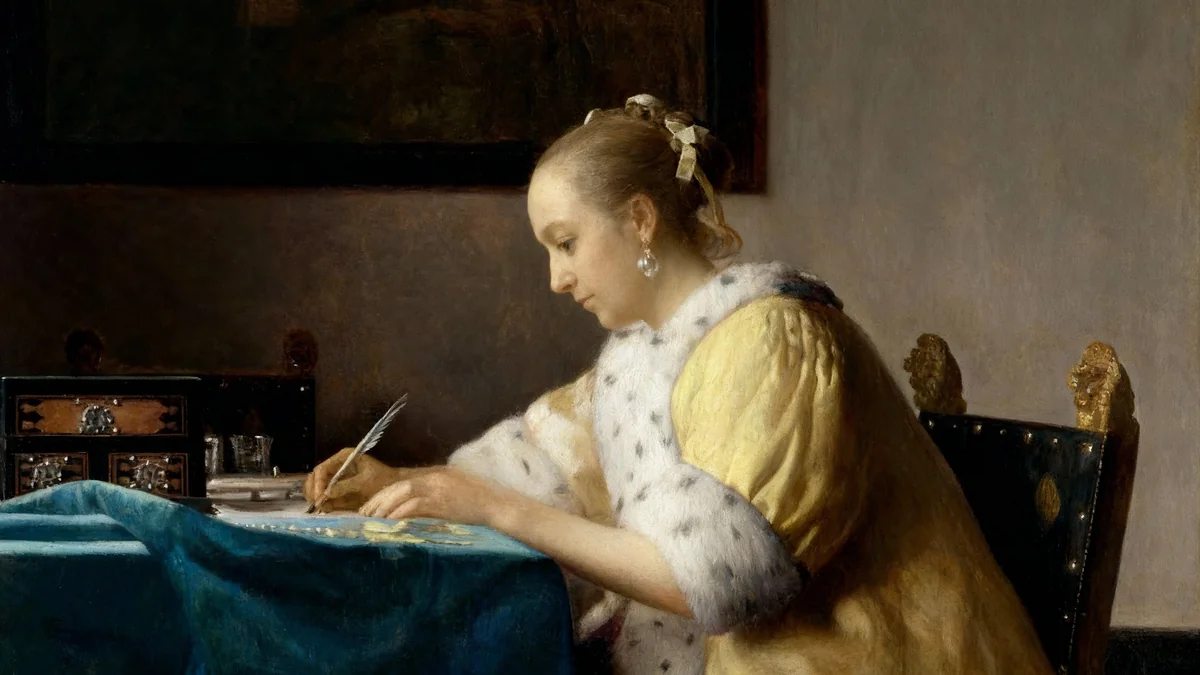


A new discovery has shed light on the intricate details within Johannes Vermeer's renowned paintings. An object previously depicted as a decorative box has been identified as a rare 17th-century Indian jewellery casket, offering fresh insights into the artist's meticulous work and the global connections of his time.
This revelation comes from Alexandra van Dongen, a curator at Rotterdam’s Boijmans Van Beuningen Museum. Her findings are detailed in an upcoming book, De tastbare wereld van Johannes Vermeer (The tangible world of Johannes Vermeer), set to be published in the Netherlands on November 20.
Key Takeaways
- An object in two Vermeer paintings is an Indo-Portuguese jewellery casket.
- The casket was made in Cochin (now Kochi), India, in the 17th century.
- It combines Indian and Portuguese design elements.
- Such caskets were expensive and rare in 17th-century Holland.
- Vermeer's patron, Maria de Knuijt, likely owned the casket.
- Another painting features a Japanese lacquer box.
Unmasking the Indo-Portuguese Casket
The specific object in question appears in two of Vermeer's paintings: Mistress and Maid, housed at the Frick Collection in New York, and A Lady Writing, found at the National Gallery of Art in Washington, DC. Both paintings date from between 1664 and 1667. For years, the object was simply recognized as an ornate container.
Van Dongen's research confirms it is an Indo-Portuguese casket. These unique items were crafted in the 17th century in the port city of Cochin, now known as Kochi, located in southern India. Local artisans, skilled in their craft, created these pieces specifically for European buyers, blending both Indian and Portuguese design aesthetics.
Intriguing Fact
The Indo-Portuguese casket depicted by Vermeer is made from teak and ebony, materials that were highly valued for their durability and beauty in the 17th century.
These caskets are now incredibly rare. Van Dongen, with assistance from Amsterdam dealer Dickie Zebregs, managed to locate what might be the only surviving example. This historical piece is currently part of the Tavora Sequiera Pinto collection in Porto and is scheduled for public display next year at the Museu das Convergência.
Vermeer's Studio and Patronage
In 17th-century Holland, such caskets would have been extremely expensive. It is unlikely Vermeer, despite his artistic success, could have afforded one himself. However, his accurate depiction of the casket in two distinct paintings suggests he had direct access to an example in his studio.
The book by Van Dongen proposes that Vermeer's most significant patron, Maria de Knuijt, was the likely owner of this precious item. De Knuijt is believed to have purchased at least 20 of Vermeer's approximately 37 known paintings. She and her husband, Pieter van Ruijven, provided substantial support to the artist as his style developed over time.
"The clear connection between the painted and real caskets show how Vermeer wished to depict beautiful objects accurately."
Maria de Knuijt was not only wealthy but also a major shareholder in the Dutch East India Company. This powerful trading company facilitated commerce between the Netherlands and India, making it highly plausible that she acquired such an exquisite Indian casket through her connections.
It is quite conceivable that De Knuijt requested Vermeer to include her cherished casket in Mistress and Maid and A Lady Writing. Both paintings are thought to have been part of her personal collection. This connection underscores Vermeer's commitment to depicting beautiful objects with remarkable realism.
Historical Context
The Dutch East India Company (VOC) was a powerful trading company established in 1602. It played a major role in global trade, particularly with Asia, importing spices, textiles, and luxury goods like the Indo-Portuguese casket into Europe.
Other Asian Influences and Everyday Objects
The Indian casket is not the only Asian object to appear in Vermeer's works. Another notable example is a 17th-century Japanese lacquer box, adorned with intricate gold-powder decoration. This can be seen in his painting Woman with a Pearl Necklace, created between 1662 and 1664, now held at the Staatliche Museen zu Berlin.
This Japanese box would have arrived in Holland via Nagasaki, the only Japanese port where Europeans, specifically the Dutch, were permitted to trade at that time. Like the Indian casket, the Japanese box likely served as a container for jewellery or grooming accessories. It is again possible that Maria de Knuijt, the first owner of Woman with a Pearl Necklace, also owned this object, given that the painting dates from the same period as those featuring the Indo-Portuguese casket.
- Global Connections: Vermeer's paintings reveal the extensive global trade networks of the 17th century, bringing exotic goods from India and Japan to Europe.
- Artistic Accuracy: The artist's precise rendering of these objects highlights his dedication to realism and detail.
From Luxury to the Commonplace
Van Dongen's research also examines more everyday items within Vermeer's oeuvre. She identifies the earthenware cooking pot featured in The Milkmaid (1658-1659), a masterpiece held at the Rijksmuseum in Amsterdam. The pot, into which the milk is poured, was likely made in Oosterhout, a town about 60 kilometers south of Delft.
These specific pots typically stood on three legs, though these are obscured by the bread in Vermeer's painting. As Vermeer also managed his family's "Mechelen" tavern in Delft's market square, he would have had easy access to various pottery vessels. This demonstrates his ability to depict both luxurious and commonplace items with equal realism and attention to detail.
Vermeer's paintings continue to offer a window into 17th-century life, from the opulent possessions of the wealthy to the humble tools of daily work, all rendered with his characteristic precision and beauty.