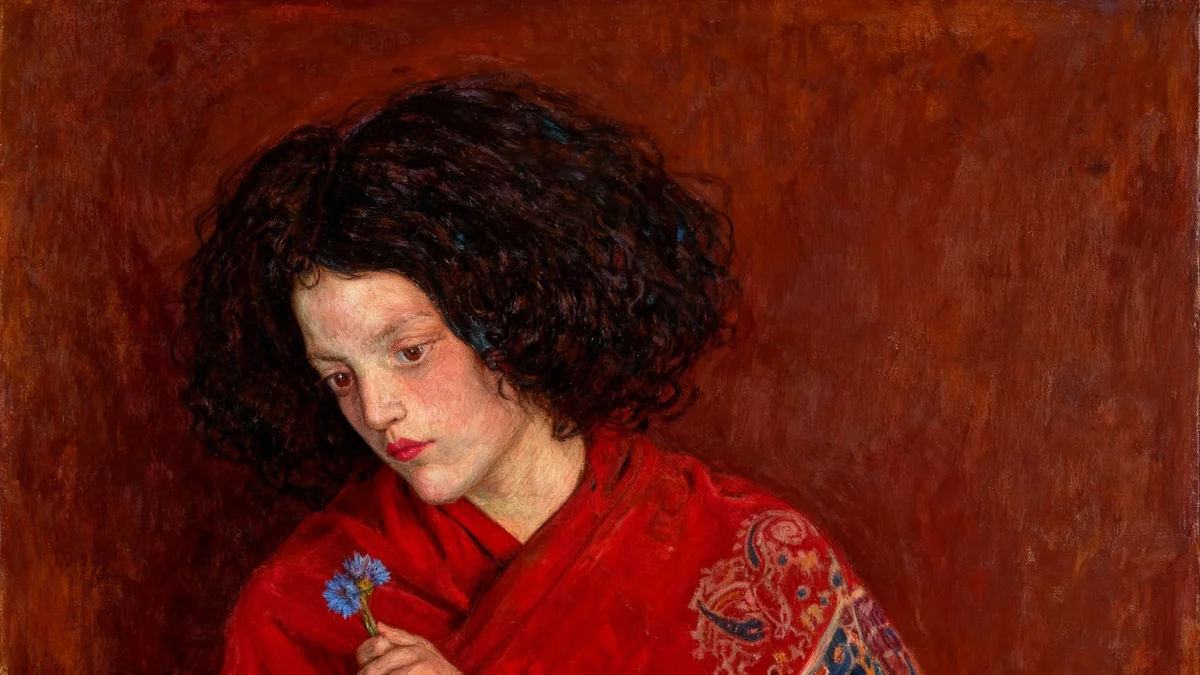


A striking portrait, known as 'The Irish Girl,' painted in 1860 by Ford Madox Brown, continues to captivate art enthusiasts. This small yet powerful work, now housed at the Yale Center for British Art in New Haven, Connecticut, offers a nuanced glimpse into Victorian society, defying the moralistic tones often found in Brown's larger, more ambitious projects.
The painting features a young Irish girl, encountered by Brown selling oranges on a London street. Her direct gaze and subtle expression have drawn significant attention, suggesting a deeper narrative beyond a simple street vendor portrait.
Key Takeaways
- 'The Irish Girl' was painted by Ford Madox Brown in 1860.
- It was originally a study for his major work, 'Work,' but stands alone as a masterpiece.
- The painting is noted for its naturalistic detail and the girl's expressive gaze.
- It reflects themes of social class and Victorian societal views on labor.
- The artwork is housed at the Yale Center for British Art.
Origins and Context of the Painting
Ford Madox Brown created 'The Irish Girl' while actively working on his monumental painting, 'Work.' This larger project, which consumed 13 years of his life, aimed to depict the heroic nature of manual labor in Victorian England. Brown, though never a formal member, was closely associated with the Pre-Raphaelite Brotherhood. This group of young painters rejected the academic art traditions of their time, favoring detailed naturalism, vibrant colors, and strong symbolism with a clear moral purpose.
Brown frequently sought out real-life subjects for his paintings. He reportedly met the young girl who modeled for 'The Irish Girl' while scouting locations in London's Hampstead neighborhood. He depicted her in a simple shawl, characteristic of impoverished Irish immigrants, and placed a single cornflower in her hand.
Interesting Fact
Ford Madox Brown's 'Work' features prominent figures like Thomas Carlyle, a renowned Scottish philosopher whose ideas influenced much of Victorian thought on labor and society.
A Counterpoint to Victorian Ideals
'Work' was Brown's artistic response to Thomas Carlyle's concept of the 'Condition of England' problem. Carlyle questioned the paradox of Britain's immense material wealth coexisting with widespread poverty and a perceived crisis of spiritual purpose among its populace. Carlyle advocated for the idea of the 'heroic,' believing in the power of 'Great Men' and their deeds to shape society.
Brown's 'Work,' displayed at the Manchester Art Gallery, celebrates manual labor. It portrays central figures as almost god-like, engaged in tasks such as installing modern sewerage. The painting also includes members of the leisure class, orphans, and street sellers, implying their lack of understanding of labor's value.
The subtle, questioning kink in her eyebrow suggests an intelligent skepticism, a profound unimpressed glance at the world around her.
However, 'The Irish Girl' offers a stark contrast. Measuring under a square foot, this smaller study was not meant for public display in the same way as 'Work.' Instead, it was likely intended for private domestic interiors. In the same year, Brown painted a companion piece, 'The English Boy,' depicting his own son, Oliver, in fine attire, holding a toy whip and a spinning top. This English boy was meant to be a respectable counterpoint to the 'disreputable' Irish girl.
Artistic Technique and Enduring Appeal
'The Irish Girl' draws parallels to the 17th-century Dutch tradition of 'tronies.' These were head studies of anonymous sitters, primarily serving as exercises for artists to explore light, form, and expression. Johannes Vermeer's 'Girl With a Pearl Earring' is perhaps the most famous example of a tronie.
Brown's masterful use of paint in 'The Irish Girl' is evident in the mottled reds and creams of her face. He used exquisitely aerated, multidirectional brushstrokes that appear to flow across her facial contours. Subtle touches of blue in her dark hair and the whites of her eyes echo the cornflower she holds, creating a harmonious color palette. Her strong chin, glossy brow, and vivid hazel eyes leave a lasting impression.
Background on Pre-Raphaelite Art
The Pre-Raphaelite Brotherhood, formed in 1848, sought to return to the abundant detail, intense colors, and complex compositions of Quattrocento Italian art, before Raphael. They emphasized naturalism and moral narratives in their work, often challenging the artistic establishment of their time.
The girl's expression goes beyond simple portraiture. Her watchful, assessing, and faintly disgusted gaze suggests a deeper inner life. This expression can be interpreted as a quiet defiance of the Victorian societal norms and the often-hypocritical moralizing prevalent during that era. She appears unimpressed by the grand pronouncements of figures like Carlyle or the evangelical zeal of patrons like Thomas Plint, who commissioned 'Work.'
Her single flower, a cornflower, could have been perceived by Victorian gentlemen as a symbol of her poverty or even an invitation for illicit advances. Yet, Brown's portrayal imbues her with an undeniable intelligence and strength, making her more than just a subject of pity or judgment.
Legacy and Interpretation
While 'Work' remains a significant historical document, 'The Irish Girl' has achieved its own status as a masterpiece. It stands out for its raw emotional power and directness, offering a more intimate and less didactic view of Victorian life. The painting's ability to transcend its initial purpose as a mere study and speak volumes about social observation and individual spirit is a testament to Brown's artistic skill.
The enduring appeal of 'The Irish Girl' lies in its universal themes of human dignity and resilience. Her gaze, full of fiery interest and quiet skepticism, continues to resonate with viewers today, making her a compelling figure in the history of British art.
- The painting is approximately one square foot in size.
- It is considered one of the glories of the Yale Center for British Art collection.
- Brown's ability to capture such a complex expression in a small format highlights his mastery.