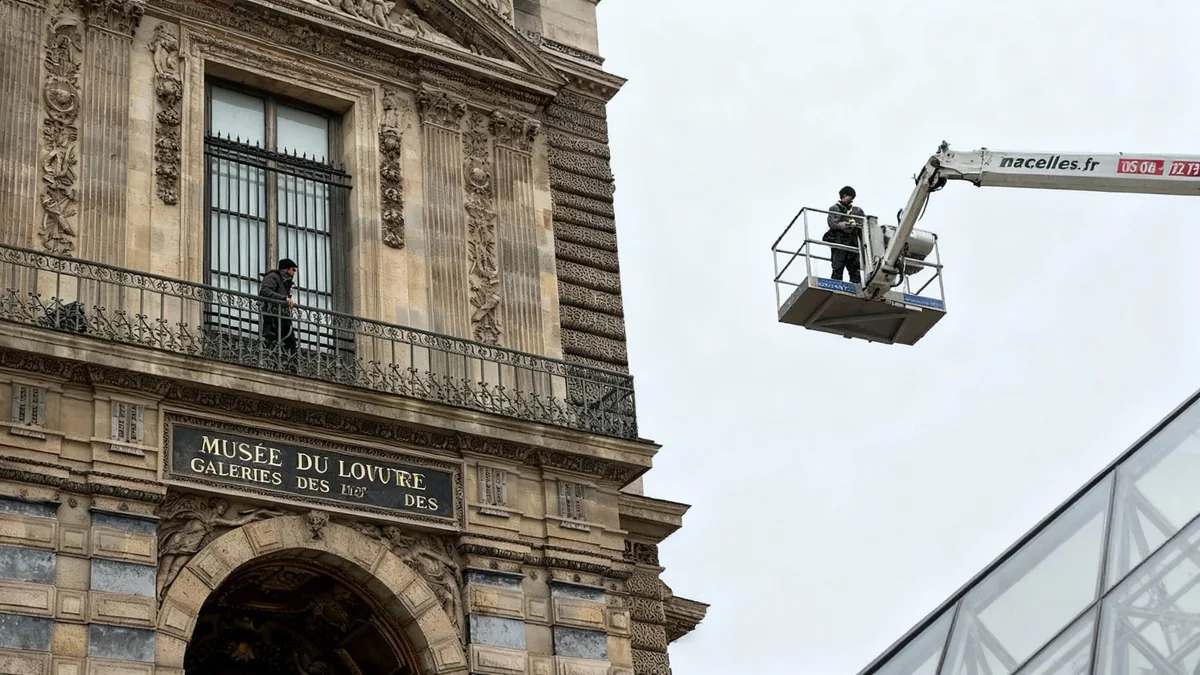



The Louvre Museum in Paris has significantly upgraded its security measures following a high-profile jewel heist in October. New security bars were installed on a critical balcony used by burglars, marking a direct response to the incident.
This move is part of a broader security overhaul at the world-renowned institution, which aims to prevent future breaches and protect its invaluable collection.
Key Takeaways
- Security bars installed on the Apollo gallery balcony, the entry point for October's heist.
- Four individuals stole an estimated $102 million worth of crown jewels in a rapid, seven-minute operation.
- The museum plans to deploy 100 additional security cameras next year.
- A mobile police squad is now stationed near the iconic glass pyramid.
- The heist exposed significant vulnerabilities in the museum's exterior surveillance.
Immediate Actions Taken at the Louvre
On Tuesday, a large crane carefully lifted and positioned a new security grille. This grille now seals the glass door that leads to the Apollo gallery balcony. This specific balcony was the entry point for the burglars on October 19.
The installation directly addresses a major security vulnerability. The museum has acknowledged that its exterior walls, particularly this balcony area, lacked adequate camera coverage before the incident.
"The Louvre is learning all the lessons from the theft of October 19 and is continuing its transformation and the strengthening of its security architecture," the museum stated in a public announcement.
Heist Details
- Date of Heist: October 19
- Number of Burglars: Four individuals entered the museum.
- Value of Stolen Jewels: Estimated at $102 million.
- Duration of Heist: Less than 7 minutes.
- Entry Method: Movers' lift to balcony, smashed window.
- Escape Method: Scooters driven by accomplices.
The October Incident Unpacked
The October heist was a rapid and audacious operation. Four individuals used a movers' lift to reach the Apollo gallery balcony. They then smashed a window to gain entry.
Inside, the burglars used angle grinders to break open display cases containing crown jewels. They then fled on scooters, with accomplices waiting outside. The entire operation lasted less than seven minutes.
This swift execution highlighted severe security gaps. The stolen jewels remain missing, though police have identified eight suspects in connection with the crime.
Broader Security Enhancements Underway
The installation of security bars is just one part of a comprehensive plan to bolster the Louvre's defenses. The museum is implementing multiple layers of protection.
Next year, an additional 100 cameras will be deployed around the museum premises. This significant increase in surveillance aims to cover previously unmonitored areas.
Furthermore, a mobile police squad now maintains a constant presence at the roundabout located in front of the iconic glass pyramid. This visible police presence adds another deterrent layer.
The Louvre's Recent Challenges
The October jewel heist was not the only challenge faced by the Louvre in recent weeks. The museum has experienced several setbacks.
- An adjacent gallery to the Apollo was closed due to structural weakness.
- A water leak caused damage to books in the Egyptian antiquities department.
- The museum faced partial closures for several days due to staff strikes.
These issues underscore the ongoing need for maintenance and security upgrades at the historic institution.
Addressing Vulnerabilities and Future Plans
Louvre officials have openly admitted to the security shortcomings. Specifically, they noted the inadequate external camera coverage, particularly around the balcony that served as the entry point for the burglars.
The museum's commitment to "strengthening its security architecture" indicates a proactive approach. The goal is to ensure the safety of its priceless artifacts, including the world-famous Mona Lisa.
The ongoing investigations into the heist continue. The focus remains on recovering the stolen jewels and bringing all involved parties to justice.
These security enhancements are crucial for maintaining the Louvre's reputation as a safe haven for art and history. They also reassure the millions of visitors who come to experience its treasures each year.