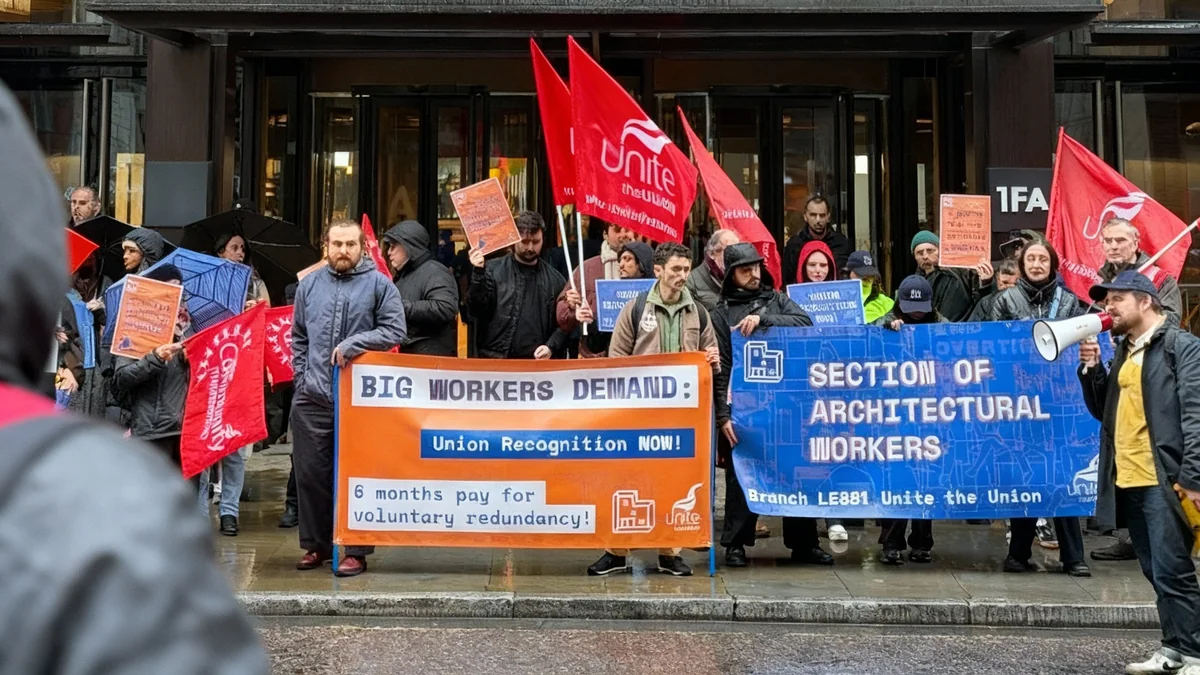



Employees from the Danish architecture firm BIG, along with members of the Unite union, staged a protest today in London. The demonstration took place outside BIG's Broadgate offices, drawing approximately 40 individuals who expressed concerns over proposed layoffs at the studio.
The protest highlighted the firm's redundancy process, which the union claims could affect a significant portion of the London workforce. Chants during the demonstration directly addressed studio founder Bjarke Ingels, referencing company dividends.
Key Takeaways
- Approximately 40 people protested outside BIG's London office.
- Unite union claims 72 out of 160 employees are at risk of redundancy.
- Protestors demanded better redundancy terms and union engagement.
- Chants referenced £7 million in shareholder dividends.
- BIG stated redundancies follow UK guidelines after a major project loss.
London Workforce Faces Significant Redundancies
The Unite union reports that 72 of BIG's 160 employees in London are at risk of redundancy. This potential job loss follows the termination of a major project, which reportedly accounted for a substantial part of the London studio's workload.
Demonstrators aimed to pressure BIG into offering more favorable redundancy terms. They also sought a meeting with union officials to explore alternatives to the proposed layoffs, emphasizing dialogue with the employees' representatives.
Key Numbers
- 72 employees at risk of redundancy.
- 160 employees total in the London studio.
- £7 million reported in shareholder dividends.
During the protest, chants were directed at Bjarke Ingels, the founder of BIG. Slogans like "Bjarke Ingels shame on you" and "Seven million Bjarke has stowed, give your workers what they’re owed" echoed through Broadgate.
Union Claims High Membership, Firm Declines Meetings
A representative from Unite stated that over 80 BIG employees have joined the Section of Architectural Workers, which is the architectural branch of the Unite union. This indicates a significant level of union density within the firm's London office.
Despite this, the union representative claimed that BIG has repeatedly refused to meet with union officials. This refusal has been a central point of contention for the protestors, who seek direct engagement from the company's leadership.
"This is one of the first architectural workplaces in the country to reach this kind of union density and yet the employer has repeatedly refused to meet with us," a Unite representative stated at the protest. "They have repeatedly refused to engage with what their employees want to talk about."
The representative also highlighted a perceived inconsistency in the company's actions. They suggested that BIG is actively hiring for other offices in Europe, while simultaneously pursuing significant layoffs in London. The option of relocating affected employees to other European offices has not been discussed, according to the union.
BIG's Global Presence
BIG, or Bjarke Ingels Group, was founded in Copenhagen in 2005 by Danish architect Bjarke Ingels. The firm has grown into a global practice with studios in major cities worldwide, including New York, Barcelona, and London. Its international footprint makes the lack of relocation discussions a key point for the union.
Company Cites Major Project Termination
Henriette Helstrup, the managing director of BIG's London firm, confirmed that the studio had lost a significant project. She stated that the redundancy process is being conducted "in full accordance with UK guidelines and due process."
Helstrup explained that the major project in the London studio was terminated at the end of November last year due to circumstances beyond the company's control. This project reportedly employed approximately half of the London office staff.
Upon the project's termination, the entire team was immediately informed. Helstrup emphasized that BIG's leadership team is engaging directly with those affected in a thoughtful and constructive manner, adhering strictly to UK legal requirements.
The situation at BIG is not isolated within the architecture sector. Recently, another prominent firm, Snøhetta, faced accusations of laying off pro-union employees at its New York office. This suggests a broader trend of labor disputes emerging within the architectural industry.
The protests at BIG underscore growing concerns among architectural workers regarding job security and fair treatment. The call for improved redundancy terms and direct communication with union representatives highlights the evolving landscape of labor relations in the design world.
The union's strong membership numbers within BIG's London office could set a precedent for future labor organizing efforts in the architectural sector. As the industry navigates economic shifts and project changes, the dialogue between firms and their employees becomes increasingly vital.
The outcome of these negotiations at BIG will likely be closely watched by other architecture studios and their employees, potentially influencing how similar situations are handled across the industry in the future. The emphasis on union density and the refusal to engage directly with union representatives are central to the ongoing dispute.