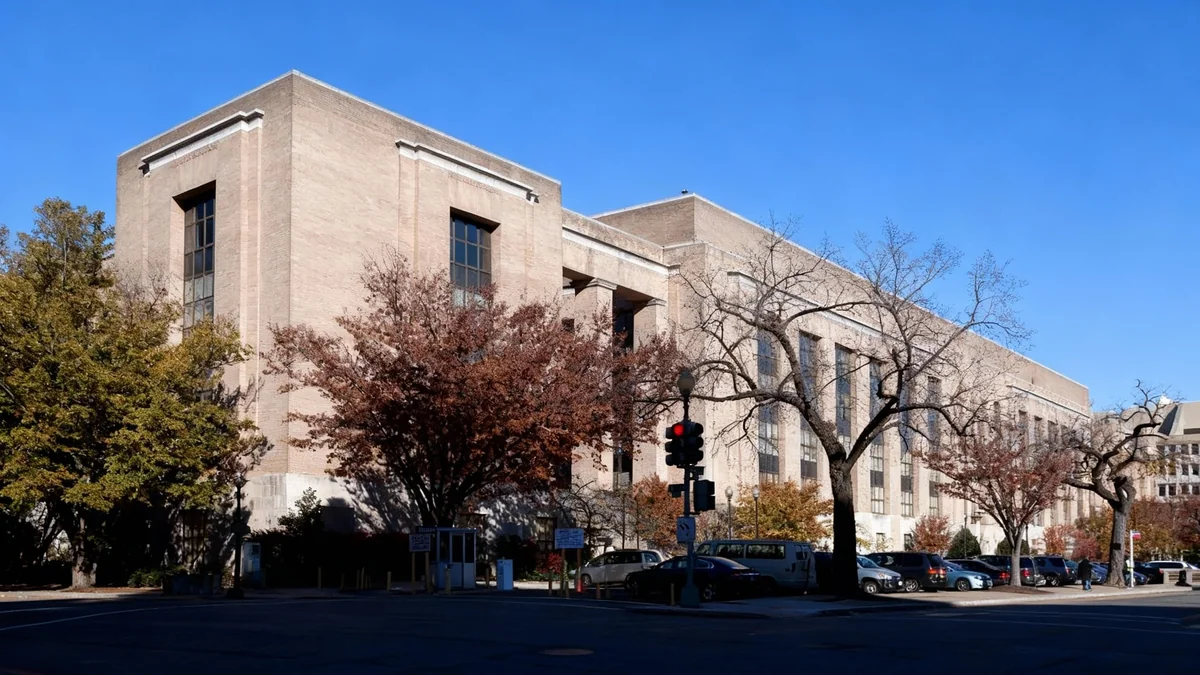

The Wilbur J. Cohen Federal Building in Washington, D.C., a landmark structure from the New Deal era, faces an urgent threat of demolition. Recent testimony from a former federal official suggests the White House is bypassing standard preservation processes for this and three other historic buildings, raising alarms among preservationists and cultural heritage advocates.
The building, completed in 1940, originally served as the Social Security Building. It is renowned for its distinctive Art Moderne and Stripped Classicism architectural styles and houses irreplaceable fresco murals by celebrated American artists such as Ben Shahn, Philip Guston, and Seymour Fogel. These artworks are integral to the building's structure, making their removal nearly impossible.
Key Takeaways
- The Wilbur J. Cohen Federal Building, a New Deal landmark, is under imminent threat of demolition.
- Former GSA official Mydelle Wright testified that the White House is circumventing preservation laws for four federal buildings.
- The building houses significant, irremovable artworks by artists like Ben Shahn and Philip Guston.
- Preservation groups are urging public action and seeking legal intervention to prevent destruction.
- Concerns exist that demolition could occur rapidly, potentially over holidays, similar to the White House East Wing.
Imminent Danger for Historic Federal Buildings
The threat to the Cohen Building became critically clear on December 8, during federal district court testimony. Mydelle Wright, a recently retired and highly respected official from the General Services Administration (GSA), provided a stark warning. She stated that the White House is actively working to bypass or circumvent the GSA-led Section 106 review process for four federal buildings on an "accelerated disposals" list.
This list includes not only the Cohen Building but also the Old GSA Regional Office Building, another New Deal-era structure that features 22 large, oil-on-canvas murals by Harold Weston. Wright's declaration points to coordinated bids for demolition, which would violate the National Historic Preservation Act and several other federal and state environmental protection laws.
"Demolition is no longer an abstract possibility but an imminent threat," Wright declared, emphasizing the personal risk she undertook to deliver this warning.
Building Significance
- Year Completed: 1940
- Original Purpose: Social Security Building
- Architectural Style: Pre-World War II Art Moderne, Stripped Classicism, subtle Egyptian flair
- Notable Artworks: Fresco murals by Ben Shahn, Philip Guston, Seymour Fogel; sculptural reliefs
- Art Integration: Most artworks are chemically bound or carved into walls, making removal extremely difficult.
Preservation Efforts and Legal Challenges
The Living New Deal (LND) organization has been a key advocate in tracking threats to federal government art and architecture. Following administrative changes and the forced leave of GSA fine art and historic preservation staff, LND initiated a watchdog campaign. This campaign monitors the GSA’s newly created "accelerated disposals" list, which initially included over 400 properties.
In October, LND and its advisors sent a formal letter to the GSA and other federal agencies. They requested participation as a consulting party in the Section 106 process. This process is crucial for determining the fate of historic properties. LND hoped to explore options like private-public partnerships for adaptive reuse, a strategy that could make the Cohen Building a profitable hub while preserving its historical integrity.
Understanding Section 106
Section 106 of the National Historic Preservation Act requires federal agencies to consider the effects of their undertakings on historic properties. It mandates consultation with various parties, including state and tribal historic preservation officers, local governments, and the public, before any federal project that could affect historic sites moves forward. This process aims to avoid, minimize, or mitigate adverse effects on historic resources.
Despite initial assurances that the Section 106 process would not begin immediately, Ms. Wright's testimony revealed a critical shift. Marianne Copenhaver, GSA Associate Administrator for Strategic Communications, dismissed the concerns as a "manufactured narrative built on speculation." She emphasized GSA’s goal to "right-size the federal real estate portfolio" through "disposal" of "unneeded assets." However, critics argue that "disposal" without a rigorous Section 106 review effectively greenlights demolition.
Echoes of Past Demolitions
Concerns about a rushed or absent review process are heightened by recent events. In October, the East Wing of the White House was demolished following a rapid assessment. This assessment, a 17-page Environmental Assessment report filed in late August, considered only two options: demolition or no demolition. Despite acknowledging "substantial adverse effects," it concluded "No Significant Finding," paving the way for its swift destruction.
The East Wing was gone within approximately two months of the report's filing. This precedent raises fears that the Cohen Building could face a similar fate, potentially over the upcoming holiday break or in the new year, when federal staff might be less present.
- The East Wing of the White House was demolished in October.
- A rapid 17-page environmental report preceded the demolition.
- The report admitted "substantial adverse effects" but concluded "No Significant Finding."
- This swift action sets a concerning precedent for other historic federal properties.
Evidence gathered suggests that adaptive reuse is not currently being considered for the Cohen Building. Selling the building intact also appears unlikely. Without a Memoranda of Agreement in any forthcoming contract of sale, a legally binding document that includes historic preservation covenants and financial incentives for responsible stewardship, demolition becomes almost certain.
Call to Action for Preservation
Preservationists are urging the public to take action to protect the Cohen Building and its invaluable artworks. They argue that these New Deal-era structures represent equitable government policies, fair employment practices, and a nation that values its workers and shared history.
The Living New Deal is asking Washington, D.C. residents to monitor the Cohen Building throughout the holiday period. They encourage citizens to take photographs and report any signs of construction mobilization to LND and the media. A public petition on Change.org has already gathered over 5,000 signatures, demonstrating significant public interest.
"We must fight for what these New Deal-era artworks represent: equitable government policies, fair employment practices, social safety nets, and a nation that values all workers and honors our shared history," states a representative from the Living New Deal.
There are also concerns about potential congressional legislation or new provisions that could introduce Section 106 waivers for sites on the GSA’s accelerated disposals list. Such waivers would further streamline demolition processes, bypassing critical review steps.
Cultural leaders, artists, academics, and architects are being called upon to publicly defend the Cohen Building. The building’s architect, Charles Z. Klauder, carefully selected materials like Indiana limestone and Vermont Verde marble, creating a 1,000,000-square-foot structure dedicated to public service. LND founder Gray Brechin has even called it the "Sistine Chapel of New Deal art."
The holiday season, typically a time for reflection, is now a critical moment in this preservation battle. Advocates are urging individuals and institutions to speak out, collaborate, and hold elected officials accountable to safeguard historic preservation laws and the nation's cultural heritage. Preserving these buildings is seen as an investment in the future, reflecting the progressive impact of the New Deal and the government's role in building a more just society.