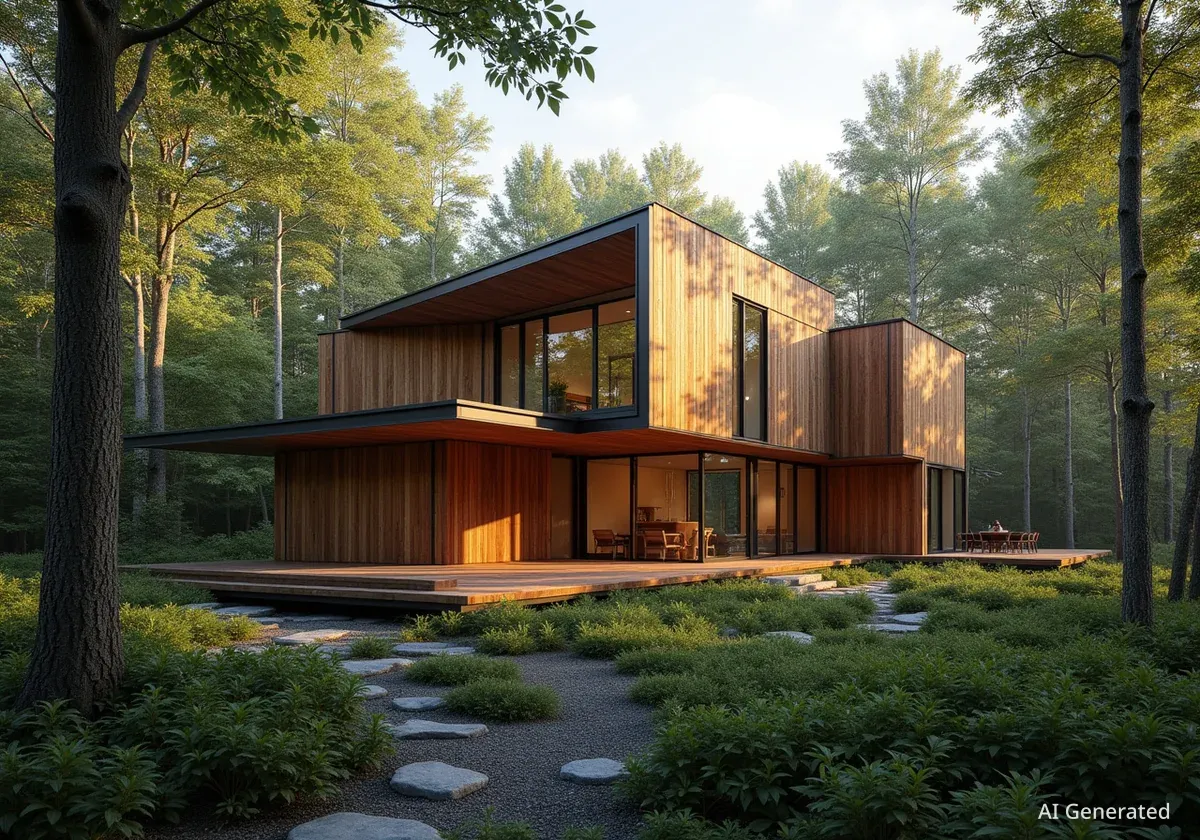
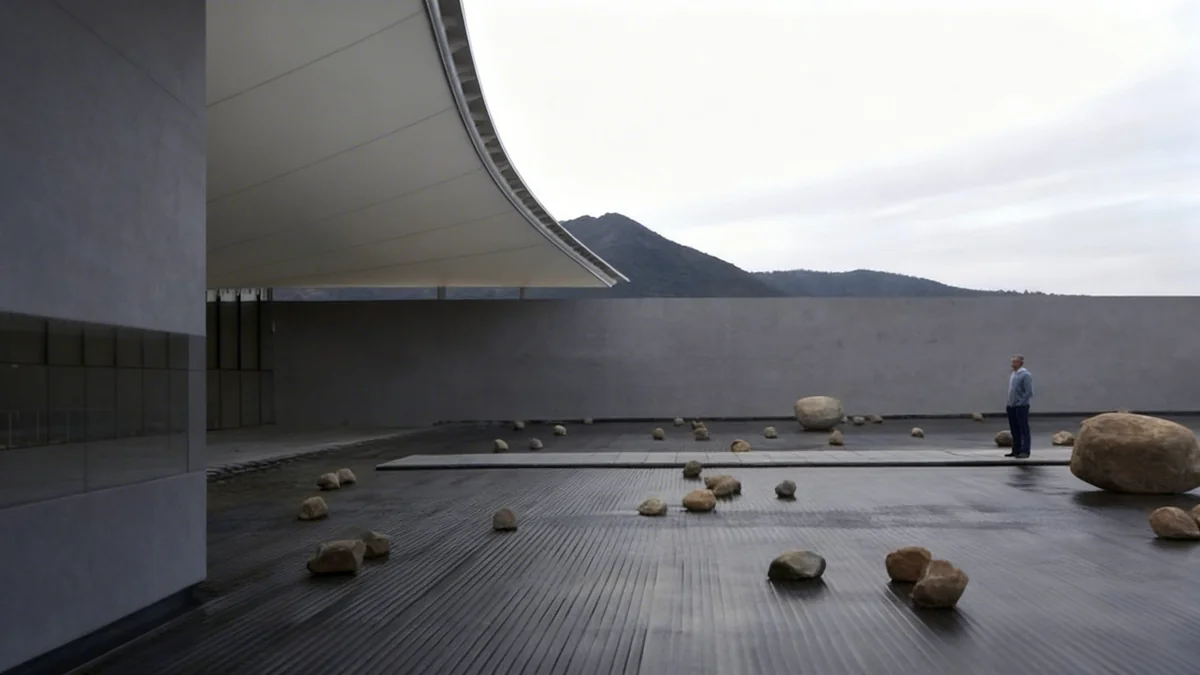
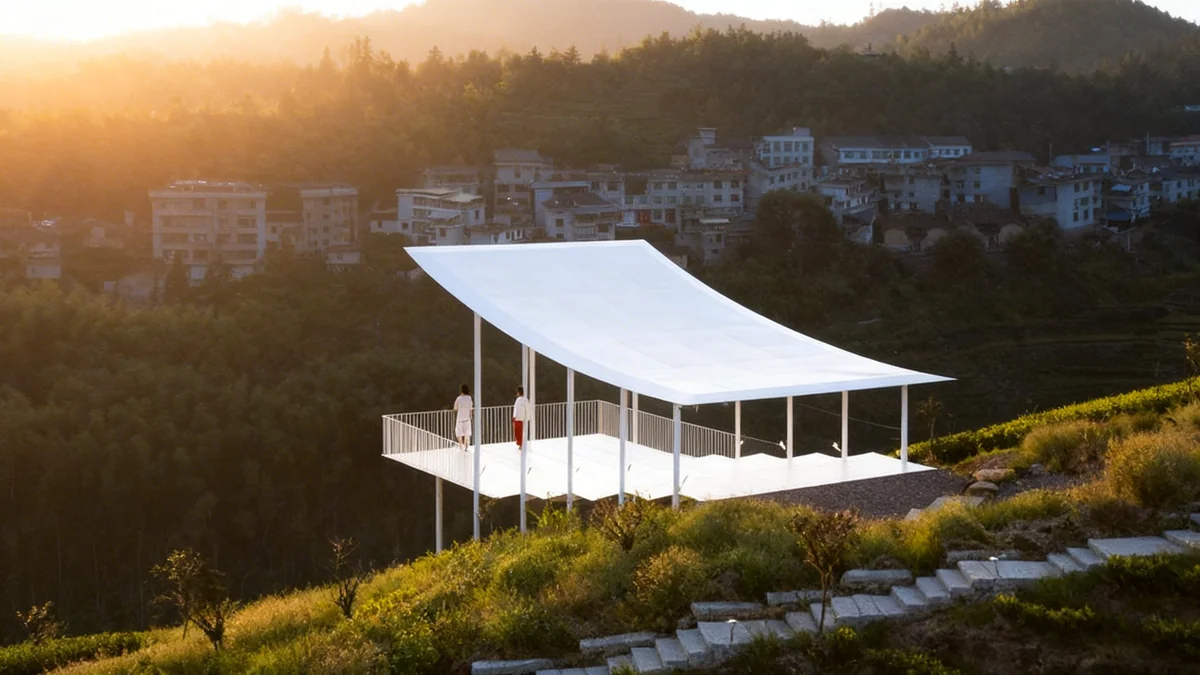
In a natural clearing in Sutton, Quebec, a new residential project named Waterhouse has been completed by Canadian architectural studios Oyama and Julia Manaćas Architecte. The 260-square-metre (2,800-square-foot) home is defined by its unique composition of three separate but connected structures, all uniformly clad in cedar shingles to blend with the surrounding woodland environment.
Key Takeaways
- Waterhouse is a 260-square-metre residence located in a woodland clearing in Sutton, Quebec.
- The project was designed by Montreal-based studios Oyama and Julia Manaćas Architecte.
- The house is composed of three distinct volumes known as the Atelier, the Great Room, and the Tower.
- A uniform exterior of cedar shingles creates a cohesive visual identity for the separated forms.
Architectural Concept and Site Integration
The Waterhouse residence is situated in a forest opening, surrounded by a pond, large boulders, ferns, and wildflowers. The location offers views of rolling hills that extend towards the Green Mountains. The design team, collaborating under the name An architecture capsule, approached the project by breaking down a single residential form into three distinct parts to better engage with the landscape and its various views.
This division resulted in three structures that the architects describe as a series of monuments. These forms create a dynamic relationship between enclosed interior spaces and open outdoor areas. The design encourages movement and exploration around the property.
"The forms are an invitation to wander in, around and even on top of the house, leveraging all the site has to offer," the design team stated.
The process involved using both physical and digital models to refine the relationship between the volumes. According to the studio, this iterative approach helped achieve a more intimate scale and a porous interaction between the buildings and the natural site.
A Collaborative Design Approach
Oyama and Julia Manaćas Architecte are both based in Montreal and collaborate as "An architecture capsule." Their work on Waterhouse demonstrates a focus on sculptural form and site-specific design, using a process of separation and refinement to create a home that is both unified and fragmented.
The Three Distinct Volumes
The home's program is distributed across three main buildings, each with a specific function and orientation. A central vestibule connects these volumes, facilitating a fluid circulation pattern throughout the residence.
The Atelier
Upon approaching the property, the first visible element is the blind wall of the square-based Atelier. This structure has a pyramidal shape and is designed for functional purposes. It contains a workshop and a parking space on its main level. Tucked into the steep pitch of its roof is a storage mezzanine, maximizing the use of vertical space.
The Great Room
The Great Room forms the central living hub of the house. This rectangular block contains the primary living spaces, including an open-plan kitchen, dining area, and living room. It is rotated to face due south, which allows for optimal sun exposure throughout the day. A full wall of windows provides expansive views of the surrounding landscape. A thickened interior wall discreetly houses the fireplace, storage, and ventilation systems. This wall also serves as a divider, separating the public living area from the private primary suite to the east, which features its own large deck.
The Tower
The westernmost structure is the Tower, a three-story building dedicated to guest accommodations and additional functional spaces. Each of the three floors contains a guest suite. The ground floor of the Tower is partially submerged into the sloping site and includes a home office. A key feature is a footbridge on the third floor, which extends over a green roof to connect with a terrace on top of the Great Room, offering elevated views of the property.
Project Specifications
- Name: Waterhouse
- Location: Sutton, Quebec, Canada
- Architects: Oyama and Julia Manaćas Architecte
- Area: 260 square metres (2,800 square feet)
- Exterior Cladding: Cedar shingles
Materiality and Interior Flow
The choice of materials plays a crucial role in unifying the three separate volumes into a single, cohesive project. The architects selected cedar shingles for the entire exterior, describing the result as "strange bodies in familiar clothing." This traditional material wraps the unconventional forms, grounding them in a vernacular architectural language.
The space created between the three buildings forms an internal courtyard. In contrast to the cedar exterior, the walls of this central area are clad in oak paneling. This design choice extends the natural wood palette to the interior, creating a warm and sheltered transition zone.
This central vestibule is not just a hallway; it is a programmed space that houses essential services, including a laundry room and a bathroom. It organizes movement between the volumes in a non-linear way.
"The programmed transitional space organises movement in and out of each volume, rejecting a rigid, linear sequence for a more fluid and natural circulation," the team explained.
This circulation design allows the inhabitants to experience the home as a collection of interconnected spaces rather than a single, monolithic structure, reinforcing the project's core concept of dissolving a singular form into a dynamic collection of bodies that respond directly to their natural environment.