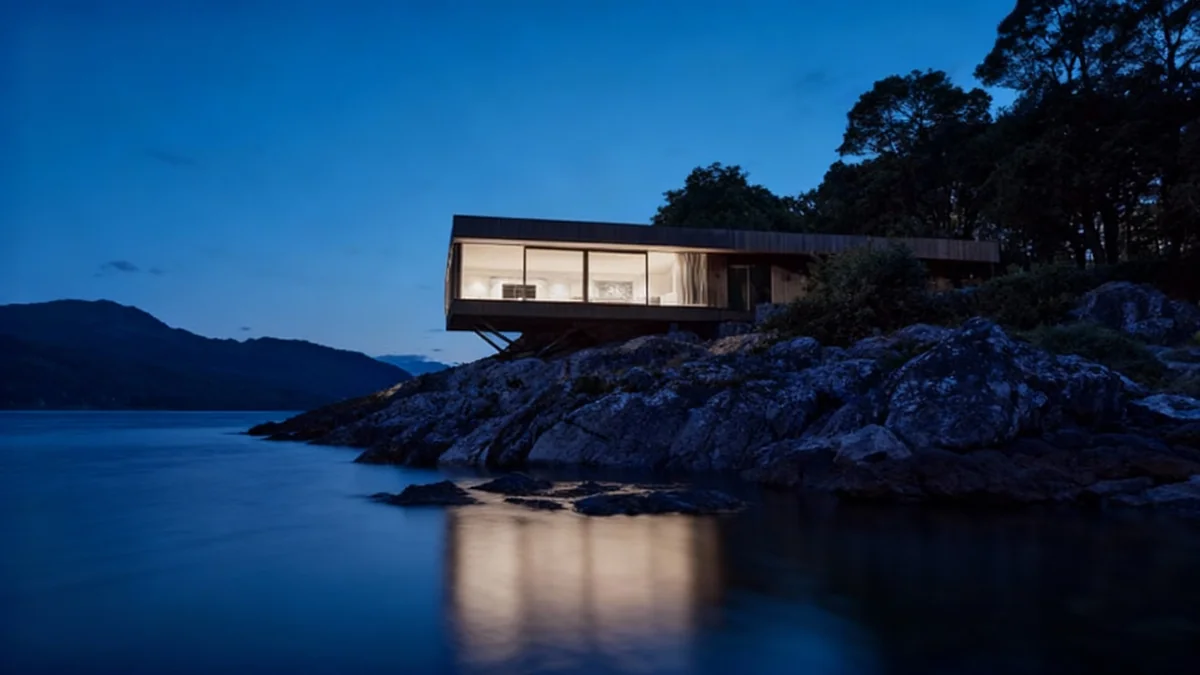

A striking contemporary home, Rock Cove, now stands cantilevered over the rocky shores of Loch Long on Scotland’s Rosneath peninsula. This architectural achievement, inspired by modernist design principles, transforms a former brownfield military site into a dwelling that seamlessly connects with its rugged natural surroundings. The house, a collaborative vision between homeowner John MacKinnon and architect Stuart Cameron, showcases innovative design in a challenging coastal environment.
Key Takeaways
- Rock Cove is a modernist home on Scotland's Loch Long.
- It features a cantilevered living area extending over rocks.
- The design draws inspiration from Frank Lloyd Wright's Fallingwater.
- The project transformed a former military brownfield site.
- Durability and future-proofing were key design considerations.
A Vision on Loch Long's Shore
The journey to create Rock Cove began with a desire to transform an overlooked piece of land. John MacKinnon, who previously developed another property on the same site, Cape Cove, saw potential in the adjacent disused Ministry of Defence land. This area, once home to overgrown huts and rubble, presented a unique opportunity for a new architectural statement.
Working with architect Stuart Cameron of Cameron Webster, MacKinnon set out to design a home that would maximize the stunning views while integrating into the wild Scottish landscape. The vision was a property that would stand out but also feel at one with nature.
Interesting Fact
The site for Rock Cove was once a brownfield area, previously occupied by disused Ministry of Defence buildings and left overgrown with rubble.
Architectural Inspirations
The design of Rock Cove draws heavily from iconic modernist architecture. Influences include the low-slung desert modernist homes of Palm Springs, California, and the famous works of Frank Lloyd Wright, particularly his masterpiece, Fallingwater in Pennsylvania. The Vandamm House, a set from Alfred Hitchcock's thriller North By Northwest, also served as inspiration, itself influenced by Fallingwater.
John MacKinnon emphasized the importance of clean lines and a strong connection to nature. This connection is achieved through the careful selection of materials and the extensive use of glass walls, blurring the lines between indoor and outdoor spaces.
"It’s about the clean lines and the connection to nature, through both the materials and the walls of glass," says John MacKinnon.
Designing for Durability and Views
The primary design brief for Rock Cove focused on two key elements: making the most of the incredible views and ensuring the home was future-proofed for retirement. This meant a single-level, step-free design that would be easy to maintain over time. The solution proposed by Cameron was a house that literally juts out over the rocks below, a bold cantilevered structure.
The resultant building is a simple yet striking low-slung box. Its unique design has already garnered several architectural awards, highlighting its innovative approach to coastal living.
Background Information
Building directly on the British coastline presents significant challenges, including complex planning permissions and the need to design for often harsh weather conditions. Rock Cove successfully navigated these hurdles through thoughtful design and collaboration.
Clever Space Utilization
While the main living, dining, and kitchen area is generously proportioned, the four en suite bedrooms are more modestly sized. Each bedroom opens directly onto a terrace that runs along one side of the house, providing private access to the outdoors. The opposite side of the house is windowless, ensuring privacy for both Rock Cove and the adjacent Cape Cove.
A notable design decision was transforming the corridor into a functional room. At a generous 2 meters wide, this space serves multiple purposes. "It’s a great space to put tables during parties and John wanted somewhere to display his collection of Aboriginal art," explains Stuart Cameron.
Materials and Weather Resilience
The choice of materials for Rock Cove aligns with its modernist influences, emphasizing natural elements like wood and stone. These materials not only provide a close-to-nature feel but are also reusable, reflecting a sustainable approach to building.
Given the sometimes extreme weather conditions on the Scottish west coast, resilience was paramount. The floor-to-ceiling windows are triple-glazed to offer superior insulation and protection against the elements. Furthermore, the doors are designed to drop down onto seals when closed, effectively keeping strong winds at bay.
- Triple-glazed windows: Essential for insulation and weather protection.
- Sealing doors: Designed to withstand strong coastal winds.
- Kebony exterior: A robust timber product chosen for durability and aesthetic weathering.
The exterior of the house is wrapped in Kebony, a highly robust timber product. This material has gracefully weathered over time, developing a pleasing silvery finish that complements the natural rocky landscape.
Interior Choices and Future-Proofing
Inside Rock Cove, the focus on durability and future-proofing extends to the furniture and fixtures. Pieces like the vast modular Ikea Söderhamn sofa were chosen for their design, practicality, and ease of maintenance. "It’s a great design and easy to buy replacement covers so, again, future-proof," MacKinnon notes.
Similarly, the kitchen features a standard Howdens' design, elevated by ultra-tough Dekton by Cosentino worktops. These choices reflect a practical approach, considering both the couple's eventual retirement and the fact that the house is also let out for holidays.
Durability in Design
The kitchen uses ultra-tough Dekton by Cosentino worktops, chosen for their resilience and long-term durability, important for both personal use and holiday rentals.
Life at Rock Cove has proven to be everything the MacKinnons envisioned. They enjoy filling the house with family and friends, embracing its social potential. Yet, the home also offers a serene escape. "But it’s nice to enjoy the place in solitude, to sit and watch the ever-changing weather," says MacKinnon, highlighting the peace and connection to nature the home provides.
For those considering similar ambitious projects, architect Stuart Cameron advises early engagement with local planning departments. He suggests researching approved contemporary houses in the area and seeking recommendations for architects who challenge conventional thinking, asking "what if?" to push design boundaries.