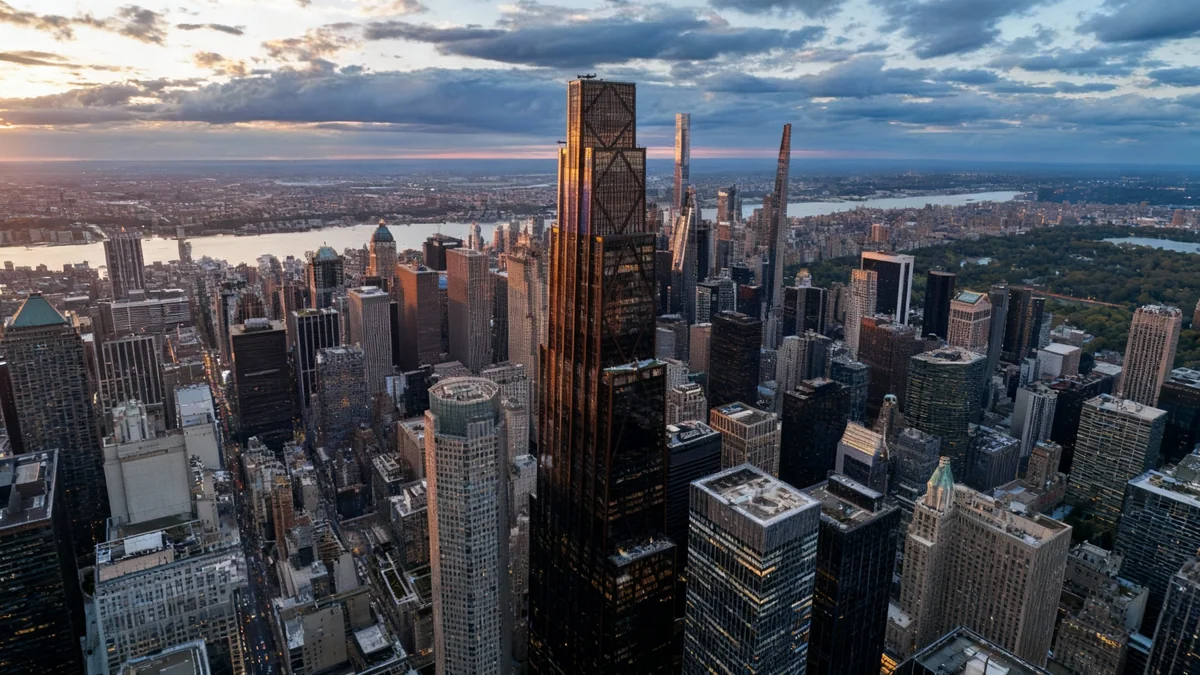

JP Morgan has unveiled its new global headquarters in New York City, a towering skyscraper designed by Foster+Partners. The 423-meter building stands as a dominant feature of the Manhattan skyline, housing 10,000 employees and representing a significant investment by the world's largest bank.
Key Takeaways
- JP Morgan's new global headquarters is a 423-meter, 60-story skyscraper in New York City.
- Designed by Foster+Partners, the building cost approximately $4 billion.
- It features 95,000 tonnes of steel, 60% more than the Empire State Building.
- The facility includes a 19-restaurant food court, fitness center, and medical clinic.
- The previous Union Carbide headquarters was demolished to make way for the new tower.
A New Landmark on the Manhattan Skyline
The new JP Morgan headquarters rises prominently in Midtown Manhattan. Its design, characterized by bulky, stepped sections, creates a distinct silhouette against the city's more slender structures. This building serves as the central hub for the bank's global operations.
The structure reaches a height of 423 meters and contains 60 stories. Its sheer scale contributes to its commanding presence, altering the visual landscape of the area.
Building Facts
- Height: 423 meters
- Stories: 60
- Cost: Approximately $4 billion
- Steel Used: 95,000 tonnes
- Occupancy: 10,000 employees
Structural Design and Material Use
The building's construction involved a substantial amount of materials. A striking 95,000 tonnes of structural steel were used in its framework. This amount is significantly higher than that used in other iconic New York skyscrapers.
For context, the Empire State Building, which is taller and has more floor space, used 60% less steel. Engineers have noted that the steel quantity could hypothetically wrap around the world twice if flattened into a strip of specific dimensions.
"We have built a fortress balance sheet, and now we have an actual fortress to go with it," Jamie Dimon, Chairman and CEO of JP Morgan, stated at the opening, emphasizing the bank's strong financial position.
Street-Level Engagement
At street level, the building makes a strong impression. Massive steel columns fan out at each corner, supporting the tower's base. These columns were strategically placed to navigate existing train tracks located beneath the site.
The design also incorporates new strips of privately owned public space. These areas feature shallow steps and planters. On Madison Avenue, a cliff face of carved granite boulders, an artwork by Maya Lin, greets visitors. This artwork aims to integrate natural elements into the urban environment.
Interior Features and Employee Amenities
Inside, the headquarters offers a wide range of amenities for its 10,000 employees. The lobby features great walls of fluted travertine, sourced from a single quarry in Italy. A grand travertine staircase is flanked by large Gerhard Richter paintings.
The building is designed as a "city within a city," providing extensive services. These include a food court with 19 restaurants offering kitchen-to-desk delivery, a hair salon, meditation rooms, and a fitness center. There is also a medical clinic and a pub.
Circadian Lighting and Workplace Strategy
The office floors incorporate circadian rhythm lighting. This technology adjusts light intensity and color throughout the day to support employees' natural sleep-wake cycles. The aim is to create a carefully calibrated environment that promotes well-being and productivity, aligning with the bank's strategy to encourage full-time office work.
Column-free office floors are a key design element, intended to create open and flexible workspaces. However, images of the new trading floors have generated discussion online, with some observers drawing comparisons to traditional, denser office layouts.
Demolition of a Predecessor
The construction of the new headquarters required the demolition of a significant existing structure. The 52-story Union Carbide headquarters, built in 1960 and designed by Natalie de Bois at SOM, previously occupied the site.
This former building had undergone a substantial refurbishment and environmental upgrade in 2012. At the time, JP Morgan itself highlighted this as "the largest green renovation of a headquarters building in the world." Seven years later, it became the tallest building ever intentionally demolished.
Demolition Impact
- Former building: 52-story Union Carbide headquarters
- Built: 1960
- Green Renovation: 2012 (touted by JP Morgan)
- Demolished: 2019
- New building: Almost twice the height, only eight more floors
Zoning Changes and Air Rights
The demolition and subsequent construction were influenced by a 2017 zoning change in East Midtown. This change aimed to revitalize the area and prevent a "flight to quality" by office tenants to newer developments like Hudson Yards.
Incentives were introduced, including allowing the sale of unused "air rights" from landmarked buildings. JP Morgan acquired 65,000 square meters of air rights from Grand Central Station and 5,000 square meters from St. Bartholomew's Church. These acquisitions allowed the bank to significantly increase the new tower's size beyond typical limits.
Future Development and Global Expansion
The JP Morgan tower is part of a broader trend in Midtown Manhattan. Other large-scale developments are planned or underway, including a 487-meter, 62-story tower at 350 Park Avenue, also designed by Foster+Partners. SOM has permission for another large structure at 175 Park Avenue.
These new supertalls are set to reshape the skyline further, potentially casting longer shadows and impacting views across Manhattan. The trend reflects ongoing urban development strategies in the city.
Beyond New York, JP Morgan is also expanding its global footprint. The bank recently announced plans for a 280,000-square-meter European headquarters in Canary Wharf, London. This will be the largest office building in the UK capital, exceeding the combined space of prominent structures like The Shard, Gherkin, and Walkie-Talkie.
The design for the London headquarters, also by Foster+Partners, has been partially revealed, showing curved bronze fins and a bulging glass drum at ground level. This project signals a continued focus on large-scale, high-impact architectural statements for the global financial institution.