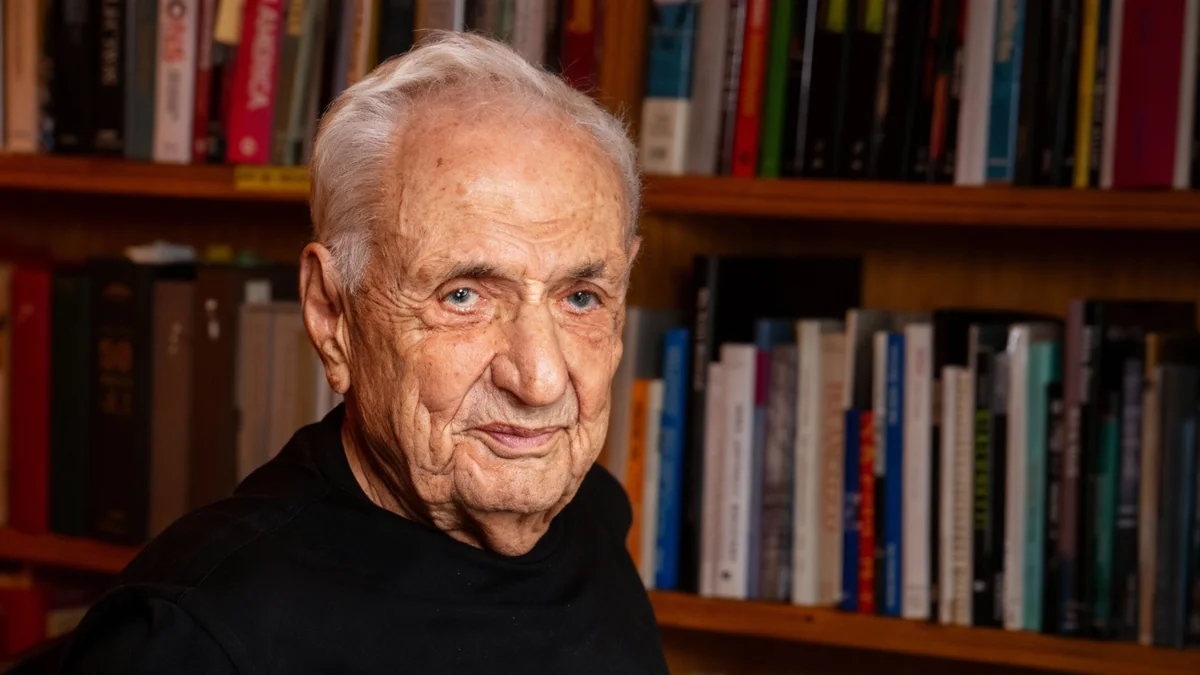


Frank O. Gehry, the pioneering architect whose distinctive, curvilinear designs reshaped urban landscapes and invigorated the global architectural scene, has died at the age of 96. Gehry passed away on Friday at his Santa Monica home following a brief respiratory illness, as confirmed by Meaghan Lloyd, chief of staff at Gehry Partners. His death marks the end of a prolific six-decade career that saw him become one of the world's most famous and influential architects.
Key Takeaways
- Frank Gehry, renowned architect, died at 96 in Santa Monica.
- His career spanned six decades, marked by innovative, complex designs.
- The Guggenheim Museum Bilbao, opened in 1997, propelled him to global fame and created the 'Bilbao Effect'.
- He designed the iconic Walt Disney Concert Hall in Los Angeles, completed in 2003.
- Gehry was known for blending sculptural forms with functional spaces, often using materials like corrugated metal and titanium.
A New Era for Architecture
Gehry's global recognition surged in the late phase of his career, a period characterized by his firm's innovative use of technology to realize geometrically complex structures. This pivotal era began with the completion of the Guggenheim Museum in Bilbao, Spain, which opened its doors in 1997. Gehry was 68 years old at the time.
The museum quickly garnered widespread acclaim for its breathtaking, sinuous profile and its dramatic interaction with the Nervión River. Its success was more than just aesthetic; it reenergized and brought new media attention to architecture, a field that had been searching for direction after the decline of the Modern movement and the false starts of Postmodernism.
The Bilbao Effect
The Guggenheim Bilbao's success in attracting tourists and media attention led to a phenomenon known as the 'Bilbao Effect'. Cities and museums worldwide began to seek out Gehry and other 'starchitects' to replicate the economic and cultural windfall. This marked a significant shift in how architecture was perceived and utilized for urban revitalization.
Iconic Structures and Critical Acclaim
Following the triumph of the Guggenheim, Gehry delivered a series of other significant projects. These included the Walt Disney Concert Hall in Los Angeles, which opened in 2003, and the Richard B. Fisher Center for the Performing Arts at Bard College in New York. The Disney Hall, though designed before Bilbao, became a testament to his ability to create both visually stunning and acoustically superior spaces.
Some critics, however, raised concerns that Gehry's rapidly expanding global firm might be spreading his talents too thinly. Projects like the Experience Music Project in Seattle, finished in 2000, faced mixed reviews. There were also questions about the cultural relevance and artistic purpose of some large-budget museum commissions, such as the Guggenheim branch in Abu Dhabi, announced in 2006 and still awaiting completion, with a target opening now set for 2026.
"Disney Hall was his answer to the charge, repeated frequently over the years, that he was more skilled at producing architectural sculpture than answering to practical or functional requirements."
Humanism in Design
Despite occasional criticisms, Gehry consistently countered detractors with projects that highlighted his profound understanding of architectural function and human scale. The Walt Disney Concert Hall, for instance, became a brilliant, eye-catching landmark that filled a civic void on Bunker Hill. Beyond its exterior, its auditorium functions superbly in acoustic terms, significantly enhancing the Los Angeles Philharmonic's visibility.
Another late-career achievement, the Fondation Louis Vuitton in Paris, which opened in 2014, showcased a refined and urbane direction in his work. Its dramatic glass forms, reminiscent of huge transparent sails, wrapped the building with a balance and elegance that challenged notions of his work being chaotic or undisciplined. This project underscored a lesser-known aspect of Gehry's genius: his dedication to creating spaces that respect and accommodate human scale.
Early Life and Influences
Born Frank Owen Goldberg in Toronto on February 28, 1929, he changed his last name to Gehry in 1954. He moved to Los Angeles with his parents in 1947 at age 17. Gehry described the city as "brash, raucous, frontier" and a place that offered "openness, and freedom because it was risk-taking somehow." This environment profoundly influenced his architectural philosophy.
Education and Early Career
Gehry pursued art and architecture classes at L.A. City College before attending USC, where he studied ceramics and architecture. He became a naturalized U.S. citizen in 1951. After a stint in the Army and further studies at Harvard Graduate School of Design, he returned to Los Angeles in 1962 to open his own firm at 33 years old.
His early designs, though initially aligned with Modernist principles, began to incorporate cues from Los Angeles's postwar commercial landscape. A 1965 loft and studio for graphic designer Lou Danziger on Melrose Avenue, with its spare stucco box exterior and surprising interior complexity, hinted at his future direction.
Pritzker Prize Winner
In 1989, Gehry became the first Los Angeles architect to win the prestigious Pritzker Prize, architecture's highest honor. The jury cited his work as "Refreshingly original and totally American, proceeding as it does from his populist Southern California perspective, Gehry’s work is a highly refined, sophisticated and adventurous aesthetic that emphasizes the art of architecture."
The Santa Monica House and Beyond
It was Gehry's remodel of his own Santa Monica home, a small 1920s bungalow he bought in 1977 with his second wife, Berta Aguilera, that first brought him national and international attention. He dramatically transformed the house, replacing large sections of its facade with glass, corrugated metal, and exposed wood framing, later adding chain-link fencing. This design drew inspiration not from academic theory but from the everyday, informal landscape of Southern California.
The house became a magnet for critics and architects throughout the 1980s, leading to significant commissions, including several buildings for Loyola Law School and the conversion of a Little Tokyo warehouse into the Temporary Contemporary for the Museum of Contemporary Art. Gehry consistently demonstrated a talent for sensitively repurposing old buildings, as seen in his Pierre Boulez Saal in Berlin (2017) and the transformation of a 1960s bank branch into the Judith and Thomas L. Beckmen YOLA Center in Inglewood (2021).
His victory in the 1988 competition to design the Walt Disney Concert Hall, where he beat out prominent international architects, served as a professional turning point. While construction faced delays, the design's eventual realization and the intervening success of the Guggenheim Bilbao cemented his legacy. Gehry leaves behind his wife, Berta, and four children.