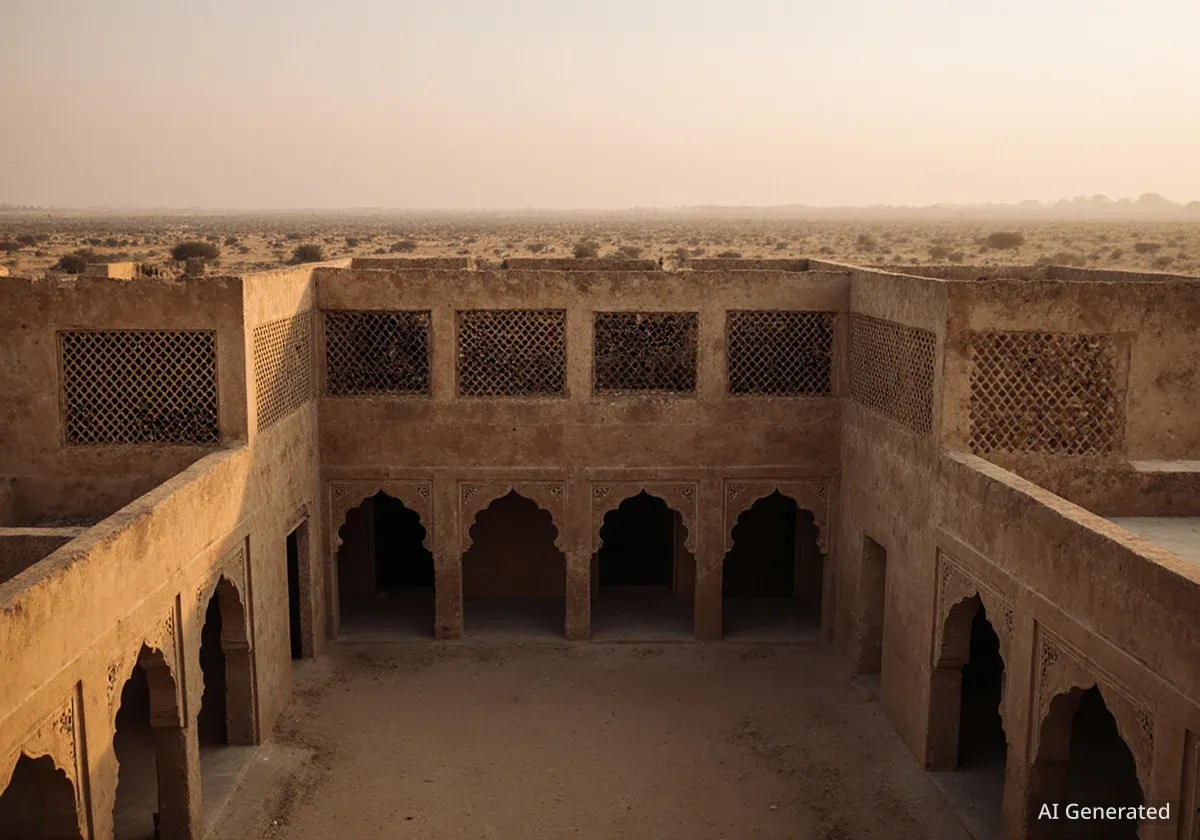

A new school for girls in India's remote Jaisalmer region, where temperatures can soar above 120 degrees Fahrenheit (49 degrees Celsius), is maintaining comfortable indoor conditions without relying on air conditioning. This innovative structure, known as The Rajkumari Ratnavati Girls School, integrates ancient building techniques with sustainable modern solutions, offering a vital educational hub in a challenging environment.
Key Takeaways
- The Rajkumari Ratnavati Girls School in Jaisalmer, India, operates without air conditioning in extreme desert heat.
- It uses local sandstone, lime plaster, a shaded courtyard, jali walls, and an elliptical design for natural cooling.
- The building is entirely solar and wind-powered, with a graywater recycling system and rainwater harvesting.
- The school provides critical educational opportunities for girls in a region with low female literacy rates.
- Future plans include expanding the campus to feature a women's cooperative, marketplace, library, and museum.
A Vision for Education in the Desert
The vision for this unique school began with Michael Daube, founder of the nonprofit organization CITTA. He aimed to establish a learning institution for girls in one of India's most rural and conservative areas, Rajasthan. This region faces some of the lowest female literacy rates in the country, often limiting girls' life paths to early marriage.
The primary challenge for this project was the extreme climate of Jaisalmer, a desert community lacking significant infrastructure. Daily temperatures often exceed 120 degrees Fahrenheit (49 degrees Celsius). Building a traditional school that could withstand such heat and remain comfortable for students was a daunting task, especially with the nearest major city located 40 kilometers away.
The Jaisalmer Climate
Jaisalmer is located in the heart of the Thar Desert, known for its arid conditions and extreme temperature fluctuations. Summers are intensely hot, with temperatures regularly peaking well above 100°F (38°C), making natural cooling solutions essential for any building project.
Architectural Ingenuity Meets Ancient Wisdom
Architect Diana Kellogg embraced the challenge, working closely with the local community to design a school that would empower women, provide a safe learning space, and effectively combat the intense desert heat. Kellogg found inspiration in the region's natural beauty and the specific challenges of its climate.
"I was so struck by Jaisalmer, the beauty of the place and how difficult it is to build in the climate," Kellogg told Stir World. "There was something very captivating about Jaisalmer and I also learned more about the situation of women and girls in that area. I was affirmed by the fact that education is better not just for individuals, but for the society as a whole. It changes the whole dynamic in societies."
The resulting design for The Rajkumari Ratnavati Girls School combines traditional Indian architectural elements with modern sustainable practices. This blend allows the indoor spaces to remain significantly cooler than the outside air, often by 20 to 30 degrees Fahrenheit.
Natural Cooling Strategies
The school's ability to stay cool without air conditioning is a testament to its thoughtful design. Several key features work in harmony to achieve this:
- Locally Sourced Sandstone: The building's golden color comes from sandstone quarried nearby. This material naturally helps to insulate the building, keeping heat from penetrating the interiors.
- Lime Plaster Walls: Inner walls are lined with lime plaster, a material known for its ability to reduce humidity, contributing to a more comfortable indoor environment.
- Shaded Courtyard: A central courtyard, a common feature in Indian architecture, provides shade throughout much of the day. It can also be covered with a canopy for additional protection from the sun.
- Jali Walls: These intricate, grid-like structures are designed to accelerate airflow into the courtyard, creating a natural breeze that circulates through the school.
- High Ceilings and Window Vents: The school incorporates high ceilings with strategically placed window vents. This design allows hot air, which naturally rises, to escape the building, preventing heat buildup.
- Elliptical Shape: The unique elliptical shape of the building is not just aesthetic; it encourages high desert winds to flow around the structure, reducing direct pressure and enhancing air circulation.
Temperature Difference
The school's innovative design allows indoor temperatures to be approximately 20-30 degrees Fahrenheit (11-17 degrees Celsius) cooler than the scorching outside desert heat, all without artificial cooling systems.
Beyond Cooling: A Sustainable Ecosystem
Sustainability extends beyond temperature control at The Rajkumari Ratnavati Girls School. The entire facility operates on solar and wind power, minimizing its environmental footprint. Furthermore, a sophisticated water harvesting system recycles the school's graywater and collects fresh rainwater, addressing water scarcity in the arid region.
The building's aesthetic design also harmonizes with its surroundings. It feels like a natural extension of the desert landscape, using materials and techniques familiar to the local community. This intentional design helps students feel safe and comfortable, fostering an environment where learning can flourish without external encumbrances.
A Blueprint for Global Education
The success of this project has garnered significant attention, including multiple architecture awards, such as a prestigious recognition in the 2023 AIA Architecture Awards. These accolades help to spread awareness about the school's innovative approach and its potential as a model for similar projects worldwide.
Plans are already underway to expand the school campus. Future additions will include more buildings to support a women's cooperative, a marketplace, a library, a museum, and an exhibition space. These expansions aim to further serve the extremely remote and rural community, creating a holistic hub for education, commerce, and culture.
Global Education Gap
In 2015, estimates suggested that around 60 million children worldwide lacked access to formal education. Projects like The Rajkumari Ratnavati Girls School offer a beacon of hope for bridging this gap, proving that creative engineering can bring safe educational spaces to children regardless of their geographical challenges.
Diana Kellogg and CITTA hope this school becomes a blueprint, demonstrating that with creative engineering and community collaboration, safe and effective educational spaces can be built even in the most challenging environments. The impact on the students is already visible.
"The comments that have come in are heart-warming. The girls find the space to be free and comfortable," Kellogg shared. She also noted the transformative effect on the students, stating, "[I've seen] the change in the girls, from being quite shy to being these bright lights that are devouring whatever kind of information you put in front of them."
This project stands as a powerful example of how sustainable design can address pressing social needs, proving that innovation can create opportunities where traditional methods might fail.