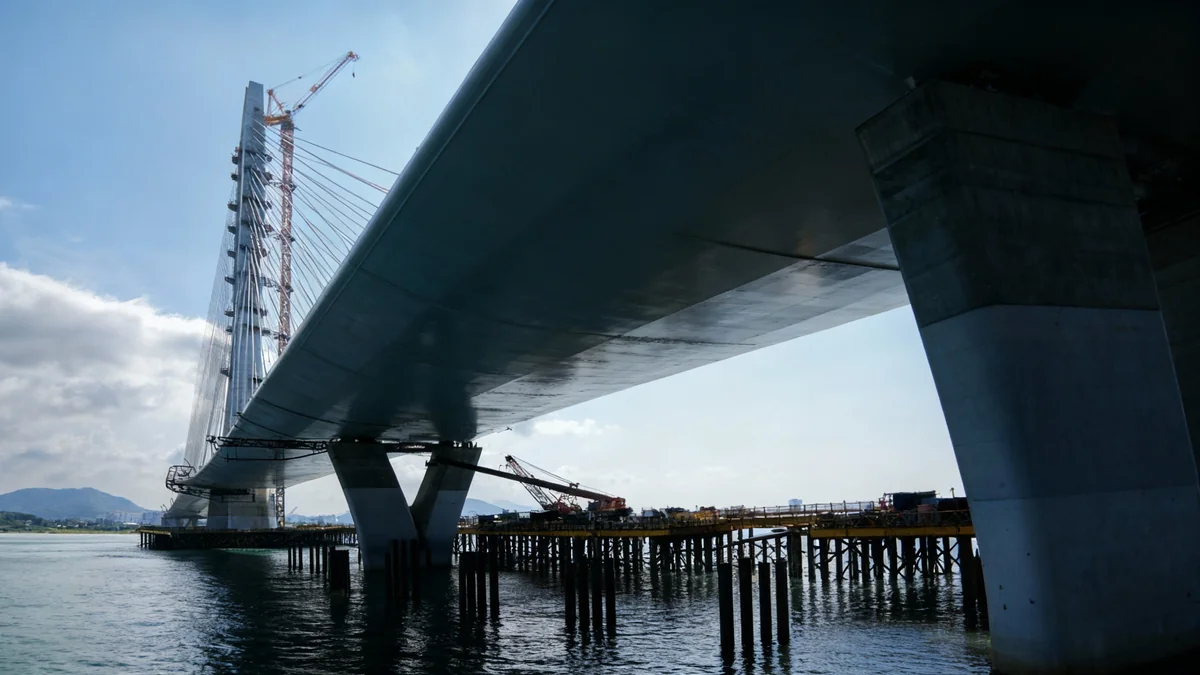
The Danjiang Bridge in Taiwan, designed by Zaha Hadid Architects, is nearing its final stages of construction. This significant infrastructure project, which will become the world's longest single-mast, asymmetric cable-stayed bridge, is on track for a May 12, 2026, opening. The final steel decking segment was installed in October 2025, successfully connecting the Tamsui River estuary's east and west banks.
Key Takeaways
- The Danjiang Bridge is set to open on May 12, 2026.
- It will be the world's longest single-mast, asymmetric cable-stayed bridge.
- The design minimizes visual impact and protects the estuary ecosystem.
- The bridge will significantly ease traffic congestion in the Taipei region.
- It includes provisions for future light rail, pedestrian, and cycling lanes.
A Landmark Architectural Achievement
The Danjiang Bridge project began construction in 2019. Its innovative design, chosen after Zaha Hadid Architects won an international competition in 2015, focuses on a single concrete structural mast. This mast supports a 920-meter-long cable-stayed span, a design choice intended to minimize the bridge's visual footprint on the landscape.
The bridge spans the Tamsui River estuary, a vital waterway flowing through Taipei. This area is known for its scenic beauty, especially sunset views. The design team carefully considered these elements, ensuring the bridge's structure would not obstruct popular vistas.
Bridge Facts
- Length: 920 meters (cable-stayed span)
- Mast Height: 200 meters
- Opening Date: May 12, 2026
- Designer: Zaha Hadid Architects
Improving Regional Connectivity and Traffic Flow
The primary goal of the Danjiang Bridge is to enhance the region's comprehensive infrastructure. It will significantly reduce traffic congestion on local roads by providing a direct link between Taipei's Highway 2 on the eastern bank and Highway 15, the West Coast Expressway (Route 61), and the Bali-Xindian Expressway (Route 64) on the western side.
This new connection will also strengthen the northern coastal traffic network. It is expected to ease the burden on the existing Guandu Bridge, located approximately 5 kilometers upriver. Improved connectivity will benefit Tamsui District, Linkou District, downtown Taipei, New Taipei City, Taoyuan International Airport, and the Port of Taipei.
"The Danjiang Bridge represents a significant step forward in our region's infrastructure development. It will not only alleviate traffic but also enhance the daily lives of countless commuters and residents."
Designed for the Future and the Environment
Zaha Hadid Architects' design incorporates future expansion plans for the Danhai Light Rail network. This foresight ensures the bridge can adapt to evolving public transportation needs. Additionally, dedicated lanes for pedestrians and cyclists are included, promoting alternative modes of transport and recreational use.
Environmental protection was a key consideration. The bridge's single-mast design reduces its impact on the riverbed. This approach aligns with stringent environmental programs established to safeguard the Tamsui River estuary's delicate ecosystem. Detailed 3D modeling and mapping of the estuary were crucial in determining the mast's placement and the road deck's height, ensuring safe passage for river vessels.
Protecting the Estuary
The Tamsui River estuary is a vibrant ecosystem and a popular spot for both locals and tourists. The design of the Danjiang Bridge underwent rigorous environmental impact assessments to ensure minimal disruption to the natural habitat and recreational activities, particularly sunset viewing.
Engineering for Performance and Aesthetics
The 200-meter-tall concrete mast was engineered to be as slender as possible. This design choice supports the bridge's 450-meter central span while ensuring structural performance under challenging conditions. Taiwan is prone to extreme weather and seismic activity, making robust engineering critical for such a large-scale project.
With the main structural components now complete, construction teams are focused on the final phases. These include laying asphalt on the road deck, installing lighting, noise barriers, and various auxiliary facilities. Adjustments to cable forces and comprehensive structural load tests will precede the official opening in May 2026.
Final Touches Before Opening
- Asphalt laying on road deck
- Installation of lighting systems
- Placement of noise barriers
- Integration of auxiliary facilities
- Cable force adjustments
- Final structural load tests
The completion of the Danjiang Bridge will mark a new chapter for transportation and urban development in the Taipei region. It stands as a testament to modern engineering and architectural vision, balancing functionality, environmental responsibility, and aesthetic appeal.