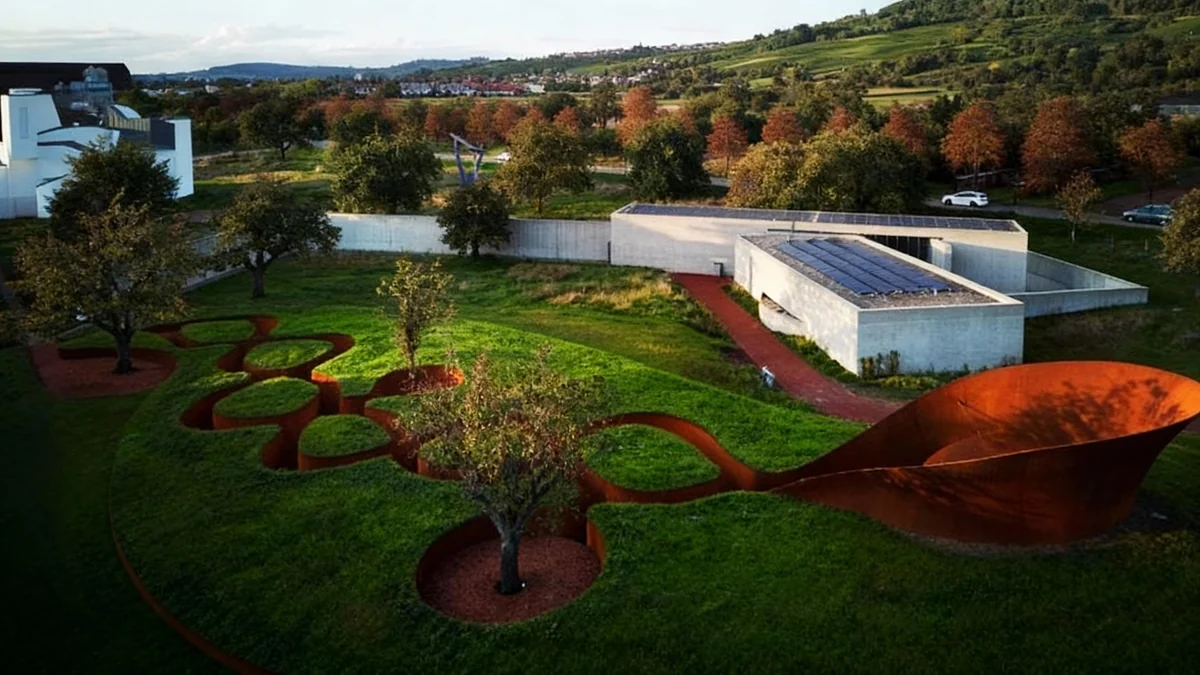

The Doshi Retreat, the final project by the late Pritzker Architecture Prize laureate Balkrishna Doshi, has officially opened at the Vitra Campus in Weil am Rhein, Germany. This unique structure, characterized by its weathered steel and snake-like form, offers a dedicated space for quiet reflection and contemplation.
Key Takeaways
- Doshi Retreat is the last completed work by Balkrishna Doshi.
- It is Doshi's first project outside of India.
- The design features intertwining, sunken pathways leading to a contemplation chamber.
- Constructed from weathered steel, the structure changes appearance with the elements.
- The retreat emphasizes solitude and reflection, a response to global instability.
A Legacy Unveiled
The Doshi Retreat marks a significant addition to the renowned Vitra Campus, a site celebrated for its collection of architectural masterpieces by leading global designers. This particular project holds special importance as it represents the culmination of Doshi's illustrious career, completed posthumously in collaboration with his granddaughter, Khushnu Panthaki Hoof, and her partner, Sönke Hoof, from Studio Sangath.
It stands as a testament to Doshi's profound architectural philosophy, which often explored the relationship between nature, spirituality, and human experience. The retreat is strategically placed adjacent to Tadao Ando's concrete Conference Pavilion, creating a dialogue between two distinct yet complementary architectural visions.
Interesting Fact
The Doshi Retreat is the first building designed by Balkrishna Doshi to be completed outside of his native India, making its location at the Vitra Campus particularly noteworthy.
Inspired by a Dream
The distinctive winding layout of the Doshi Retreat originates from a deeply personal source: a dream Doshi had about two intertwining cobras. This vision, which resonated with ancient Indian symbolism, directly influenced the design of the two interwoven pathways that descend below ground level.
These paths guide visitors towards a central pavilion, which the design team describes as a "contemplation chamber." The journey itself is an integral part of the experience, designed to prepare the mind for reflection.
"What we realised is that the retreat cannot be a place which you just enter into, it has to be a place that you arrive at," Khushnu Panthaki Hoof explained during a tour of the building. "We showed Doshi five different pathway iterations, and one of them had somewhat intertwined paths, and he came and he stood at it and kept looking at it, and said 'this reminds me of a dream I had in my ancestral home of these intertwined serpents.'"
The Materiality of Weathered Steel
The entire structure, including the sunken pathways and the sculptural pavilion, is crafted from weathered steel. This material choice was deliberate, selected for its aesthetic qualities and its ability to change over time. The steel, which was donated by ArcelorMittal, also boasts a high proportion of recycled scrap steel, adding a sustainable dimension to the project.
Sönke Hoof noted that the weathering steel was chosen partly because its appearance evolves with the weather, making it "feel alive." This dynamic surface interacts with its surroundings, enhancing the organic feel of the retreat.
Architectural Context
The Vitra Campus is a unique collection of buildings by world-renowned architects, serving as a hub for furniture design and architecture. Notable structures include Zaha Hadid's Vitra Fire Station, Frank Gehry's Vitra Design Museum, and Herzog & de Meuron's VitraHaus.
A Journey to Contemplation
Access to the pavilion is through a short, arched tunnel. Inside, visitors find a large gong and two semicircular stone benches, inviting a sense of calm. A hand-hammered brass mandala, created by artisans in India, partially shelters these elements. A deliberate gap around the mandala allows rainwater to enter, which collects in a basin encircling the pavilion, creating a serene, ever-changing backdrop of sound and sight.
The design also draws inspiration from Kundalini, an ancient Sanskrit term referring to primal energy often conceptualized as a coil or spiral. As visitors move along the pathways, they encounter raised areas built around trees, while an embedded audio system subtly plays sounds of gongs and flutes, further enhancing the contemplative atmosphere.
The Vision of Rolf Fehlbaum
The project began in 2020 when Vitra's chairman emeritus, Rolf Fehlbaum, approached Doshi. Fehlbaum, the visionary behind the architectural landscape of the Vitra Campus, had been deeply moved by a small shrine at the Modhera Sun Temple in India. He sought to create a similar space for solitude and contemplation at Vitra.
Fehlbaum emphasized the importance of such a space in an era of increasing global instability. He believes the Doshi Retreat offers a much-needed tranquil counterpoint.
"A tranquil counterpoint, a place of contemplation, felt timely," Fehlbaum explained. "Confrontation, polarisation, war and authoritarianism have become increasingly prevalent. So in this climate, we felt that a place representing Doshi's values feels even more appropriate."
The location of the Doshi Retreat was carefully chosen for its distance from the main campus buildings. This deliberate placement reinforces the idea that visitors must make an effort to reach it, allowing their minds to clear and prepare for reflection, a concept echoing Ando's approach to his conference center.
- Recent Campus Additions:
- Marina Tabassum's Khudi Bari house (2024)
- Tsuyoshi Tane's thatch garden house (2023)
- Sabine Marcelis' color-blocked scenography for the VitraHaus loft (last year)
The Doshi Retreat stands as a profound final statement from an architectural master, offering a timeless space for quiet introspection amidst the vibrant architectural tapestry of the Vitra Campus.