
Cities worldwide are rethinking how architecture and urban design can enhance safety and security. This shift moves beyond traditional barriers and surveillance, focusing instead on integrated design principles that foster community trust and resilience. Experts highlight how thoughtful planning can prevent crime and protect public spaces without creating fortress-like environments.
Key Takeaways
- Architectural design actively reduces crime in residential areas.
- Public spaces are being redesigned for safety against mass threats.
- Security measures are integrated subtly into urban infrastructure.
- Balance between safety, openness, and inclusivity is crucial.
- Forensic thinking and design collaboration improve community protection.
Designing Safer Communities at the Domestic Scale
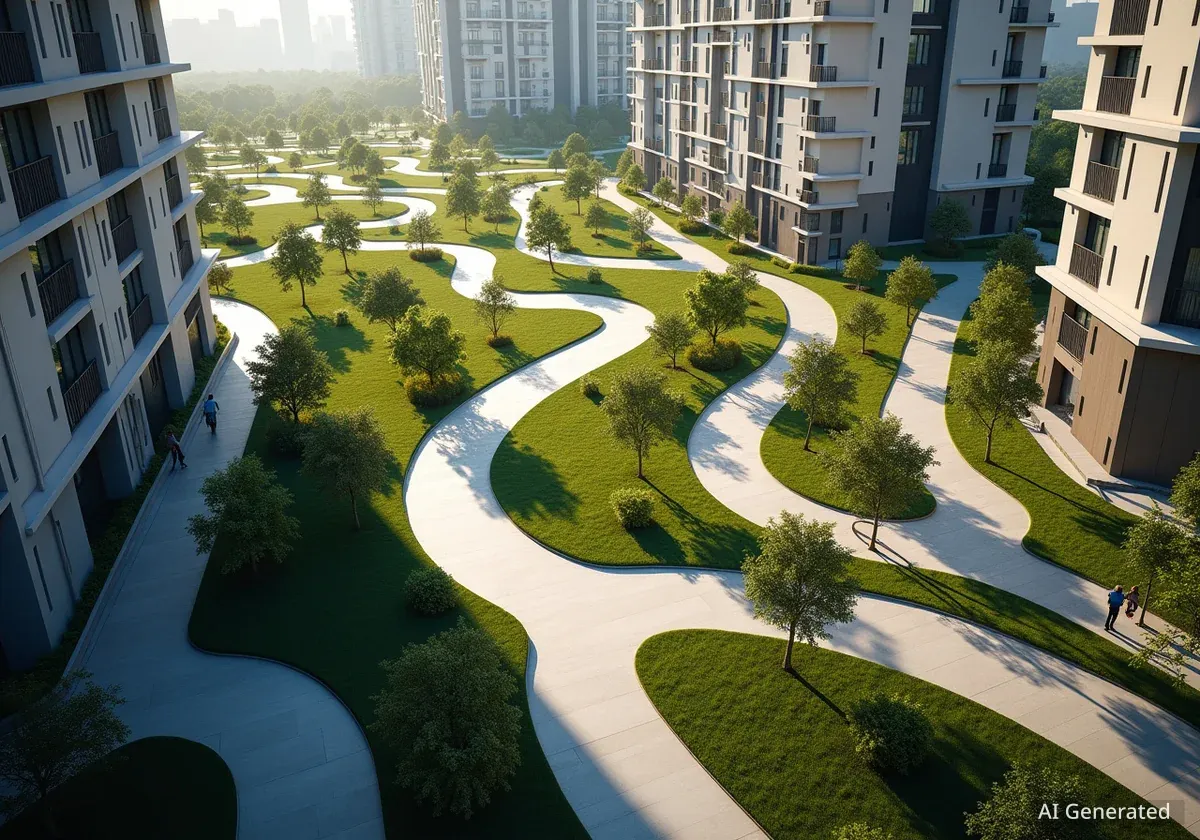
In Southeast London, the Erith Park regeneration project provides a clear example of design's impact on crime reduction. Once characterized by high-rise concrete towers, failing social infrastructure, and high crime rates, the area underwent a significant transformation starting in 2013. Old tower blocks were demolished and replaced with new low and medium-rise homes.
The new development re-established traditional street layouts. Its design for mixed-tenure housing was guided by the 'Secured by Design' (SBD) initiative. This approach focused on creating an environment that naturally deters criminal activity. The results were notable, with crime rates approximately 80% lower than in the surrounding ward.
Erith Park Crime Statistics
- Zero recorded burglaries within the estate boundary.
- Zero weapons offenses reported.
- No drugs-related crime.
- No robberies or personal thefts were recorded.
The success of Erith Park stemmed from intentional design elements that promoted natural surveillance. This included clear sightlines, fewer hidden alleys, and building frontages that directly faced the street. Architects also designed defensible private and semi-private spaces, improved lighting, and incorporated controlled access points with robust doors and windows. Layouts avoided ambiguous, in-between areas that could attract unwanted behavior.
"In this context, architecture plays a proactive role, with architects, law enforcement, developers, and the community collaborating to integrate safety into their neighborhoods," states a report on the project.
The Role of Defensible Space Theory
Oscar Newman's Defensible Space Theory supports these design principles. This theory suggests that the physical layout of an environment can influence social behavior. By fostering a sense of ownership and responsibility among residents, crime can be discouraged. Beyond physical barriers, neighborhood regenerations can also use aesthetics and maintenance as forms of social control. Well-kept landscaped gardens, durable materials, and illuminated pathways visually enhance the environment. This communicates that the space is valued and cared for, subtly deterring unwanted actions.
What is Architectural Forensics?
Architectural forensics involves applying scientific and investigative methods to analyze built environments. In the context of safety, it means understanding how design choices can contribute to or mitigate risks, often by examining crime patterns and human behavior within specific spaces.
Rethinking Public Safety at the City Scale
At the city level, the focus shifts from individual crimes to broader public safety concerns. These include mass gatherings, vehicle-borne attacks, and terrorism. The challenge is to implement security measures without making urban areas feel like fortresses. Anne Quito, a journalist, highlighted this dilemma, writing that "erecting fortress-like protections is, in a way, giving into terror – it allows fear to dictate how we live."
A new generation of security design seeks to integrate protection seamlessly with civic life. Items once purely functional, such as bollards, have evolved into elements of defensive design. They are often disguised as planters, benches, or sculptural forms, blending into the urban landscape while providing essential protection.
Integrating Security into Urban Design
Thomas Vonier, then-President of the American Institute of Architects, urged architects and urban planners to rethink public and civic infrastructure at the 2017 Paris CityLab conference. His call was not for more barricades. Instead, he advocated for design that anticipates risk in subtle, integrated ways. This includes strategic use of lighting, careful street layouts, and unobtrusive barriers.
Vonier's approach highlights a fundamental tension: how much security can be added without sacrificing comfort and openness? How many barriers can be installed without isolating citizens? There is also an equity dimension, where certain populations can face disproportionate scrutiny due to security measures. Any security design in public urban fabric must balance safety with inclusion and transparency. This makes architecture an ethical and geopolitical concern.
Design Principles for Urban Safety
- Natural Surveillance: Maximizing visibility in public spaces.
- Defensible Space: Creating clear ownership and responsibility.
- Legible Boundaries: Distinguishing public from private areas.
- Material Robustness: Using durable, resilient construction.
- Transparency: Openness in design to foster trust.
A Proactive Approach to Protective Architecture
Across both domestic and city-scaled interventions, architecture is moving towards anticipating risk rather than merely reacting to it. Safety is no longer an afterthought, retrofitted with gates, cameras, or barricades. Instead, it is a guiding principle integrated into street patterns, building layouts, and civic infrastructures from the start. In London's Erith Park, streets and building frontages are configured to "design out crime." Meanwhile, city infrastructure aims to embed vigilance without disrupting the daily rhythms of life.
While the scale of projects shifts, the core principles remain consistent. Natural surveillance, defensible space, clear public/private boundaries, robust materials, and transparency form a toolkit for protective architecture. The built environment has the power to either reinforce fear or build trust. When architecture collaborates with criminology and forensics, safety is redefined. It moves from being merely the absence of crime to the active presence of resilience.
The intersection of architecture and safety involves complex considerations. These include surveillance versus privacy, fortification versus openness, and the politics of whose safety is prioritized. Protective measures can sometimes displace or stigmatize certain groups. This gives the false impression that architecture alone can resolve social inequities. The ongoing tension allows architecture to assert its ethical responsibility. Safety is not just built; it is imagined, performed, and constantly debated. It reflects both the values and the vulnerabilities of the people it serves.