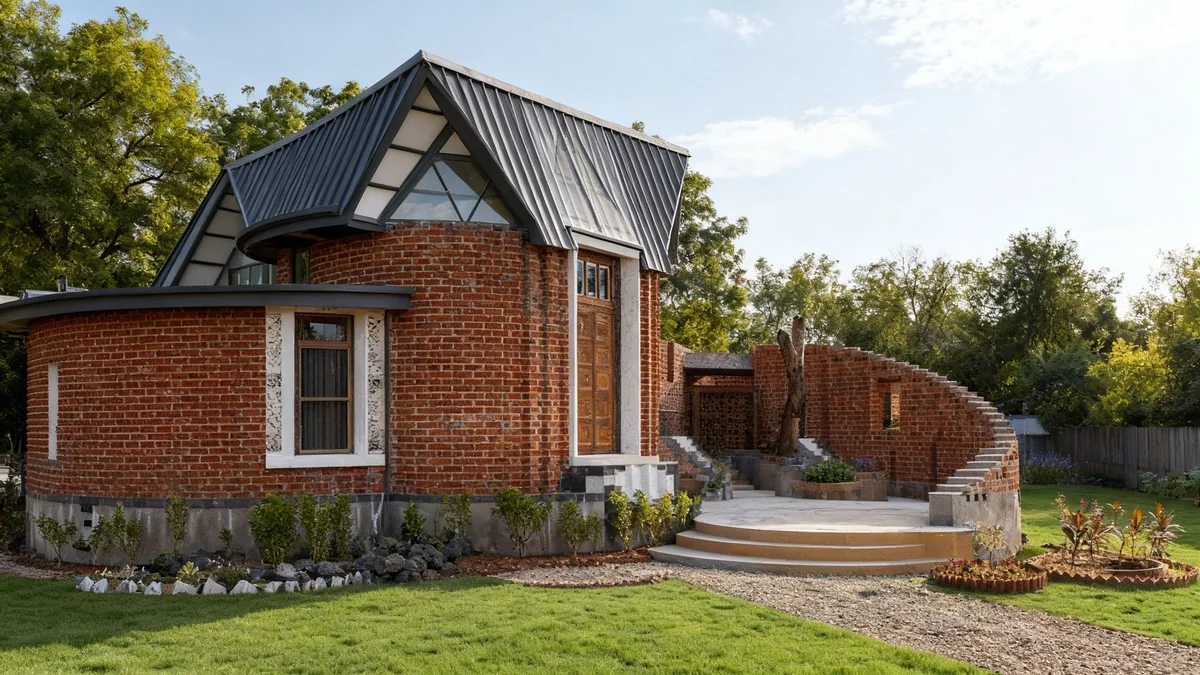
The Antriya House, a unique family weekend home designed for three generations, is nearing completion in Muchintal, a quiet village on the outskirts of Hyderabad, India. This project, led by 23 Degrees Design Shift, focuses on integrating nature, family history, and modern living across a sprawling five-acre site. Scheduled for completion in 2025, the residence aims to provide a retreat that fosters connection with both family and the natural environment.
Key Takeaways
- Antriya House is a multi-generational weekend home in Muchintal, Hyderabad.
- Designed by 23 Degrees Design Shift, it emphasizes nature and family connection.
- The five-acre site features a unique organic driveway and diverse outdoor activities.
- Architectural elements like floating plinths and deep overhangs minimize heat gain.
- Local materials like Khammam brown sandstone and Markapuram slate are used throughout.
Concept and Client Vision
In 2021, Mr. Sachin Agarwal and Mr. Nitin Agarwal approached 23 Degrees Design Shift with the idea for a family weekend home. The architects engaged in extensive discussions with the brothers, requesting a detailed brief that included input from all three generations of their joint family. This collaborative approach aimed to understand not only their spatial requirements but also their inspirations, aspirations, and family stories.
The Agarwal family, involved in various businesses from steel to jewelry, sought a space distinct from their city residence. Their parents, living a retired life, provide daily guidance to their sons' families. The younger generation, recently out of high school, is exploring the world. Understanding these diverse needs was crucial in shaping the design of Antriya House, ensuring it would offer both physical comfort and emotional resonance.
"This inquiry made us understand what a weekend home should offer them both in its physical and emotional existence," the architects stated, highlighting the project's deep personal connection to the family's narrative.
The Muchintal Site and Its Unique Features
The chosen site is located in Muchintal, a serene village south of Hyderabad. Its proximity to a national highway and the family's steel factory suggested that the home would be used more frequently than a typical weekend retreat. This led the family to decide on a shared responsibility for its upkeep, involving both elders and younger members.
Site Snapshot
- Location: Muchintal, Hyderabad outskirts
- Size: 5 acres
- Key Feature: One large peepal tree (Ficus religiosa)
- Access: From the shorter east side
The five-acre site is long and narrow, initially featuring minimal vegetation except for a significant peepal tree on its western side. The design team decided to place the main building on the western half, where the land was free of sheet rock and boulders, simplifying construction.
Organic Driveway and Landscape Design
A curving, organic driveway cuts through the center of the site. It carefully navigates around existing boulders and sheet rock, creating an engaging entry experience. Low-height walls line the driveway, blocking views of the house until visitors reach the drop-off point, enhancing the sense of discovery.
The landscape along the driveway is not merely aesthetic; it is functional. Activities are placed on both sides, ensuring the entire length of the site is utilized. These include a grape garden, which evokes childhood memories for Sachin and Nitin, and sports nets and an ATV mud track for the younger family members. A semi-open outdoor kitchen caters to larger gatherings.
Mediterranean Inspiration
A rock garden, designed using existing boulders and featuring desert palm trees and bougainvillea, draws inspiration from the family's travel experiences in the Mediterranean. This personal touch integrates their global adventures into the local landscape.
Multiple guest parking spots and a secluded domestic help quarters block are also integrated into the landscape, providing necessary privacy and utility.
Architectural Design of Antriya House
The house itself sits in the western part of the site. The drop-off area is positioned next to the large peepal tree, creating a strong sense of arrival. The entire structure is defined by three linear stone walls that provide direction, privacy, and a feeling of enclosure. These walls guide movement and establish spatial relationships.
The Private Pool Area
Privacy for the pool was a primary request from the client, ensuring all age groups could use it comfortably. The first linear stone wall on the north side, with an adjoining floating pathway, directs visitors towards a semi-open verandah while also providing privacy for the pool. Even with its privacy, the pool area offers a connection to nature through dense landscaping growing through wall offsets and a central open-to-sky roof.
Main House Structure and Features
A pathway, floating four feet above ground, leads to the main house. A second stone wall centrally divides the common areas (living, dining, verandahs, kitchen) from the private bedroom spaces. All internal spaces boast a fifteen-foot internal volume, with an intermediate slab running at a ten-foot height around the house.
Deep Overhangs for Climate Control
Cantilevered overhangs, spanning eight to ten feet, extend around the entire house. These deep overhangs are designed to shade the glazing systems throughout the day, significantly reducing heat gain. They also ensure uninterrupted views from inside the structure. Greenery planted above the overhang slab is visible through clerestory windows in all rooms, creating dramatic lighting effects as light filters through the plants.
The Floating Plinth and Water Body
The entire house appears to float on a cantilevered plinth above a continuous water body. This water feature, populated with fish and aquatic plants, serves a dual purpose: it adds aesthetic value and acts as a natural barrier against snakes and other crawling creatures, a practical consideration for a home in a natural setting. The floating plinth and intermediate slab reduce the perceived scale of the house, making it feel more human-centered and cozy.
Central Axis and Landscape Integration
The house's design incorporates central axis lines in both east-west and north-south directions. These invisible lines create visual permeability, making the structure feel lighter from both inside and outside. The axes terminate at four nodes, each featuring weeping willow trees and stone-paved seating areas.
Extensive tree plantations are set forty feet away from the house, allowing for open lawns that ensure uninterrupted airflow and help reduce ambient heat gain. These lawns also provide space for social gatherings. Curated shrub plantations around the water body enhance the house's floating effect. Coconut trees are strategically placed near the house to break down its scale. Curtain creepers growing from the overhangs offer additional shade and a dynamic visual element as they move with the wind.
Interior Spaces and Material Palette
Upon reaching the verandah, visitors are greeted by a bold, sculptural staircase that forms the backdrop to a semi-open lounge. This verandah can transform into a larger indoor living space with a sliding glazing system, creating a versatile pavilion for various family activities and social events. A third stone wall on the south side screens service areas from the main house.
Bedrooms and Views
The house features five bedrooms. Four are located on the ground floor, keeping the main living areas close to the ground. A single bedroom on the first floor, situated on the southeast side, offers expansive views of the garden.
Material Choices Reflect Nature
The design team aimed to use less processed, genuine materials, bringing residents closer to nature. The house is finished with neutral light grey lime plaster, allowing it to blend seamlessly with its surroundings. The three prominent stone walls are constructed from Khammam brown sandstone, while the flooring uses Markapuram slate stone.
- Khammam brown sandstone: Locally sourced, offers a rough, porous texture for creepers to grow.
- Markapuram slate stone: Also locally available, provides a smooth yet undulating surface, encouraging barefoot walking.
Reclaimed solid teak wood furniture and live-edge wood pieces as benches and tables enrich the natural palette. Jute rugs and curtains complement the built context. Black metal accents, including glazing systems, lights, and fans, provide a contrast to the light grey walls, enhancing the space's artistic character.
Antriya House: A Space for Connection
The Antriya House is designed as a transgenerational space, fostering family unity and a deep connection with nature. It is a place for hosting friends, born from family memories and aspirations, and accommodating the younger generation's desire for activities. The house encourages self-reflection and a sense of oneness, embodying its name, Antriya.
Its modern usage patterns are rooted in nature, offering a timeless character. By using fundamental design tools like light, air, earth, and sky, the space aims to ground its users and promote a compassionate interaction with nature. It is a home that is both open and intimate, truly reflecting its purpose as a family retreat.