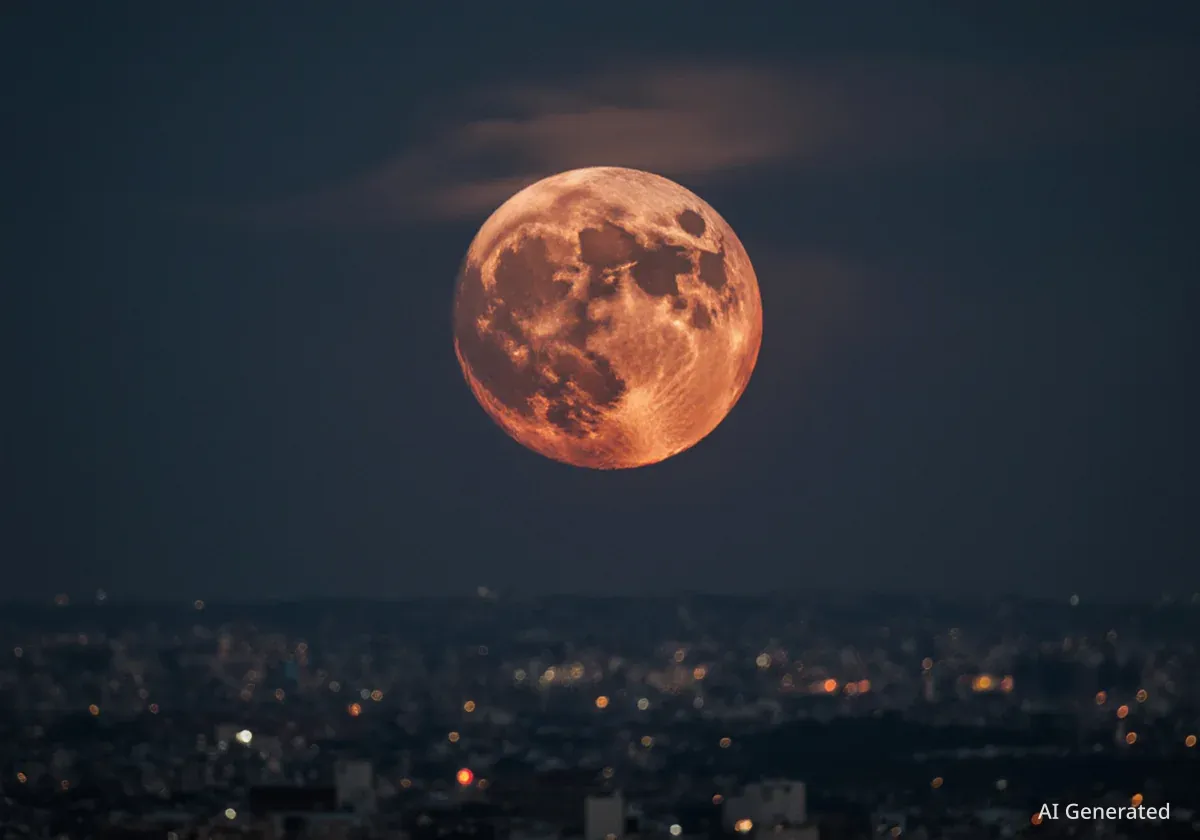



Skygazers across the United States are preparing for a spectacular celestial event on March 3: a total lunar eclipse, often referred to as a "blood moon." This phenomenon will transform the moon into a striking reddish-orange hue, offering a unique visual experience in the early morning hours.
During a total lunar eclipse, the Earth positions itself directly between the sun and the moon. This alignment casts Earth's shadow across the lunar surface, and the reddish appearance results from sunlight filtering through our planet's atmosphere and scattering onto the moon.
Key Takeaways
- A total lunar eclipse, or "blood moon," is set for March 3.
- The event will be visible across the United States.
- Partial eclipse begins around 4 a.m. ET, with totality starting after 6 a.m. ET.
- Digital cameras offer the best photo results, but smartphones can also capture the event.
- Experts advise using a tripod and adjusting camera settings for optimal photos.
Eclipse Visibility and Timing
The upcoming lunar eclipse on March 3 will be visible from roughly half of Earth. Fortunately, this includes a wide area of North America, making it accessible to millions of viewers in the United States.
According to NASA, the partial eclipse phase will commence around 4 a.m. ET. This is when Earth's shadow first begins to cover a portion of the moon. The dramatic totality phase, where the moon is fully immersed in Earth's shadow and takes on its characteristic red color, is expected to begin just after 6 a.m. ET.
The total eclipse will last for approximately one hour, providing ample time for observers to witness the event. Viewers should plan to be outside and looking towards the moon during these crucial early morning hours to catch the full spectacle.
Lunar Eclipse Facts
- The term "blood moon" describes the reddish color of the moon during a total lunar eclipse.
- This color is caused by sunlight bending through Earth's atmosphere, similar to how sunsets appear red.
- Each lunar eclipse is visible from roughly half of Earth at any given time.
Photographing the Blood Moon with Digital Cameras
Capturing a clear image of the moon during a lunar eclipse presents a unique challenge. For those aiming to photograph the event, a digital camera is the recommended tool for the best results. NASA offers several key tips for photographers.
First and foremost, stability is crucial. Using a tripod will prevent camera shake, which can blur images, especially in low-light conditions. To further minimize movement, photographers should consider using their camera's self-timer function instead of manually pressing the shutter button.
Camera settings require careful adjustment. Despite the dark sky, it is advisable to avoid using typical low-light settings. The moonlight is essentially reflected sunlight, so setting the camera's white balance to daylight can help reveal the moon's features more clearly. Additionally, a fast shutter speed combined with a smaller aperture (higher f-stop number) is often effective.
Finally, remember that the moon often appears larger to the naked eye than it does in photographs. Therefore, it is essential to zoom in significantly to ensure the moon fills a substantial portion of the frame.
Smartphone Photography Tips for the Eclipse
While digital cameras offer superior quality, most people will likely use their smartphones to capture the eclipse. Todd Vorenkamp, a photographer and instructor at the Rhode Island School of Design, has experience with eclipse photography and shares practical advice for smartphone users.
Vorenkamp notes that the red color of the moon might appear even brighter in smartphone photos than it does to the naked eye, creating a vivid image. He emphasizes a few simple adjustments to improve results.
One critical step is to adjust exposure. Smartphone cameras tend to average the light across the entire scene, making the moon appear as an overly bright spot against a dark background. To counter this, tap on the moon on your phone's screen to focus the camera and adjust its exposure specifically for the moon. iPhone users can also manually control brightness after tapping to focus.
Why the Moon Turns Red
During a total lunar eclipse, the moon passes through the darkest part of Earth's shadow, known as the umbra. However, some sunlight still reaches the moon. This light is refracted and scattered by Earth's atmosphere, with blue light scattering away, leaving only red and orange wavelengths to reach the moon's surface. This is the same phenomenon that causes sunrises and sunsets to appear red.
Another important tip for smartphone photographers is to zoom in. Most smartphone cameras feature wide-angle lenses, which can make the moon appear very small in the frame. Zooming in will help capture more detail. However, be mindful that digital zoom can reduce image quality, so use it judiciously.
Many modern smartphones also include a night mode setting. This feature increases the camera's sensitivity in low-light conditions and may assist in capturing clearer images of the moon during the eclipse. Experimenting with night mode could yield interesting results.
Enjoy the Experience
Vorenkamp offers a valuable piece of advice: do not let the pursuit of the perfect photograph overshadow the experience itself. While smartphones are convenient, he reminds viewers that digital cameras generally produce better-quality images of celestial events.
"Enjoy the experience, look with your own eyes and don't sweat getting the most epic photograph because there's a bunch of pros that are going to be out there and taking that epic photo and putting it on Instagram for you to look at later," Vorenkamp stated.
His words serve as a reminder to appreciate the rare beauty of a total lunar eclipse firsthand. The memory of witnessing the blood moon directly can be more rewarding than striving for a flawless photo.
So, on March 3, set your alarms early, find a clear viewing spot, and prepare to witness one of nature's most captivating celestial displays. Whether you capture it on camera or simply take it all in with your own eyes, it promises to be a memorable morning.