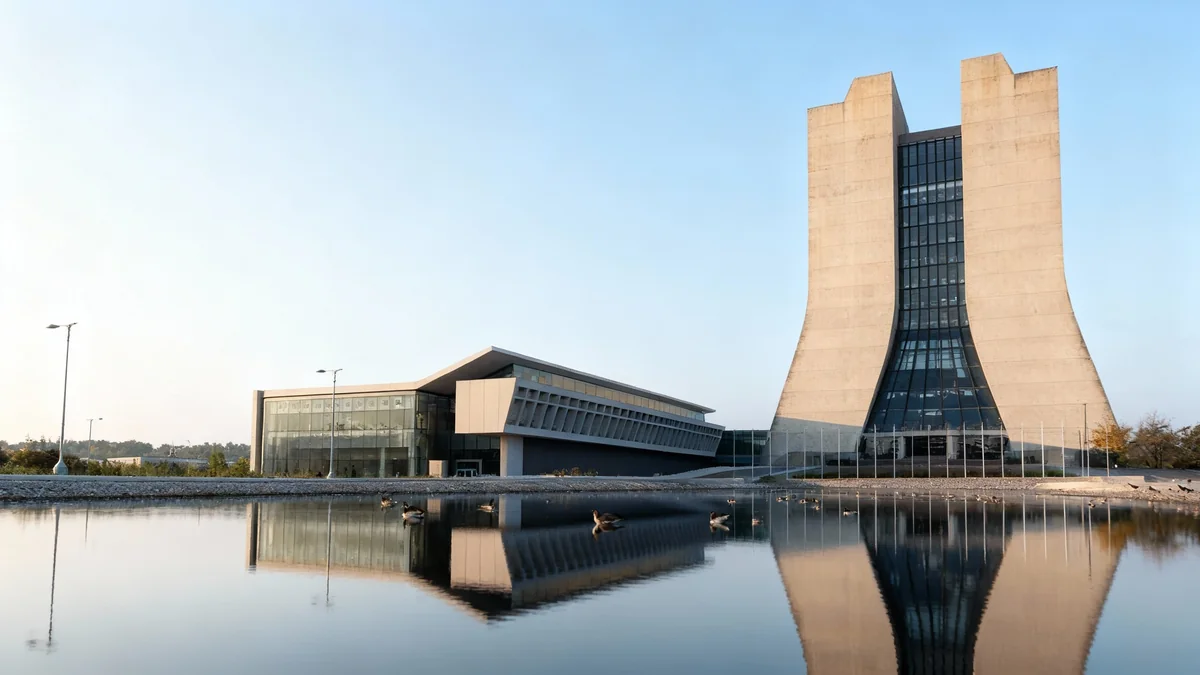




Fermilab, the United States' leading particle physics laboratory, has officially opened its new Helen Edwards Engineering Research Center (HEERC). This 8,361 square meter facility, completed in 2023, is designed to consolidate researchers and engineers who were previously spread across various buildings on the vast 6,800-acre campus near Chicago. The center aims to foster enhanced collaboration and support ongoing breakthroughs in particle physics, including the critical Deep Underground Neutrino Experiment.
The HEERC is named in honor of Dr. Helen Edwards, a pioneering particle physicist who dedicated over four decades of her career to Fermilab. Her legacy of innovation and dedication is now reflected in a building designed to push the boundaries of scientific discovery for generations to come.
Key Takeaways
- Fermilab's new Helen Edwards Engineering Research Center (HEERC) spans 8,361 square meters.
- The facility brings together researchers and engineers previously dispersed across the 6,800-acre campus.
- It supports the Deep Underground Neutrino Experiment and other particle physics research.
- The building is named after Dr. Helen Edwards, a pivotal figure in particle physics at Fermilab.
- Design emphasizes flexibility, collaboration, and integration with the existing historic campus.
A New Hub for Particle Physics Innovation
The new Helen Edwards Engineering Research Center marks a significant step for Fermilab. For years, the laboratory's talented scientists and engineers worked in separate facilities. This new center changes that, bringing these critical teams under one roof. The goal is to create a more cohesive environment, allowing for quicker problem-solving and shared insights.
The facility's strategic location northeast of the iconic Wilson Hall ensures its seamless integration into Fermilab's historic landscape. Architects Perkins&Will carefully considered the proportions and scale of Wilson Hall, ensuring that HEERC complements its surroundings while introducing a modern architectural approach. A transparent bridge connects the two structures, facilitating the movement of equipment and supplies, and symbolizing the link between Fermilab's past achievements and its future aspirations.
Quick Facts: HEERC
- Area: 8,361 square meters
- Completion Year: 2023
- Location: Batavia, United States (Fermilab campus)
- Architects: Perkins&Will
Designed for Flexibility and Collaboration
The core design philosophy behind HEERC centers on openness and adaptability. The ground floor features high-bay, vibration-sensitive laboratories. These labs offer direct access to Wilson Hall and its adjacent loading dock, streamlining operations for large-scale experiments.
Collaboration is a central theme throughout the building. Flexible 'hybrid' labs and open work areas can be reconfigured to meet various research demands. These spaces can function as traditional offices, electrical engineering testing zones, or even accommodate future uses not yet imagined. This modular design provides Fermilab with the agility needed to adapt as scientific research evolves over time.
"The Helen Edwards Engineering Research Center represents more than just a new building," a Fermilab spokesperson stated. "It embodies Fermilab's commitment to uniting people, advancing discovery, and preparing for the future of particle physics." This sentiment highlights the facility's role in fostering a dynamic research community.
Acoustic Performance Supports Focus
Creating an environment conducive to deep scientific work, while also promoting open collaboration, presented a unique challenge. Acoustic performance was a critical design consideration. The architects incorporated sound-absorbing finishes and carefully selected furnishings to minimize noise. Double-glazed office fronts and advanced mechanical system attenuation further ensure quiet, focused workspaces. This attention to detail allows complex technical activities to proceed without interruption, even in open-plan areas.
Fermilab's Mission
Fermilab, officially the Fermi National Accelerator Laboratory, is a U.S. Department of Energy national laboratory specializing in particle physics. Its primary mission is to advance humankind's understanding of the universe and its fundamental constituents. For over 50 years, Fermilab has been a global leader in scientific discovery, pushing the boundaries of knowledge through accelerator science and related technologies.
Science on Display: Argon Cube and Quantum Science Center
HEERC also serves as a showcase for the groundbreaking science happening within its walls. Two notable spaces highlight this commitment to transparency and public engagement: the Argon Cube and a multi-function Quantum Science Center. The Argon Cube houses a massive 15,000-gallon vat of liquid argon, a crucial component in neutrino detection experiments.
These spaces demonstrate how thoughtful design can elevate the visibility of science. They make complex research more accessible and engaging for both the scientific community and the broader public. By putting science on display, HEERC aims to inspire future generations of physicists and engineers.
Supporting the Deep Underground Neutrino Experiment (DUNE)
A major focus of the research at HEERC is the Deep Underground Neutrino Experiment (DUNE). This international collaboration aims to unlock the mysteries of neutrinos, fundamental particles that could hold clues to why the universe is made of matter. The work done at HEERC directly supports the development and operation of detectors for DUNE, which will eventually send neutrino beams over 800 miles through the Earth to detectors in South Dakota.
The advanced labs and collaborative spaces within HEERC are essential for developing and testing the sophisticated equipment required for such an ambitious experiment. Engineers and physicists will work side-by-side, refining technologies that will probe some of the universe's most profound questions.
Preparing for the Future of Particle Physics
The Helen Edwards Engineering Research Center represents more than just a new facility; it embodies Fermilab's commitment to uniting people, advancing discovery, and preparing for the future of particle physics. By thoughtfully integrating with its historic setting while providing flexible, collaborative, and highly specialized spaces, HEERC ensures Fermilab remains at the forefront of scientific innovation for decades to come.
This new center is expected to draw top talent from around the world, further solidifying Fermilab's position as a global leader in high-energy physics. The investment in HEERC underscores the importance of fundamental research in expanding human knowledge and technological capabilities.