Ai Weiwei, the renowned dissident artist, made a surprising return to China in mid-December for a three-week visit. This marks his first time on Chinese soil in nearly a decade, following the revocation of his passport in 2011 and a period of secret government detention. His return, alongside his 17-year-old son, signals a deeply personal reconnection with his homeland.
The artist, who has spent the last ten years living in Germany, the UK, and Portugal, described the moment of his arrival in Beijing as if a long-disconnected phone call had suddenly reconnected. He noted that the familiar tone, rhythm, and speed of his surroundings immediately returned.
Key Takeaways
- Ai Weiwei returned to China for a three-week visit in December after a decade of exile.
- His passport was revoked in 2011, leading to his departure in 2015.
- The artist reunited with his 93-year-old mother and explored Beijing with his son.
- He faced a nearly two-hour interrogation at Beijing airport but the rest of his trip was smooth.
- Ai believes his long-term public expression of views has led to a degree of official recognition.
A Return to Familiar Sights and Sounds
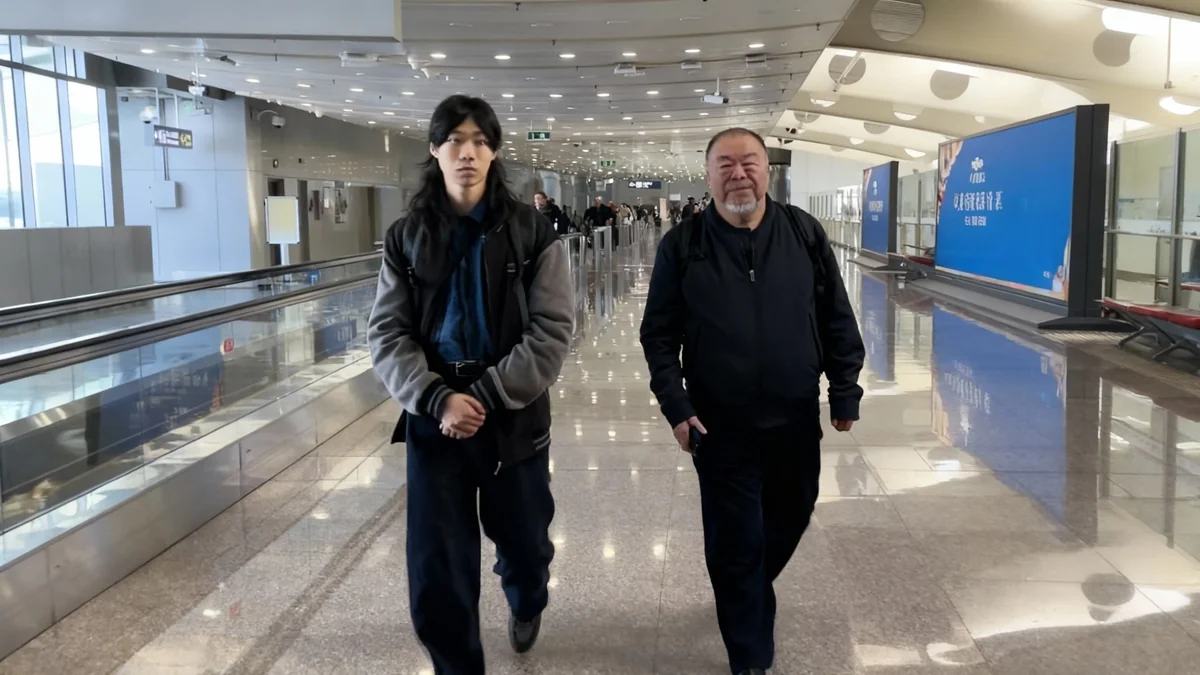
Ai Weiwei arrived at Beijing Capital International Airport with his son. Photos shared from their journey capture their exit from the airport, marking a significant moment for the family.
Glimpses of the trip appeared on Ai’s Instagram account, where he regularly posts images without extensive captions. These posts offered understated views of his time in China. One video showed smokestacks against the soft light of a Beijing winter, a characteristic scene of the capital.
Other images captured everyday moments: the artist smoking cigarettes while a Lazy Susan spun with dishes and a bottle of Nongfu Spring mineral water, a robot exiting an elevator, and Ai lifting dumbbells in an indoor gym. These ordinary scenes gained an extraordinary quality when considering his past intense surveillance in Beijing.
"What I missed most was speaking Chinese," Ai Weiwei stated. "For immigrants, the greatest loss is not wealth, loneliness or an unfamiliar lifestyle, but the loss of linguistic exchange."
Reunion and Reflection
A poignant part of Ai's visit was his reunion with his 93-year-old mother. Shared photos depict the emotional meeting, showing his mother smiling and holding hands with his son. This intergenerational connection brought a sense of natural, human happiness.
Fact Check
Ai Weiwei spent 81 days in secret government detention in 2011, accused of tax evasion. His passport was returned in 2015, allowing him to leave China.
The artist described his mother's contentment as a gentle wind on a hot day or a few drops of rain during a drought. He found this feeling unfamiliar and surprising, highlighting the depth of the emotional impact.
Another photograph from his trip shows Ai posing with a Foshou, or "Buddha’s Hand," plant. This plant grows in Jinhua, the location of his ancestral family home, further emphasizing his connection to his roots.
Past Criticisms and Evolving Surveillance
When Ai Weiwei left China in 2015, he was a prominent critic of the government. He openly spoke against alleged human rights abuses, censorship, and corruption. His artwork often served as a form of protest.
His 2009 installation "Remembering" drew international attention by commemorating children who died in the collapse of poorly constructed school buildings during the 2008 Sichuan earthquake. In 2013, his piece "S.A.C.R.E.D." debuted at the Venice Biennale, using six life-sized dioramas to depict his nearly three-month imprisonment.
Historical Context
Following the 2008 Beijing Olympics, Chinese officials intensified efforts to project an image of national development while actively suppressing dissent. Ai Weiwei's critical artworks emerged during this period.
In the decade since Ai's departure, China's censorship and surveillance infrastructure have grown more advanced. Critics now express concerns that artificial intelligence is enhancing these systems of control, making them more sophisticated than ever before.
Airport Interrogation and Smooth Sailing
Despite not taking specific precautions for his trip, Ai Weiwei faced an inspection and interrogation lasting almost two hours at Beijing’s airport. Authorities questioned him about his planned length of stay and his intended destinations.
However, after this initial hurdle, the rest of the 68-year-old artist's visit was described as smooth and pleasant. This relatively trouble-free stay may indicate a shift in official strategy.
One possible reason for the authorities' relaxed approach could be their confidence in two areas. First, the Chinese public is increasingly unfamiliar with Ai Weiwei, as his name and works have largely been censored on the country’s social media platforms. Second, the government's surveillance technologies are now expansive and highly capable.
Politically, detaining or preventing a high-profile artist like Ai Weiwei from entering Beijing might also generate significant international outcry, something the authorities might wish to avoid. The precise "red lines" in China remain vague and constantly evolving.
Continued Work and Future Outlook
From Europe, Ai Weiwei has continued to create art that critiques the state. His 2020 documentary "Coronation" examined China’s initial handling of the Covid-19 outbreak in Wuhan. "Cockroach" offered a sympathetic perspective on the 2019 Hong Kong pro-democracy protests.
He has also focused on global issues, including the refugee crisis and the war in Ukraine. When asked if he believed the Chinese government’s attitude toward him had changed, he suggested that any change was not recent.
"Rather, it comes from my long-term public work in expressing my views… Although a country or group may disagree with my positions, they at least recognize that I speak sincerely and not for personal gain."
Ai Weiwei observes that China is in an "upward phase," citing individual wealth, national strength, and personal freedoms, even though political discussions remain taboo. He believes the overall trajectory is one of ascent, despite emerging problems at different stages.
Conversely, he argues that Western society is in decline, a view that aligns with frequent messages from Chinese leaders. He expressed shock at the changes he has witnessed over the past decade, feeling that values once celebrated in the West now appear hollow.
Regarding a permanent return to China, Ai Weiwei stated he has "never truly left anywhere; the distance has simply grown longer." He has previously expressed feeling like a "stranger" everywhere, belonging nowhere. However, his Chinese passport remains his anchor, providing him the fundamental right to return to his place of birth, regardless of human-made obstacles.