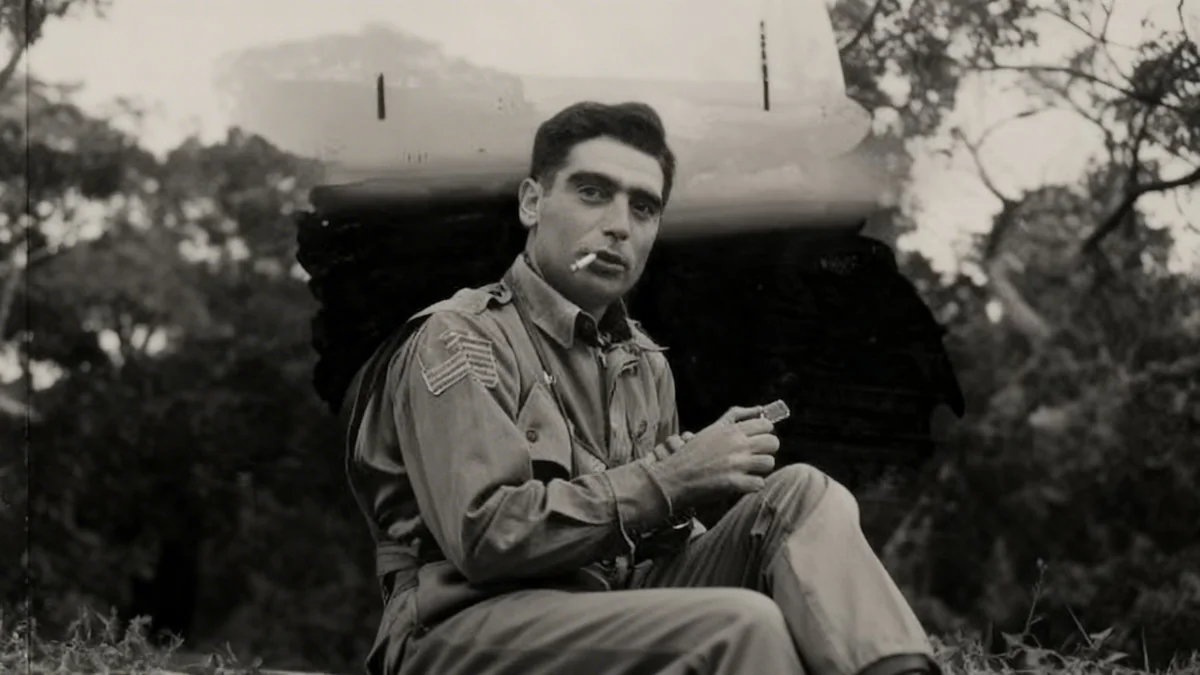
A new exhibition at Paris's Liberation Museum is offering a deep dive into the life and work of Robert Capa, the legendary war photographer. Known for his daring frontline coverage and a carefully crafted public persona, Capa's story goes beyond the battlefield, revealing a complex individual who shaped modern photojournalism.
Key Takeaways
- Robert Capa, born Endre Friedmann, invented both a persona and a photographic style.
- The exhibition covers his early life as a Jewish exile, his rise during the Spanish Civil War, and D-Day photography.
- His affair with Ingrid Bergman is explored, which reportedly inspired Alfred Hitchcock's film, Rear Window.
- Capa co-founded Magnum Photos and died at 40 while covering the Indochina War.
The Making of a Legend: Endre Friedmann Becomes Robert Capa
Born Endre Friedmann in Budapest, Hungary, Capa was the son of a Jewish tailor. His early life was marked by political turmoil and persecution. He fled Hungary in 1931 at the age of 18, escaping the increasingly hostile nationalist regime of Admiral Miklós Horthy.
His rebellious nature and opposition to fascism led to his arrest and imprisonment. To secure his release, he had to promise to leave the country. This marked the beginning of his journey across Europe.
He moved to Berlin, intending to study journalism and political science. He supported himself by working for the Dephot photo agency. However, the rise of the Nazis forced him to flee again, this time to Paris.
Interesting Fact
Robert Capa was not his birth name. He adopted it in Paris to make himself more marketable as a photojournalist. Some accounts suggest his partner, Gerda Taro, helped choose the name.
In Paris, he became a freelance photographer. It was there he met Gerda Taro, a German Jewish photographer who also fled Nazi Germany. Taro, born Gerta Pohorylle, also changed her name. Together, they made a significant impact on frontline photojournalism.
Frontline Photography and Personal Loss
Capa and Taro gained acclaim for their coverage of the Spanish Civil War, which began in 1936. Their work from the front lines established Capa's reputation. One of his most iconic images, The Falling Soldier, captures a Republican militiaman at the Battle of Cerro Muriano in 1936.
Tragically, Gerda Taro was fatally injured in July 1937 while covering the conflict. She died at 26 in a Madrid hospital, with Capa by her side.
"He invented both a personality and a style of photography," stated Sylvie Zaidman, director of the Liberation Museum. "His approach set the tone for generations of frontline photojournalists."
During the Spanish Civil War, Capa formed a close bond with American author Ernest Hemingway. Capa photographed Hemingway interacting with soldiers on the front line in 1937, even showing him helping a Republican fighter unjam his rifle. Their camaraderie extended beyond the war, with Capa later photographing Hemingway on a duck hunt in Idaho in 1940.
World War II and Iconic D-Day Images
As World War II broke out in September 1939, Capa returned to Paris. However, as a stateless Jew facing increasingly strict French laws on "undesirable foreigners," staying in Paris became too dangerous. He closed his studio and boarded a ship for America, making New York his base for much of the war.
Despite being based in New York, Capa frequently traveled back to Europe for assignments, notably for magazines like Life. His photographs of the Allied landings on D-Day, June 6, 1944, are among his most famous.
His slightly blurred image of an American GI struggling through the surf at Omaha Beach under intense German machine-gun fire remains a defining image of the landings. The raw, immediate quality of these photographs conveyed the chaos and bravery of the moment.
Historical Context: D-Day Photography
While Capa took many photographs on D-Day, only ten of his images from the landings survived. The immense impact of these few surviving pictures highlights their significance in documenting one of the most pivotal moments of World War II.
Another powerful image from 1944 shows a Frenchwoman whose head was shaved in Chartres for allegedly collaborating with the Germans. This photograph was first published in Life magazine, capturing the harsh realities and public reckoning that followed liberation.
Footage displayed at the exhibition shows Capa at work in newly liberated Paris, where he photographed General Charles de Gaulle, French civilians, and soldiers. It was during this period that he often socialized with Hemingway, frequenting the Hôtel Scribe and various parties.
Post-War Life, Hollywood Romance, and Last Assignment
After the war, Capa co-founded Magnum Photos, a renowned international photographic cooperative, with his friend Henri Cartier-Bresson and other photographers. He continued his travels, including a trip to the Soviet Union with American author John Steinbeck.
His post-war years also included a passionate, two-year affair with Hollywood star Ingrid Bergman. They met in 1945 at the Ritz in Paris, a favorite haunt of Hemingway's, while Bergman was touring to entertain American troops. Their relationship quickly blossomed.
Capa followed Bergman to Hollywood, where he photographed her on film sets and even had a small role in the movie Temptation. At the time, Bergman was in a strained marriage with Petter Lindstrom, a Swedish-American neurosurgeon.
Hollywood Inspiration
Alfred Hitchcock's 1954 film Rear Window, featuring a risk-addicted photojournalist and a New York socialite, is widely believed to be loosely inspired by Capa's relationship with Ingrid Bergman.
Bergman reportedly confided in Hitchcock, expressing her conflict between her marriage and her relationship with the restless war photographer. She considered divorcing Lindstrom to marry Capa. However, Capa famously told her he was "not the marrying kind," unwilling to give up his freedom to cover conflicts around the world.
Capa's life of relentless action came to an end in 1954. He died at the age of 40 in what is now Vietnam, after stepping on a land mine while covering the independence war against French colonial rule. His last photograph, taken shortly before his death, captures the ongoing conflict.
"He lived life at full speed," Sylvie Zaidman commented. "He was witty, generous and didn't take himself too seriously, but despite his carousing and his many affairs, he was totally committed. Robert Capa never betrayed the ideals of Endre Friedmann."
The Paris exhibition highlights Capa's commitment to documenting history, emphasizing the historical context of his work and his unwavering stance against fascism. His legacy continues to influence photojournalists and artists worldwide.