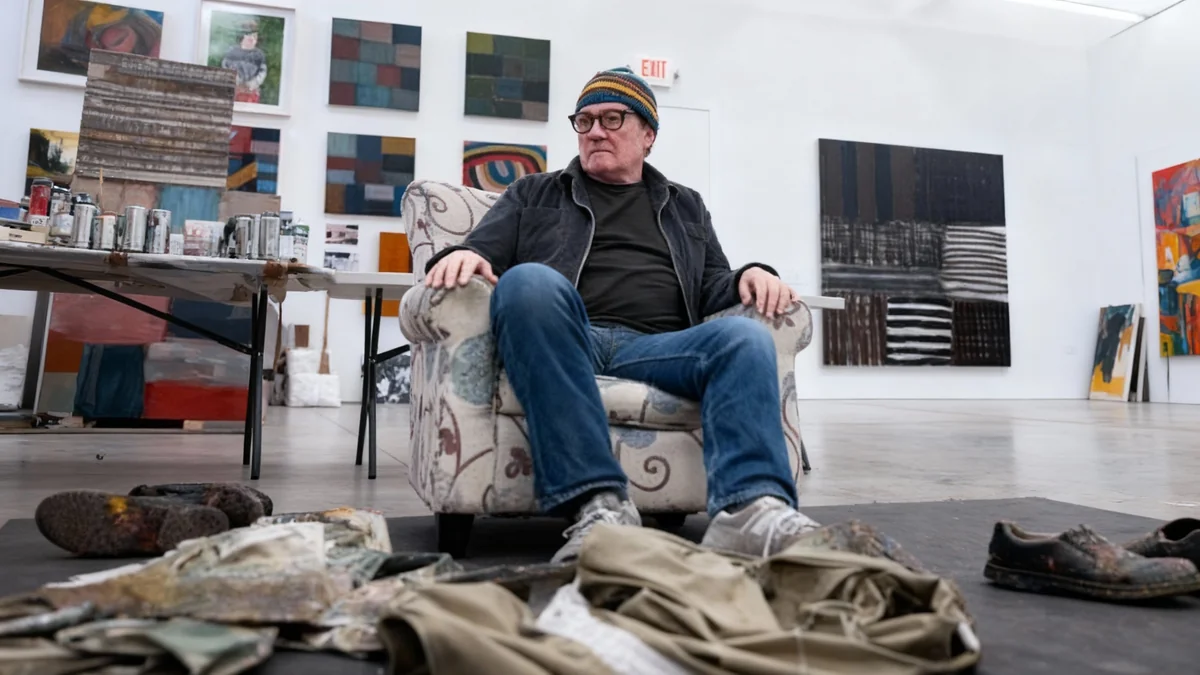

Renowned abstract painter Sean Scully, 80, continues to draw on a lifetime of personal struggle to create his deeply emotive works. His latest exhibition in Paris, featuring powerful blue compositions, showcases an artist grappling with profound feelings, translating them into a language of color and form.
Key Takeaways
- Sean Scully's abstract art is driven by personal pain and a search for spiritual meaning.
- His new 'Blue' series in Paris explores themes of order and underlying emotional turbulence.
- Scully's childhood experiences, including family upheaval and a loss of faith, profoundly shaped his artistic vision.
- He views abstract painting as a pre-verbal, direct connection to the soul, akin to instrumental music.
- Despite minimalist appearances, his works are imbued with deep intimacy and vulnerability.
A Life Shaped by Early Turmoil
Scully, born in Dublin in 1945, moved to London as a young child. His early life was marked by significant family disruption. His grandfather died in military prison in 1916, having deserted the British army to join the Easter Rising. His father also faced imprisonment during World War II for desertion.
Growing up in a slum off the Old Kent Road in postwar London, Scully describes his family as "completely smashed-up." His mother, whom he characterizes as a "hurricane" or "monsoon," deeply influenced his childhood, providing warmth but leaving a trail of brokenness.
Artist's Roots
Sean Scully's birth certificate lists his father's profession as 'traveller', reflecting the transient nature of his early family life.
Loss of Faith and the Birth of an Artist
A pivotal moment occurred at age seven when Scully was removed from a Catholic school after his mother clashed with the nuns over religious beliefs. This abrupt separation from the ritual and ceremony of Catholicism led to a "nervous breakdown."
He sees this rupture as the moment he became an artist, a way to rebuild the spiritual connection he lost. "I’ve tried to put it back together with art," he explains.
The Language of Abstraction
Scully approaches abstract painting much like a musician approaches instrumental music. He compares his work to the improvisational brilliance of jazz artists like Miles Davis or John Coltrane, where meaning is felt rather than explicitly stated through words or images.
His paintings feature rectangles, squares, and strips of color that abut and intertwine, creating a visual rhythm. These forms, while seemingly minimalist, carry immense emotional weight. His new 'Blue' paintings, currently captivating audiences in Paris, evoke the deep, soulful notes of the blues.
"You might ask, what’s Miles Davis got over the Beatles? And the answer is: doesn’t have any words in it," Scully states, explaining his preference for abstract expression.
Blues as a Personal Motif
The color blue holds profound significance for Scully. "I got interested in blue because I had the blues," he says. This connection to personal sadness is evident in the rich, textured blue notes that dominate his recent works, mingling with blacks, reds, and browns.
Despite the bright, white environment of the gallery, the anguish Scully describes—a fear of the dark that persists even today—manifests in his art. Underneath the seemingly orderly patterns of his rectangles, a storm of barely controlled feeling simmers.
Beyond Minimalism: Infusing Feeling
After training as a figurative artist in England and supporting himself with manual jobs, Scully moved to New York in 1975. He encountered a scene where abstract expressionists and minimalists were defining the art world. However, he felt that much of the American avant-garde had become "emptied out," creating large but hollow works.
He cites Barnett Newman as an example, finding his quasi-religious abstract art to be pomposity. Even the revered Rothko Chapel, a pinnacle of abstract expressionism, left Scully "extraordinarily underwhelming."
Abstract Expressionism vs. Minimalism
Abstract Expressionism, prominent in the mid-20th century, emphasized spontaneous, emotional expression. Minimalism, which followed, focused on geometric forms and impersonal, objective aesthetics.
Vulnerability and Intimacy in Scale
Scully, while an heir to these movements, found a way to re-infuse romantic spirituality into minimalist forms. His paintings, though simple in shape, pulse with inner passion. He aims to create "abutments and unions and relationships that are difficult, strange, tender, poetic," reflecting human connections.
The scale of his paintings is also crucial. Many of his works are not monumental. "The fact that they’re so small I think makes them vulnerable in some way. And their intimacy is very, very strong. They’re not heroic," he explains, creating a direct, personal encounter for the viewer.
Art as a Spiritual Quest
Scully's art remains a search for the faith he lost. He is deeply drawn to the spiritual dimension that inspired artists like Rothko. He believes abstract painting has a unique function: "Abstract painting goes straight into your soul. So I think it has to believe in some kind of spiritual power... It goes bang, straight inside."
This spiritual quest was intensified by personal tragedy. In 1983, his first son, Paul, died in a car accident at age 18. This loss profoundly affected him, causing him to "go off the rails" with grief.
- Personal Tragedy: The death of his son at 18 deeply impacted Scully's life and art.
- Studio as Sanctuary: He finds solace and happiness in his studio, working every day.
- Direct Approach: Scully describes his painting process as "very, very direct."
Despite the sadness he carries, Scully finds joy and purpose in his studio. "I have a lot of sadness in me, but I love painting. I love it. I’m so happy in my studio. I go there every day."
Continuing the Legacy of Emotional Abstraction
Scully's work continues to challenge perceptions of abstract art, which some dismiss as mere patterns. His paintings possess a sense of necessity, expressing mysteries that cannot be conveyed in any other form.
His 'Blue' paintings, with their rivulets and ridges of color, speak directly to the soul, evoking a mystery and intensity reminiscent of Rothko, despite Scully's earlier skepticism. He aims to evoke a powerful emotional response in viewers, much like a moving piece of instrumental music.
"When you listen to Nessun Dorma, it makes you cry – but you don’t know what the words are. That’s what I’m trying to do. I’m trying to break people’s hearts. I want to make abstraction popular without lowering the bar," Scully asserts.
Sean Scully's exhibition, 'Blue,' is on view at Thaddaeus Ropac in Paris until January 17, offering a profound journey into the artist's soul through the universal language of abstract color and form.