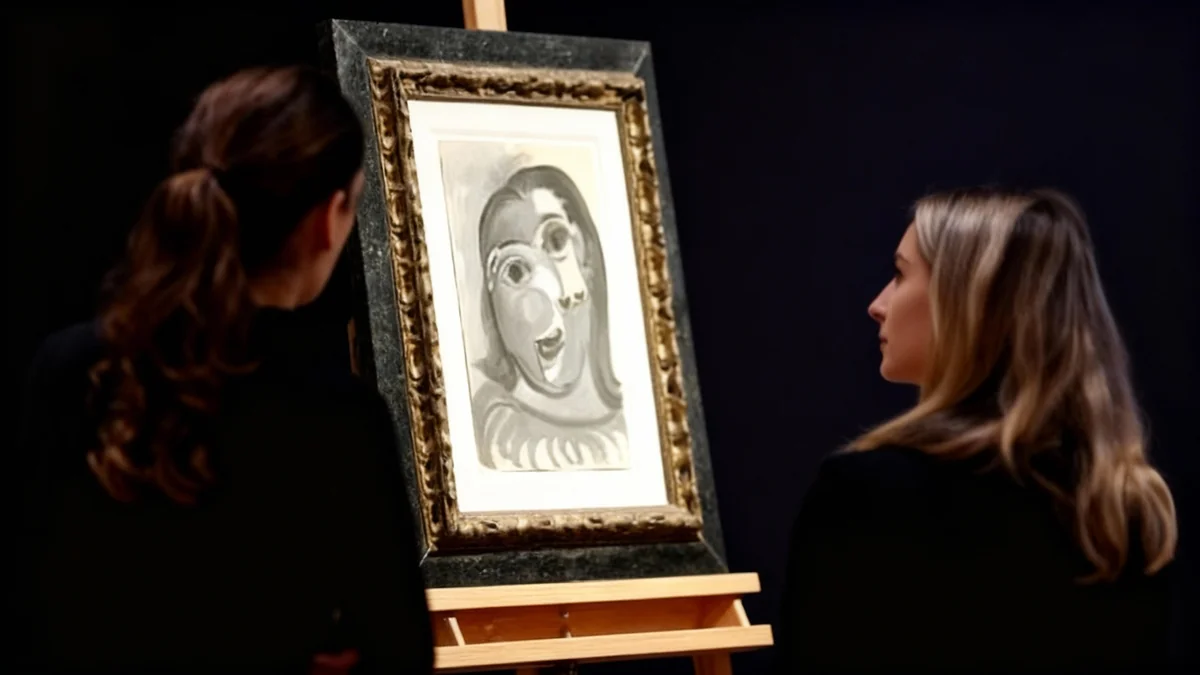


A rare 1941 watercolor by Pablo Picasso, titled Tête de femme, is being offered in a charity raffle. Tickets are priced at €100 each, providing a unique opportunity for individuals worldwide to own a piece of art history while supporting Alzheimer’s research. The artwork itself is valued at over €1 million.
This initiative, named '1 Picasso for 100 Euros,' aims to raise €11 million for the Alzheimer's Research Foundation in France. The draw is scheduled to take place at Christie's auction house in Paris on April 14.
Key Takeaways
- Picasso's 1941 watercolor, Tête de femme, is being raffled for €100 per ticket.
- The artwork holds a value exceeding €1 million.
- Proceeds will fund Alzheimer's research, aiming for an €11 million total.
- The raffle marks a rare opportunity for public ownership of a major Picasso piece.
A Unique Opportunity for Art Enthusiasts
Pablo Picasso's work consistently ranks among the most expensive art globally, with some paintings selling for over $100 million at auction. This raffle democratizes art ownership, making a Picasso accessible to a broader audience.
The project represents a significant departure from traditional high-value art transactions. It combines philanthropy with the thrill of potentially owning a masterpiece for a modest sum.
Fast Fact
Picasso's Tête de femme (1941) is a watercolor valued at over €1 million. It was painted in the same Left Bank studio in Paris as his 1937 masterpiece, Guernica.
Supporting a Critical Cause
The primary goal of this raffle is to raise substantial funds for Alzheimer's research. Alzheimer's disease remains a leading cause of death and disability worldwide, with no known cure or treatment to halt its progression.
Olivier Picasso, the artist's grandson, emphasized the importance of this cause. He noted the personal connection many people have to the disease.
"My grandfather was very generous, but he was also discreet," Olivier Picasso stated. "He helped his family, especially my grandmother Marie-Thérèse [Walter]. He helped friends. He helped people in need during the civil war in Spain, during the second world war, and even after, in the 50s and 60s."
He sees the project as a natural continuation of his grandfather's legacy of support for those in need.
The Vision Behind the Raffle
The initiative is the brainchild of French television producer Péri Cochin. She drew inspiration from seeing her mother use raffles for fundraising events.
Cochin envisioned a global raffle, selling tickets online to maximize reach. She recognized Picasso's universal appeal as the most famous name in art.
Historical Context
The 1941 period was challenging for Picasso. He was finalizing his divorce from his first wife, Olga Khokhlova, a process complicated by the abolition of divorce law in France in 1939. Paris was also under Nazi occupation, influencing the darker palette of his work from this time.
After contacting Olivier Picasso, who is also a childhood friend, the project received approval from the Picasso administration and estate. The 1941 painting was reserved from the Opera gallery.
The gallery will receive just under €1 million after the draw. This collaboration marks a unique instance where a Picasso artwork is directly linked to a charitable endeavor.
The Artwork: Tête de femme
Olivier Picasso described Tête de femme as a "very interesting" work. Its creation in the same studio as Guernica highlights its significance.
The painting's colors—brown, black, and grey—reflect the somber atmosphere of wartime Paris. Despite these darker tones, it remains a beautiful depiction of a woman, embodying Picasso's distinctive ambience.
Picasso himself kept the painting, suggesting its personal importance as a memento of that specific historical moment.
Previous Successful Raffles
This is not Péri Cochin's first foray into art raffles for charity. She previously organized two similar events for Picasso paintings in 2013 and 2020.
These earlier raffles collectively raised over €10 million for various causes. They demonstrated the public's enthusiasm for such initiatives.
- The 2013 winner, Jeffrey Gonano, a 25-year-old, acquired a Picasso drawing valued at €860,000. He displayed it at the Museum of Pittsburgh before placing it in storage at Christie's in New York.
- In 2020, Claudia Borgogno, an accountant from Ventimiglia, Italy, won a 1921 Picasso valued at €1 million. Her son had given her the raffle ticket as a Christmas gift. She still owns the painting, which she says changed her life.
These success stories underscore the potential impact of the current raffle. They offer hope that the €11 million target for Alzheimer's research will be met.
If the target of 120,000 tickets is not reached to cover the cost of the painting, all participants will receive a full reimbursement.