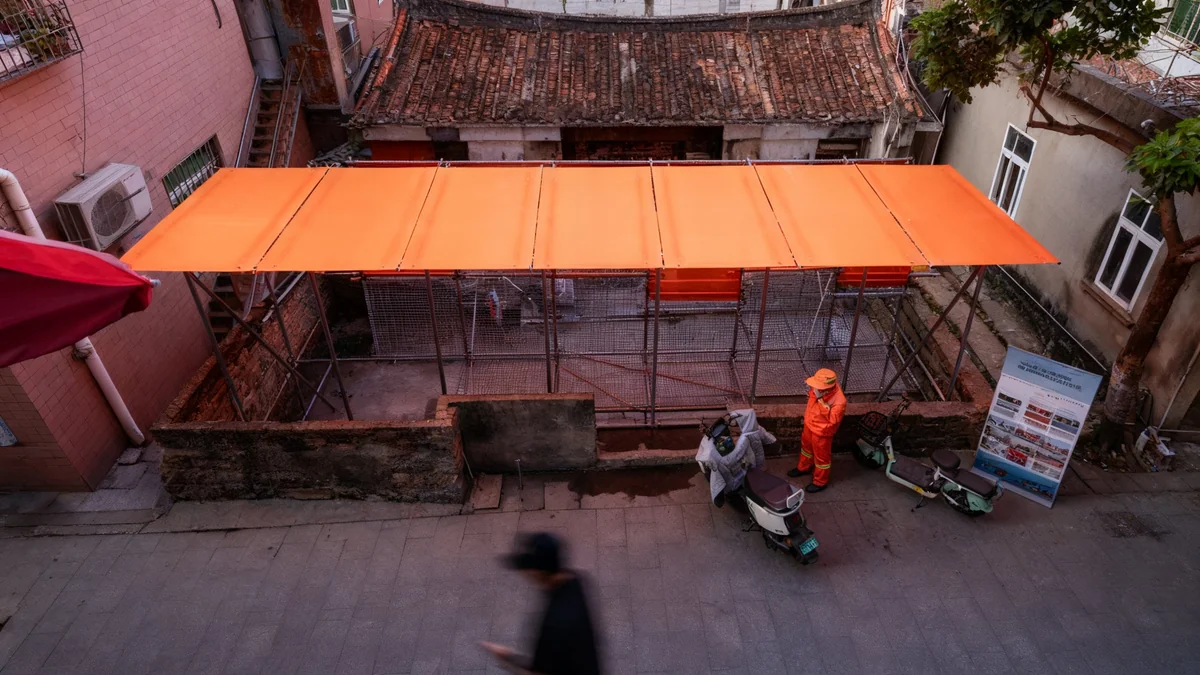

Gaoqi Village, a historic fishing community in Xiamen, China, is undergoing a significant transformation. A unique 'Orange Fence' art installation is now serving a dual purpose, acting as a vibrant screen for an ongoing community center renovation and offering new public amenities to residents.
This innovative project, part of the 2025 Xiamen Urban Art Festival, addresses a long-standing need for public facilities in the village. It provides a low-cost solution that blends modern design with traditional Minnan architectural elements.
Key Takeaways
- Gaoqi Village, a unique community under Xiamen's airport flight path, is revitalizing its public spaces.
- The 'Orange Fence' is a multi-functional art installation supporting the renovation of the Lins-Courtyard into a community service center.
- It uses recycled scaffolding and semi-transparent orange polycarbonate panels, costing less than 30,000 yuan (approximately $4,000 USD).
- The design reinterprets traditional Minnan architecture, offering temporary vendor stalls and bicycle shelters during construction.
- After renovation, the fence will become the main entrance, featuring an information board and mini-exhibition gallery.
Gaoqi Village's Unique History and Development Needs
Gaoqi Village holds a distinct place in Xiamen's history. Located at the northern tip of Xiamen Island, it once served as a crucial ferry terminal connecting the mainland to the island. Its proximity to the urban airport, built in the 1980s, has paradoxically preserved its traditional character.
Due to height restrictions imposed by flight paths, the village largely escaped the widespread demolition seen in other rapidly urbanizing areas. This allowed it to maintain its original layout and continue its traditional fishing practices.
A Village Under the Flight Path
Gaoqi Village is home to over 20,000 residents. Despite its historical significance and ongoing community life, it has faced a critical shortage of modern public facilities. The new community service center aims to fill this gap, providing much-needed resources for its large population.
The local government initiated plans to restore and renovate the abandoned Lins-Courtyard, one of the few remaining heritage buildings in the village. This transformation into a community service center is central to improving residents' quality of life.
The Multi-Functional 'Orange Fence' Installation
The 2025 Xiamen Urban Art Festival provided the perfect opportunity to fund and implement an innovative solution for the Lins-Courtyard renovation. The chosen project, dubbed the 'Orange Fence,' is far more than a simple barrier.
During the construction phase, the installation effectively screens the messy building site. It creates a safe, tidy, and visually appealing street-side interface for the community. This temporary function is crucial for maintaining village aesthetics and safety during the renovation.
Cost-Effective Design
The 'Orange Fence' project was completed with a budget of less than 30,000 yuan, which translates to approximately 4,000 US dollars. This low-cost approach highlights effective resource management and creative material use.
Beyond screening the site, the Orange Fence offers immediate benefits to residents. It provides a small number of stalls for itinerant vendors, supporting local commerce. It also includes a temporary shelter for electric bicycles, addressing a common urban need.
Reinterpreting Traditional Minnan Architecture
The design of the Orange Fence pays homage to the traditional Minnan-style residences prevalent in the region. These historic homes typically feature three main components: orange-tiled roofs, orange brick walls, and stone foundations.
The designers sought to reinterpret these elements using contemporary architectural language and readily available materials. This approach ensures the new structure integrates seamlessly with the village's heritage while offering modern functionality.
"The design tries to reinterpret the facade of traditional Minnan-style residences by contemporary architectural language," said one of the lead architects, Yanze Wang. "It creates a vibrant interface for the community."
Materials and Construction
The primary structural framework for the Orange Fence is built using recycled construction scaffolding. This choice significantly reduces costs and promotes sustainable practices. Semi-transparent orange polycarbonate panels form the main facade.
These panels evoke the visual character of traditional orange tiles and bricks. They are specifically slanted and suspended at the top, mimicking the distinctive overhanging eaves of Minnan roofs. This design detail connects the modern installation to the village's architectural past.
- Main Structure: Recycled construction scaffolding
- Facade Material: Semi-transparent orange polycarbonate panels
- Visual Inspiration: Orange-tiled roofs and orange brick walls of Minnan residences
- Gaps: 100-millimeter wide spaces between panels and steel plates
The facade features an interspersed arrangement of polycarbonate panels and steel plates. Small, 100-millimeter-wide gaps are left between these elements. This detail echoes the random, vernacular patterns often found on local walls.
These gaps also serve a practical purpose, creating small peepholes. These allow curious residents to catch glimpses of the restoration and renovation progress inside the Lins-Courtyard, fostering community engagement.
Future Role as Community Hub Entrance
Once the community service center inside the Lins-Courtyard is complete, the Orange Fence will not be removed. Instead, it will be retained and integrated as the main entrance space of the new center.
In its permanent role, the installation will continue to serve as public facilities. It will function as a community information board, providing updates and news to residents. Additionally, it will double as an open mini-exhibition gallery, showcasing local art and history.
This long-term vision ensures that the initial art festival investment yields lasting benefits for Gaoqi Village. The Orange Fence exemplifies how thoughtful design and low-cost materials can create impactful public spaces that respect tradition while embracing innovation.
The project, led by a design team including Yanze Wang, Guanzhong Wu, Bei Mao, Ziyun Yin, and Qiao Qiu, demonstrates a commitment to community-focused urban development. Project management was handled by the College of Architecture, Huaqiao University.