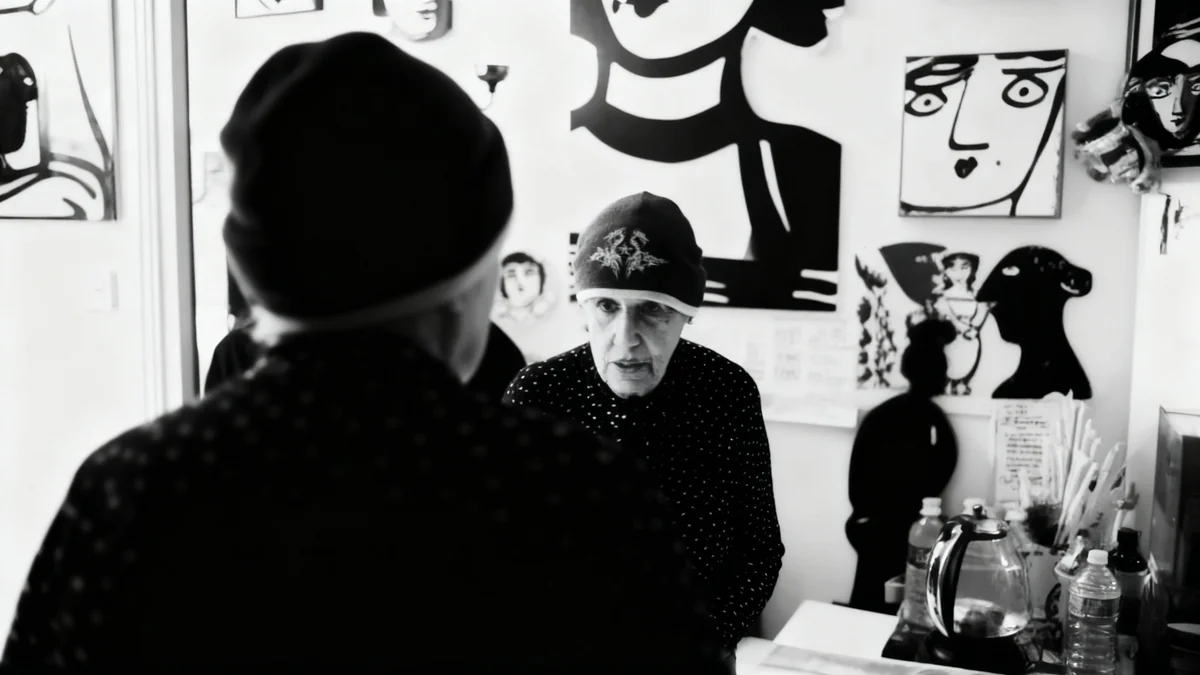

San Francisco artist Toby Klayman, at 90 years old, continues to produce a vibrant body of work that spans decades. Her unique style, blending naive and modernist influences, has garnered a dedicated following, including prominent figures in the tech industry. Klayman's home studio in Bernal Heights serves as a testament to her prolific career, filled with paintings, prints, and ceramics.
Key Takeaways
- Toby Klayman, 90, remains a highly active and influential artist in San Francisco.
- Her work is sought after by collectors, including executives from major tech companies.
- Klayman's artistic journey began in the 1950s and evolved through various mediums.
- She has embraced modern platforms like Instagram and Pinterest for her art.
- Klayman emphasizes the importance of persistence for aspiring artists.
A Lifetime of Creative Expression
Toby Klayman's distinctive artwork, characterized by bold lines and playful forms, has been a fixture in San Francisco's art scene since the 1960s. Her pieces often feature monochromatic animals and human figures, hinting at a deeper world of texture and color. These whimsical creations can be seen peeking from her Prentiss Street home, drawing in curious passersby.
Collectors, particularly those from leading tech companies like Google, Microsoft, Instagram, and Airbnb, highly value Klayman's output. They are drawn to her unique blend of naive charm and modernist sensibility. Klayman's inspirations include Japanese print artist Toshusai Sharaku, France's Jean Cocteau, and German painter Max Beckmann.
Quick Fact
One of Toby Klayman's early large-scale canvases, titled "Garden of Eden," recently sold to a private collector for $100,000, highlighting the enduring appeal and value of her work.
From Boston to San Francisco
Klayman's artistic journey began in the 1950s at Brandeis University in Rhode Island. Initially interested in sculpting, she shifted to painting after a boyfriend challenged her to try the more difficult medium. She quickly fell in love with painting and began immersing herself in the vibrant artist community around Harvard Square.
In 1966, Klayman made a significant move to San Francisco, arriving with just "$10 and three suitcases." She sought to escape the burgeoning drug scene in Boston and found a new home in the Bay Area, far from the psychedelic Haight-Ashbury culture. She supported herself with a temporary typing job at Bank of America while pursuing her passion for art in her free time, frequenting jazz clubs and literary hotspots like City Lights Bookstore.
Breaking Through and Mentoring Others
Klayman's big break came when Maxwell Galleries purchased one of her pieces. This led to further gallery connections and, eventually, a teaching position at City College. She taught there for nearly three decades, impacting countless aspiring artists. Her experience as an artist who built a career from humble beginnings deeply informed her teaching philosophy.
"I’ve taught thousands of people [how] to stay artists, in spite of the husband not liking it, the parents not liking it, even if you have to get a second job," Klayman states, emphasizing the practical resilience required for an artistic career.
Background
Larry Friedlander, a professor emeritus at Stanford University and a long-time friend, describes Klayman as someone who "didn’t have a patron." He notes her ability to survive and flourish in San Francisco, becoming a mentor to many. Friedlander views her as a key figure in making San Francisco a welcoming city for those pursuing creative paths, a task he acknowledges has become increasingly difficult.
Embracing New Platforms and Overcoming Challenges
Klayman has witnessed significant changes in San Francisco's art landscape over the decades. She recalls the devastating impact of the AIDS epidemic, which claimed many of her students and friends. She also notes the closure of art schools and the dwindling number of galleries willing to host emerging talent, attributing these changes to a shift in cultural funding. However, Klayman does not blame the tech industry for these shifts.
Instead, she has embraced technology, actively using Instagram and Pinterest to share her work and engage with her audience. She is quick to communicate online and remains unconcerned by the rise of AI in art. Klayman views her tech-world collectors simply as "people" with their own passions.
- Instagram: A primary platform for sharing her latest creations.
- Pinterest: Utilized for broader artistic engagement and inspiration.
- Direct Communication: Klayman actively responds to inquiries and connects with followers.
A Home Filled with Art and Love
Klayman shares her home and a sprawling 1,000-square-foot studio with her husband of 28 years, artist Joe Branchcomb, also 90. Their combined works, including Branchcomb’s colorful assemblages and watercolors alongside Klayman’s mostly black-and-white acrylics and ceramics, create a living space bursting with creative energy. A notable piece in their collection is a sculpture of Klayman's face by Ruth Asawa, carefully stored in a padded shoe box.
Their enduring relationship is marked by humor and lightness. Branchcomb affectionately refers to Klayman as his "young wife." He often diffuses arguments by singing in pretend Italian, a gesture Klayman finds endearing. Their home is not just a studio but a hub of creativity and mutual support.
Airbnb CEO Brian Chesky personally invited Klayman to participate in the company's "Experiences" program after discovering her work. This led to a presentation in front of 400 people, connecting her with a new circle of collectors who have remained loyal even as they have moved across the globe and within the tech industry.
Bola Akinsanya, Global Operations Lead at Airbnb and a collector, explains the appeal: "Toby‘s art initially is appealing because it is deceptively simple, with bold brush strokes on different mediums with contrasting forms that feel almost childlike. Her art just makes me happy."
For Klayman, the focus remains on the present. She is not preoccupied with her legacy, preferring to continue her daily ritual of creating. "I have to be in the studio every day," she says. "It’s just like brushing my teeth and saying hello to my husband."